Class implementing a kd-tree.
Contents:
In computer science, a kd-tree (short for k-dimensional tree) is a space-partitioning data structure for organizing points in a k-dimensional space. kd-trees are a useful data structure for several applications, such as searches involving a multidimensional search key (e.g. range searches and nearest neighbour searches). kd-trees are a special case of BSP trees.
A kd-tree uses only splitting planes that are perpendicular to one of the coordinate system axes. This differs from BSP trees, in which arbitrary splitting planes can be used. In addition, in the typical definition every node of a kd-tree, from the root to the leaves, stores a point. This differs from BSP trees, in which leaves are typically the only nodes that contain points (or other geometric primitives). As a consequence, each splitting plane must go through one of the points in the kd-tree. kd-trees are a variant that store data only in leaf nodes.
Since there are many possible ways to choose axis-aligned splitting planes, there are many different ways to construct kd-trees. The canonical method of kd-tree construction has the following constraints:
As one moves down the tree, one cycles through the axes used to select the splitting planes. (For example, the root would have an x-aligned plane, the root's children would both have y-aligned planes, the root's grandchildren would all have z-aligned planes, and so on.) At each step, the point selected to create the splitting plane is the median of the points being put into the kd-tree, with respect to their coordinates in the axis being used. (Note the assumption that we feed the entire set of points into the algorithm up-front.)
This method leads to a balanced kd-tree, in which each leaf node is about the same distance from the root. However, balanced trees are not necessarily optimal for all applications. The following pseudo-code illustrates this canonical construction procedure (NOTE, that the procedure used by the TKDTree class is a bit different, the following pseudo-code is given as a simple illustration of the concept):
Our construction method is optimized to save memory, and differs a bit from the constraints above. In particular, the division axis is chosen as the one with the biggest spread, and the point to create the splitting plane is chosen so, that one of the two subtrees contains exactly 2^k terminal nodes and is a perfectly balanced binary tree, and, while at the same time, trying to keep the number of terminal nodes in the 2 subtrees as close as possible. The following section gives more details about our implementation.
The interface of the TKDTree, that allows to set input data, has been developed to simplify using it together with TTree::Draw() functions. That's why the data has to be provided column-wise. For example:
NOTE, that this implementation of kd-tree doesn't support adding new points after the tree has been built
Of course, it's not necessary to use TTree::Draw(). What is important, is to have data columnwise.
An example with regular arrays:
By default, the kd-tree doesn't own the data and doesn't delete it with itself. If you want the
data to be deleted together with the kd-tree, call TKDTree::SetOwner(kTRUE).

Most functions of the kd-tree don't require the original data to be present after the tree
has been built. Check the functions documentation for more details.
Nodes of the tree are indexed top to bottom, left to right. The root node has index 0. Functions
TKDTree::GetLeft(Index inode), TKDTree::GetRight(Index inode) and TKDTree::GetParent(Index inode)
allow to find the children and the parent of a given node.

For a given node, one can find the indexes of the original points, contained in this node,
by calling the GetNodePointsIndexes(Index inode) function. Additionally, for terminal nodes,
there is a function GetPointsIndexes(Index inode) that returns a pointer to the relevant
part of the index array. To find the number of point in the node
(not only terminal), call TKDTree::GetNpointsNode(Index inode).
TKDtree is optimized to minimize memory consumption. Nodes of the TKDTree do not store pointers to the left and right children or to the parent node, but instead there are several 1-d arrays of size fNNodes with information about the nodes. The order of the nodes information in the arrays is described below. It's important to understand it, if one's class needs to store some kind of additional information on the per node basis, for example, the fit function parameters.
As noted above, the construction of the kd-tree involves choosing the axis and the point on that axis to divide the remaining points approximately in half. The exact algorithm for choosing the division point is described in the next section. The sequence of divisions is recorded in the following arrays:
Given the index of a node in those arrays, it's easy to find the indices, corresponding to children nodes or the parent node: Suppose, the parent node is stored under the index inode. Then:
Suppose, that the child node is stored under the index inode. Then:
Number of division nodes and number of terminals : fNNodes = (fNPoints/fBucketSize)
The nodes are filled always from left side to the right side: Let inode be the index of a node, and irow - the index of a row The TKDTree looks the following way: Ideal case:
Non ideal case:
As described above, the kd-tree is built by repeatingly dividing the given set of points into 2 smaller sets. The cut is made on the axis with the biggest spread, and the value on the axis, on which the cut is performed, is chosen based on the following formula: Suppose, we want to divide n nodes into 2 groups, left and right. Then the left and right will have the following number of nodes:
For example, let n_nodes=67. Then, the closest 2^k=64, 2^k-1=32, 2^k-2=16. Left node gets 32+3=35 sub-nodes, and the right node gets 32 sub-nodes
The division process continues until all the nodes contain not more than a predefined number of points.
Some kd-tree based algorithms need to know the boundaries of each node. This information can be computed by calling the TKDTree::MakeBoundaries() function. It fills the following arrays:
The nodes are arranged in the order described in section 3a.
Public Types | |
| enum | { kSingleKey = (1ULL << (0)) , kOverwrite = (1ULL << (1)) , kWriteDelete = (1ULL << (2)) } |
| enum | { kIsOnHeap = 0x01000000 , kNotDeleted = 0x02000000 , kZombie = 0x04000000 , kInconsistent = 0x08000000 , kBitMask = 0x00ffffff } |
| enum | EDeprecatedStatusBits { kObjInCanvas = (1ULL << (3)) } |
| enum | EStatusBits { kCanDelete = (1ULL << (0)) , kMustCleanup = (1ULL << (3)) , kIsReferenced = (1ULL << (4)) , kHasUUID = (1ULL << (5)) , kCannotPick = (1ULL << (6)) , kNoContextMenu = (1ULL << (8)) , kInvalidObject = (1ULL << (13)) } |
Public Member Functions | |
| TKDTree () | |
| Default constructor. Nothing is built. | |
| TKDTree (Index npoints, Index ndim, UInt_t bsize) | |
| TKDTree (Index npoints, Index ndim, UInt_t bsize, Value **data) | |
| Create a kd-tree from the provided data array. | |
| ~TKDTree () override | |
| Destructor By default, the original data is not owned by kd-tree and is not deleted with it. | |
| void | AbstractMethod (const char *method) const |
| Call this function within a function that you don't want to define as purely virtual, in order not to force all users deriving from that class to implement that maybe (on their side) unused function; but at the same time, emit a run-time warning if they try to call it, telling that it is not implemented in the derived class: action must thus be taken on the user side to override it. | |
| virtual void | AppendPad (Option_t *option="") |
| Append graphics object to current pad. | |
| virtual void | Browse (TBrowser *b) |
| Browse object. May be overridden for another default action. | |
| void | Build () |
| Build the kd-tree. | |
| ULong_t | CheckedHash () |
| Check and record whether this class has a consistent Hash/RecursiveRemove setup (*) and then return the regular Hash value for this object. | |
| virtual const char * | ClassName () const |
| Returns name of class to which the object belongs. | |
| virtual void | Clear (Option_t *="") |
| virtual TObject * | Clone (const char *newname="") const |
| Make a clone of an object using the Streamer facility. | |
| virtual Int_t | Compare (const TObject *obj) const |
| Compare abstract method. | |
| virtual void | Copy (TObject &object) const |
| Copy this to obj. | |
| virtual void | Delete (Option_t *option="") |
| Delete this object. | |
| Double_t | Distance (const Value *point, Index ind, Int_t type=2) const |
| Find the distance between point of the first argument and the point at index value ind Type argument specifies the metric: type=2 - L2 metric, type=1 - L1 metric. | |
| void | DistanceToNode (const Value *point, Index inode, Value &min, Value &max, Int_t type=2) |
| Find the minimal and maximal distance from a given point to a given node. | |
| virtual Int_t | DistancetoPrimitive (Int_t px, Int_t py) |
| Computes distance from point (px,py) to the object. | |
| virtual void | Draw (Option_t *option="") |
| Default Draw method for all objects. | |
| virtual void | DrawClass () const |
| Draw class inheritance tree of the class to which this object belongs. | |
| virtual TObject * | DrawClone (Option_t *option="") const |
| Draw a clone of this object in the current selected pad with: gROOT->SetSelectedPad(c1). | |
| virtual void | Dump () const |
| Dump contents of object on stdout. | |
| virtual void | Error (const char *method, const char *msgfmt,...) const |
| Issue error message. | |
| virtual void | Execute (const char *method, const char *params, Int_t *error=nullptr) |
| Execute method on this object with the given parameter string, e.g. | |
| virtual void | Execute (TMethod *method, TObjArray *params, Int_t *error=nullptr) |
| Execute method on this object with parameters stored in the TObjArray. | |
| virtual void | ExecuteEvent (Int_t event, Int_t px, Int_t py) |
| Execute action corresponding to an event at (px,py). | |
| virtual void | Fatal (const char *method, const char *msgfmt,...) const |
| Issue fatal error message. | |
| void | FindBNodeA (Value *point, Value *delta, Int_t &inode) |
| find the smallest node covering the full range - start | |
| void | FindInRange (Value *point, Value range, std::vector< Index > &res) |
| Find all points in the sphere of a given radius "range" around the given point. | |
| void | FindNearestNeighbors (const Value *point, Int_t k, Index *ind, Value *dist) |
| Find kNN nearest neighbors to the point in the first argument Returns 1 on success, 0 on failure Arrays ind and dist are provided by the user and are assumed to be at least kNN elements long. | |
| Index | FindNode (const Value *point) const |
| returns the index of the terminal node to which point belongs (index in the fAxis, fValue, etc arrays) returns -1 in case of failure | |
| virtual TObject * | FindObject (const char *name) const |
| Must be redefined in derived classes. | |
| virtual TObject * | FindObject (const TObject *obj) const |
| Must be redefined in derived classes. | |
| void | FindPoint (Value *point, Index &index, Int_t &iter) |
| find the index of point works only if we keep fData pointers | |
| Value * | GetBoundaries () |
| Get the boundaries. | |
| Value * | GetBoundariesExact () |
| Get the boundaries. | |
| Value * | GetBoundary (const Int_t node) |
| Get a boundary. | |
| Value * | GetBoundaryExact (const Int_t node) |
| Get a boundary. | |
| Index | GetBucketSize () |
| Int_t | GetCrossNode () |
| ! cross node | |
| virtual Option_t * | GetDrawOption () const |
| Get option used by the graphics system to draw this object. | |
| virtual const char * | GetIconName () const |
| Returns mime type name of object. | |
| Index * | GetIndPoints () |
| Int_t | GetLeft (Int_t inode) const |
| virtual const char * | GetName () const |
| Returns name of object. | |
| Index | GetNDim () |
| Int_t | GetNNodes () const |
| UChar_t | GetNodeAxis (Int_t id) const |
| void | GetNodePointsIndexes (Int_t node, Int_t &first1, Int_t &last1, Int_t &first2, Int_t &last2) const |
| Return the indices of points in that node Indices are returned as the first and last value of the part of indices array, that belong to this node Sometimes points are in 2 intervals, then the first and last value for the second one are returned in third and fourth parameter, otherwise first2 is set to 0 and last2 is set to -1 To iterate over all the points of the node #inode, one can do, for example: Index *indices = kdtree->GetPointsIndexes(); Int_t first1, last1, first2, last2; kdtree->GetPointsIndexes(inode, first1, last1, first2, last2); for (Int_t ipoint=first1; ipoint<=last1; ipoint++){ point = indices[ipoint]; //do something with point; } for (Int_t ipoint=first2; ipoint<=last2; ipoint++){ point = indices[ipoint]; //do something with point; }. | |
| Value | GetNodeValue (Int_t id) const |
| Index | GetNPoints () |
| Index | GetNPointsNode (Int_t node) const |
| Get number of points in this node for all the terminal nodes except last, the size is fBucketSize for the last node it's fOffsetfBucketSize, or if fOffsetfBucketSize==0, it's also fBucketSize. | |
| virtual char * | GetObjectInfo (Int_t px, Int_t py) const |
| Returns string containing info about the object at position (px,py). | |
| Int_t | GetOffset () |
| ! offset in fIndPoints | |
| virtual Option_t * | GetOption () const |
| Int_t | GetParent (Int_t inode) const |
| Index * | GetPointsIndexes (Int_t node) const |
| return the indices of the points in that terminal node for all the nodes except last, the size is fBucketSize for the last node it's fOffsetfBucketSize | |
| Int_t | GetRight (Int_t inode) const |
| Int_t | GetRowT0 () |
| ! smallest terminal row | |
| virtual const char * | GetTitle () const |
| Returns title of object. | |
| Int_t | GetTotalNodes () const |
| virtual UInt_t | GetUniqueID () const |
| Return the unique object id. | |
| virtual Bool_t | HandleTimer (TTimer *timer) |
| Execute action in response of a timer timing out. | |
| virtual ULong_t | Hash () const |
| Return hash value for this object. | |
| Bool_t | HasInconsistentHash () const |
| Return true is the type of this object is known to have an inconsistent setup for Hash and RecursiveRemove (i.e. | |
| virtual void | Info (const char *method, const char *msgfmt,...) const |
| Issue info message. | |
| virtual Bool_t | InheritsFrom (const char *classname) const |
| Returns kTRUE if object inherits from class "classname". | |
| virtual Bool_t | InheritsFrom (const TClass *cl) const |
| Returns kTRUE if object inherits from TClass cl. | |
| virtual void | Inspect () const |
| Dump contents of this object in a graphics canvas. | |
| void | InvertBit (UInt_t f) |
| TClass * | IsA () const override |
| Bool_t | IsDestructed () const |
| IsDestructed. | |
| virtual Bool_t | IsEqual (const TObject *obj) const |
| Default equal comparison (objects are equal if they have the same address in memory). | |
| virtual Bool_t | IsFolder () const |
| Returns kTRUE in case object contains browsable objects (like containers or lists of other objects). | |
| Bool_t | IsOnHeap () const |
| Int_t | IsOwner () |
| virtual Bool_t | IsSortable () const |
| Bool_t | IsTerminal (Index inode) const |
| Bool_t | IsZombie () const |
| Value | KOrdStat (Index ntotal, Value *a, Index k, Index *index) const |
| copy of the TMath::KOrdStat because I need an Index work array | |
| virtual void | ls (Option_t *option="") const |
| The ls function lists the contents of a class on stdout. | |
| void | MakeBoundaries (Value *range=nullptr) |
| Build boundaries for each node. | |
| void | MakeBoundariesExact () |
| Build boundaries for each node. | |
| void | MayNotUse (const char *method) const |
| Use this method to signal that a method (defined in a base class) may not be called in a derived class (in principle against good design since a child class should not provide less functionality than its parent, however, sometimes it is necessary). | |
| virtual Bool_t | Notify () |
| This method must be overridden to handle object notification (the base implementation is no-op). | |
| void | Obsolete (const char *method, const char *asOfVers, const char *removedFromVers) const |
| Use this method to declare a method obsolete. | |
| void | operator delete (void *, size_t) |
| Operator delete for sized deallocation. | |
| void | operator delete (void *ptr) |
| Operator delete. | |
| void | operator delete (void *ptr, void *vp) |
| Only called by placement new when throwing an exception. | |
| void | operator delete[] (void *, size_t) |
| Operator delete [] for sized deallocation. | |
| void | operator delete[] (void *ptr) |
| Operator delete []. | |
| void | operator delete[] (void *ptr, void *vp) |
| Only called by placement new[] when throwing an exception. | |
| void * | operator new (size_t sz) |
| void * | operator new (size_t sz, void *vp) |
| void * | operator new[] (size_t sz) |
| void * | operator new[] (size_t sz, void *vp) |
| virtual void | Paint (Option_t *option="") |
| This method must be overridden if a class wants to paint itself. | |
| virtual void | Pop () |
| Pop on object drawn in a pad to the top of the display list. | |
| virtual void | Print (Option_t *option="") const |
| This method must be overridden when a class wants to print itself. | |
| virtual Int_t | Read (const char *name) |
| Read contents of object with specified name from the current directory. | |
| virtual void | RecursiveRemove (TObject *obj) |
| Recursively remove this object from a list. | |
| void | ResetBit (UInt_t f) |
| virtual void | SaveAs (const char *filename="", Option_t *option="") const |
| Save this object in the file specified by filename. | |
| virtual void | SavePrimitive (std::ostream &out, Option_t *option="") |
| Save a primitive as a C++ statement(s) on output stream "out". | |
| void | SetBit (UInt_t f) |
| void | SetBit (UInt_t f, Bool_t set) |
| Set or unset the user status bits as specified in f. | |
| Int_t | SetData (Index idim, Value *data) |
| Set the coordinate #ndim of all points (the column #ndim of the data matrix) After setting all the data columns, proceed by calling Build() function Note, that calling this function after Build() is not possible Note also, that no checks on the array sizes is performed anywhere. | |
| void | SetData (Index npoints, Index ndim, UInt_t bsize, Value **data) |
| Set the data array. See the constructor function comments for details. | |
| virtual void | SetDrawOption (Option_t *option="") |
| Set drawing option for object. | |
| void | SetOwner (Int_t owner) |
| virtual void | SetUniqueID (UInt_t uid) |
| Set the unique object id. | |
| void | Spread (Index ntotal, Value *a, Index *index, Value &min, Value &max) const |
| Calculate spread of the array a. | |
| void | Streamer (TBuffer &) override |
| Stream an object of class TObject. | |
| void | StreamerNVirtual (TBuffer &ClassDef_StreamerNVirtual_b) |
| virtual void | SysError (const char *method, const char *msgfmt,...) const |
| Issue system error message. | |
| Bool_t | TestBit (UInt_t f) const |
| Int_t | TestBits (UInt_t f) const |
| virtual void | UseCurrentStyle () |
| Set current style settings in this object This function is called when either TCanvas::UseCurrentStyle or TROOT::ForceStyle have been invoked. | |
| virtual void | Warning (const char *method, const char *msgfmt,...) const |
| Issue warning message. | |
| virtual Int_t | Write (const char *name=nullptr, Int_t option=0, Int_t bufsize=0) |
| Write this object to the current directory. | |
| virtual Int_t | Write (const char *name=nullptr, Int_t option=0, Int_t bufsize=0) const |
| Write this object to the current directory. | |
Static Public Member Functions | |
| static TClass * | Class () |
| static const char * | Class_Name () |
| static constexpr Version_t | Class_Version () |
| static const char * | DeclFileName () |
| static Longptr_t | GetDtorOnly () |
| Return destructor only flag. | |
| static Bool_t | GetObjectStat () |
| Get status of object stat flag. | |
| static void | SetDtorOnly (void *obj) |
| Set destructor only flag. | |
| static void | SetObjectStat (Bool_t stat) |
| Turn on/off tracking of objects in the TObjectTable. | |
Protected Types | |
| enum | { kOnlyPrepStep = (1ULL << (3)) } |
Protected Member Functions | |
| virtual void | DoError (int level, const char *location, const char *fmt, va_list va) const |
| Interface to ErrorHandler (protected). | |
| void | MakeZombie () |
Static Protected Member Functions | |
| static void | SavePrimitiveConstructor (std::ostream &out, TClass *cl, const char *variable_name, const char *constructor_agrs="", Bool_t empty_line=kTRUE) |
| Save object constructor in the output stream "out". | |
| static void | SavePrimitiveDraw (std::ostream &out, const char *variable_name, Option_t *option=nullptr) |
| Save invocation of primitive Draw() method Skipped if option contains "nodraw" string. | |
| static TString | SavePrimitiveVector (std::ostream &out, const char *prefix, Int_t len, Double_t *arr, Int_t flag=0) |
| Save array in the output stream "out" as vector. | |
Protected Attributes | |
| UChar_t * | fAxis |
| [fNNodes] nodes cutting axis | |
| Value * | fBoundaries |
| ! nodes boundaries | |
| Index | fBucketSize |
| size of the terminal nodes | |
| Int_t | fCrossNode |
| ! cross node - node that begins the last row (with terminal nodes only) | |
| Value ** | fData |
| ! data points | |
| Int_t | fDataOwner |
| ! 0 - not owner, 2 - owner of the pointer array, 1 - owner of the whole 2-d array | |
| Index * | fIndPoints |
| ! array of points indexes | |
| Index | fNDim |
| number of dimensions | |
| Index | fNDimm |
| dummy 2*fNDim | |
| Int_t | fNNodes |
| size of node array | |
| Index | fNPoints |
| number of multidimensional points | |
| Int_t | fOffset |
| ! | |
| Value * | fRange |
| [fNDimm] range of data for each dimension | |
| Int_t | fRowT0 |
| ! smallest terminal row - first row that contains terminal nodes | |
| Int_t | fTotalNodes |
| total number of nodes (fNNodes + terminal nodes) | |
| Value * | fValue |
| [fNNodes] nodes cutting value | |
Private Member Functions | |
| TKDTree (const TKDTree &) | |
| void | CookBoundaries (const Int_t node, Bool_t left) |
| define index of this terminal node | |
| TKDTree< Index, Value > & | operator= (const TKDTree< Index, Value > &) |
| void | UpdateNearestNeighbors (Index inode, const Value *point, Int_t kNN, Index *ind, Value *dist) |
| Update the nearest neighbors values by examining the node inode. | |
| void | UpdateRange (Index inode, Value *point, Value range, std::vector< Index > &res) |
| Internal recursive function with the implementation of range searches. | |
Static Private Member Functions | |
| static void | AddToTObjectTable (TObject *) |
| Private helper function which will dispatch to TObjectTable::AddObj. | |
Private Attributes | |
| UInt_t | fBits |
| bit field status word | |
| UInt_t | fUniqueID |
| object unique identifier | |
Static Private Attributes | |
| static Longptr_t | fgDtorOnly = 0 |
| object for which to call dtor only (i.e. no delete) | |
| static Bool_t | fgObjectStat = kTRUE |
| if true keep track of objects in TObjectTable | |
|
protectedinherited |
|
inherited |
|
inherited |
|
inherited |
|
inherited |
Default constructor. Nothing is built.
Definition at line 273 of file TKDTree.cxx.
| TKDTree< Index, Value >::TKDTree | ( | Index | npoints, |
| Index | ndim, | ||
| UInt_t | bsize ) |
Definition at line 295 of file TKDTree.cxx.
| TKDTree< Index, Value >::TKDTree | ( | Index | npoints, |
| Index | ndim, | ||
| UInt_t | bsize, | ||
| Value ** | data ) |
Create a kd-tree from the provided data array.
This function only sets the data, call Build() to build the tree!!! Parameters:
The data should be placed columnwise (like in a TTree). The columnwise orientation is chosen to simplify the usage together with TTree::GetV1() like functions. An example of filling such an array for a 2d case: Double_t **data = new Double_t*[2]; data[0] = new Double_t[npoints]; data[1] = new Double_t[npoints]; for (Int_t i=0; i<npoints; i++){ data[0][i]=gRandom->Uniform(-1, 1); //fill the x-coordinate data[1][i]=gRandom->Uniform(-1, 1); //fill the y-coordinate }
By default, the kd-tree doesn't own the data. If you want the kd-tree to delete the data array, call kdtree->SetOwner(kTRUE).
Definition at line 347 of file TKDTree.cxx.
Destructor By default, the original data is not owned by kd-tree and is not deleted with it.
If you want to delete the data along with the kd-tree, call SetOwner(kTRUE).
Definition at line 376 of file TKDTree.cxx.
|
private |
|
inherited |
Call this function within a function that you don't want to define as purely virtual, in order not to force all users deriving from that class to implement that maybe (on their side) unused function; but at the same time, emit a run-time warning if they try to call it, telling that it is not implemented in the derived class: action must thus be taken on the user side to override it.
In other word, this method acts as a "runtime purely virtual" warning instead of a "compiler purely virtual" error.
Definition at line 1149 of file TObject.cxx.
|
staticprivateinherited |
Private helper function which will dispatch to TObjectTable::AddObj.
Included here to avoid circular dependency between header files.
Definition at line 195 of file TObject.cxx.
|
virtualinherited |
Append graphics object to current pad.
In case no current pad is set yet, create a default canvas with the name "c1".
Definition at line 204 of file TObject.cxx.
|
virtualinherited |
Browse object. May be overridden for another default action.
Reimplemented in RooPlot, ROOT::Experimental::XRooFit::xRooNode, ROOT::Internal::THnBaseBrowsable, TApplicationRemote, TASImage, TAxis3D, TBaseClass, TBranch, TBranchClones, TBranchElement, TBranchObject, TBranchSTL, TBrowserObject, TCanvas, TChain, TClass, TCollection, TCollectionPropertyBrowsable, TDatabasePDG, TDirectory, TDirectoryFile, TEfficiency, TF1, TFolder, TGenerator, TGeoManager, TGeometry, TGeoNode, TGeoOverlap, TGeoTrack, TGeoVolume, TGraph2D, TGraph, TH1, THbookBranch, THbookFile, THbookKey, THnBase, THStack, TKey, TKeyMapFile, TLeaf, TMacro, TMapFile, TMultiDimFit, TMultiGraph, TNode, TNtuple, TNtupleD, TPad, TPair, TParticleClassPDG, TPrincipal, TRecorder, TRemoteObject, TROOT, TRootIconList, TSPlot, TStyle, TSystemDirectory, TSystemFile, TTask, TTree, TTreePerfStats, and TVirtualBranchBrowsable.
Definition at line 218 of file TObject.cxx.
Build the kd-tree.
The tree is divided recursively. See class description, section 4b for the details of the division algorithm
Definition at line 414 of file TKDTree.cxx.
|
inlineinherited |
Check and record whether this class has a consistent Hash/RecursiveRemove setup (*) and then return the regular Hash value for this object.
The intent is for this routine to be called instead of directly calling the function Hash during "insert" operations. See TObject::HasInconsistenTObjectHash();
(*) The setup is consistent when all classes in the class hierarchy that overload TObject::Hash do call ROOT::CallRecursiveRemoveIfNeeded in their destructor. i.e. it is safe to call the Hash virtual function during the RecursiveRemove operation.
|
static |
|
virtualinherited |
Returns name of class to which the object belongs.
Definition at line 227 of file TObject.cxx.
|
inlinevirtualinherited |
Reimplemented in JetEvent, RooLinkedList, ROOT::TSchemaRule, ROOT::v5::TFormula, TBackCompFitter, TBits, TBranchRef, TBtree, TCanvas, TClonesArray, TCollection, TDictAttributeMap, TDirectory, TEventList, TFitter, TFolder, TFormula, TFumili, TGeoCombiTrans, TGeoGenTrans, TGeoHMatrix, TGeoRotation, TGHtml, TGraph2D, TGTextEdit, TGTextEntry, TGTextView, TGView, THashList, THashTable, TLegend, TLinearFitter, TList, TListOfDataMembers, TListOfEnums, TListOfEnumsWithLock, TListOfFunctions, TListOfFunctionTemplates, TMap, TMatrixT< Element >, TMatrixT< AReal >, TMatrixT< Double_t >, TMatrixT< Float_t >, TMatrixTBase< Element >, TMatrixTBase< Double_t >, TMatrixTBase< Float_t >, TMatrixTSparse< Element >, TMatrixTSparse< Double_t >, TMatrixTSparse< Float_t >, TMatrixTSym< Element >, TMatrixTSym< Double_t >, TMatrixTSym< Float_t >, TMrbSubevent_Caen, TMultiDimFit, TMVA::MinuitWrapper, TMVA::ResultsClassification, TMVA::ResultsMulticlass, TMVA::ResultsRegression, TNamed, TNotifyLinkBase, TObjArray, TOrdCollection, TPad, TPaveText, TPrincipal, TProcessID, TRefArray, TRefTable, TStreamerInfo, TTask, TUsrHitBuffer, TVectorT< Element >, TVectorT< Double_t >, TVectorT< Float_t >, TViewPubDataMembers, TViewPubFunctions, TVirtualFitter, TVirtualPad, and TVirtualStreamerInfo.
|
virtualinherited |
Make a clone of an object using the Streamer facility.
If the object derives from TNamed, this function is called by TNamed::Clone. TNamed::Clone uses the optional argument to set a new name to the newly created object.
If the object class has a DirectoryAutoAdd function, it will be called at the end of the function with the parameter gDirectory. This usually means that the object will be appended to the current ROOT directory.
Reimplemented in RooAbsArg, RooAbsBinning, RooAbsCollection, RooAbsStudy, RooCatType, RooCmdArg, RooDataHist, RooDataSet, RooFitResult, RooLinkedList, RooStats::HypoTestResult, RooStats::ModelConfig, RooStudyPackage, RooTemplateProxy< T >, RooTemplateProxy< const RooHistFunc >, RooTemplateProxy< RooAbsCategory >, RooTemplateProxy< RooAbsPdf >, RooTemplateProxy< RooAbsReal >, RooTemplateProxy< RooAbsRealLValue >, RooTemplateProxy< RooMultiCategory >, RooTemplateProxy< RooRealVar >, RooWorkspace, TASImage, TChainIndex, TClass, TCollection, TF1, TFunction, TFunctionTemplate, TH1, TImage, TMethod, TMethodCall, TMinuit, TMVA::MinuitWrapper, TNamed, TStreamerInfo, and TTreeIndex.
Definition at line 243 of file TObject.cxx.
Compare abstract method.
Must be overridden if a class wants to be able to compare itself with other objects. Must return -1 if this is smaller than obj, 0 if objects are equal and 1 if this is larger than obj.
Reimplemented in RooAbsArg, RooDouble, TCollection, TEnvRec, TFileInfo, TGeoBranchArray, TGeoOverlap, TGFSFrameElement, TGLBFrameElement, TNamed, TObjString, TParameter< AParamType >, TParameter< Long64_t >, TStructNode, TStructNodeProperty, and TUrl.
Definition at line 258 of file TObject.cxx.
|
private |
define index of this terminal node
Definition at line 1072 of file TKDTree.cxx.
|
virtualinherited |
Copy this to obj.
Reimplemented in ROOT::v5::TFormula, TArc, TArrow, TAxis3D, TAxis, TBox, TColor, TCrown, TDirectory, TDirectoryFile, TEllipse, TF12, TF1, TF1AbsComposition, TF1Convolution, TF1NormSum, TF2, TF3, TFile, TFolder, TFormula, TFrame, TGTextEdit, TGTextView, TH1, TH1C, TH1D, TH1F, TH1I, TH1L, TH1S, TH2, TH2C, TH2D, TH2F, TH2I, TH2L, TH2Poly, TH2S, TH3, TH3C, TH3D, TH3F, TH3I, TH3L, TH3S, THelix, TLatex, TLegend, TLegendEntry, TLine, TMarker, TMathText, TNamed, TPaletteAxis, TPave, TPaveClass, TPaveLabel, TPieSlice, TPolyLine3D, TPolyLine, TPolyMarker3D, TPolyMarker, TProfile2D, TProfile3D, TProfile, TStyle, TSystemDirectory, TSystemFile, TText, TWbox, and TXTRU.
Definition at line 159 of file TObject.cxx.
|
virtualinherited |
Delete this object.
Typically called as a command via the interpreter. Normally use "delete" operator when object has been allocated on the heap.
Reimplemented in RooLinkedList, TAxis, TBtree, TCanvas, TClonesArray, TCollection, TDirectory, TDirectoryFile, TExMap, TFile, TGFrame, TGItemContext, TGTextEdit, THashList, THashTable, TKey, TKeySQL, TKeyXML, TList, TListOfDataMembers, TListOfEnums, TListOfEnumsWithLock, TListOfFunctions, TListOfFunctionTemplates, TMap, TMVA::Results, TObjArray, TObjectTable, TOrdCollection, TProtoClass, TQCommand, TRefArray, TSystemDirectory, TSystemFile, TThread, TTree, TTreeViewer, TViewPubDataMembers, and TViewPubFunctions.
Definition at line 268 of file TObject.cxx.
| Double_t TKDTree< Index, Value >::Distance | ( | const Value * | point, |
| Index | ind, | ||
| Int_t | type = 2 ) const |
Find the distance between point of the first argument and the point at index value ind Type argument specifies the metric: type=2 - L2 metric, type=1 - L1 metric.
Definition at line 613 of file TKDTree.cxx.
| void TKDTree< Index, Value >::DistanceToNode | ( | const Value * | point, |
| Index | inode, | ||
| Value & | min, | ||
| Value & | max, | ||
| Int_t | type = 2 ) |
Find the minimal and maximal distance from a given point to a given node.
Type argument specifies the metric: type=2 - L2 metric, type=1 - L1 metric If the point is inside the node, both min and max are set to 0.
Definition at line 638 of file TKDTree.cxx.
Computes distance from point (px,py) to the object.
This member function must be implemented for each graphics primitive. This default function returns a big number (999999).
Reimplemented in TASImage, TAxis3D, TAxis, TBox, TBRIK, TColorWheel, TCrown, TCurlyArc, TCurlyLine, TDiamond, TEfficiency, TEllipse, TF1, TF2, TF3, TFileDrawMap, TGenerator, TGeoBBox, TGeoCompositeShape, TGeoCone, TGeoConeSeg, TGeoEltu, TGeoHalfSpace, TGeoHype, TGeoNode, TGeoOverlap, TGeoParaboloid, TGeoPcon, TGeoPgon, TGeoScaledShape, TGeoShape, TGeoShapeAssembly, TGeoSphere, TGeoTessellated, TGeoTorus, TGeoTrack, TGeoTube, TGeoTubeSeg, TGeoVGShape, TGeoVolume, TGeoXtru, TGL5DDataSet, TGLHistPainter, TGLParametricEquation, TGLScenePad, TGLTH3Composition, TGLViewer, TGraph2D, TGraph, TGraphEdge, TGraphNode, TGraphPolargram, TH1, THistPainter, THStack, TLine, TMarker3DBox, TMarker, TMultiGraph, TNode, TPad, TPaletteAxis, TParallelCoord, TParallelCoordRange, TParallelCoordVar, TParticle, TPave, TPCON, TPie, TPieSlice, TPoints3DABC, TPolyLine3D, TPolyLine, TPolyMarker3D, TPolyMarker, TPrimary, TScatter2D, TScatter, TSPHE, TSpider, TSpline, TStyle, TText, TTreePerfStats, TTUBE, TTUBS, TVirtualHistPainter, and TXTRU.
Definition at line 284 of file TObject.cxx.
|
protectedvirtualinherited |
Interface to ErrorHandler (protected).
Reimplemented in TThread, and TTreeViewer.
Definition at line 1059 of file TObject.cxx.
|
virtualinherited |
Default Draw method for all objects.
Reimplemented in RooAbsData, RooPlot, RooStats::HypoTestInverterPlot, RooStats::SamplingDistPlot, ROOT::Experimental::XRooFit::xRooNLLVar::xRooHypoPoint, ROOT::Experimental::XRooFit::xRooNLLVar::xRooHypoSpace, ROOT::Experimental::XRooFit::xRooNode, ROOT::RGeoPainter, TArrow, TASImage, TBox, TBrowser, TButton, TCanvas, TChain, TClass, TClassTree, TCollection, TColorWheel, TDiamond, TDirectory, TEfficiency, TEllipse, TEveGeoNode, TEveGeoTopNode, TF1, TF2, TF3, TFile, TFITSHDU, TFrame, TGenerator, TGeoBatemanSol, TGeometry, TGeoNode, TGeoOverlap, TGeoPainter, TGeoParallelWorld, TGeoPhysicalNode, TGeoPolygon, TGeoShape, TGeoTrack, TGeoVGShape, TGeoVolume, TGItemContext, TGListTree, TGPicture, TGraph2D, TGraph, TGraphPolar, TGraphPolargram, TGraphStruct, TGraphTime, TH1, THelix, THStack, TLegend, TMarker, TMatrixTBase< Element >, TMatrixTBase< Double_t >, TMatrixTBase< Float_t >, TMultiDimFit, TMultiGraph, TMultiLayerPerceptron, TNode, TNodeDiv, TPad, TParallelCoord, TParallelCoordRange, TParallelCoordVar, TPave, TPaveLabel, TPavesText, TPaveText, TPie, TPolyLine3D, TPolyLine, TPolyMarker3D, TPolyMarker, TRatioPlot, TSpider, TSpline, TStructViewer, TStructViewerGUI, TTree, TTreePerfStats, TVectorT< Element >, TVectorT< Double_t >, TVectorT< Float_t >, TVirtualPad, and TWbox.
Definition at line 293 of file TObject.cxx.
|
virtualinherited |
Draw class inheritance tree of the class to which this object belongs.
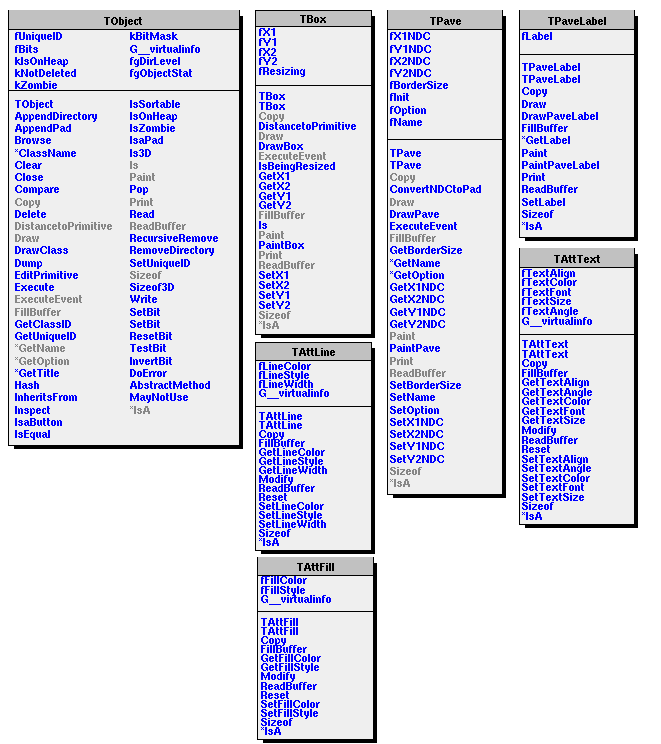
If a class B inherits from a class A, description of B is drawn on the right side of description of A. Member functions overridden by B are shown in class A with a blue line crossing-out the corresponding member function. The following picture is the class inheritance tree of class TPaveLabel:
Reimplemented in TGFrame, TSystemDirectory, and TSystemFile.
Definition at line 308 of file TObject.cxx.
Draw a clone of this object in the current selected pad with: gROOT->SetSelectedPad(c1).
If pad was not selected - gPad will be used.
Reimplemented in TAxis, TCanvas, TGFrame, TSystemDirectory, and TSystemFile.
Definition at line 319 of file TObject.cxx.
|
virtualinherited |
Dump contents of object on stdout.
Using the information in the object dictionary (class TClass) each data member is interpreted. If a data member is a pointer, the pointer value is printed
The following output is the Dump of a TArrow object:
Reimplemented in TClass, TCollection, TGFrame, TGPack, and TSystemFile.
Definition at line 367 of file TObject.cxx.
|
virtualinherited |
Issue error message.
Use "location" to specify the method where the error occurred. Accepts standard printf formatting arguments.
Reimplemented in TFitResult.
Definition at line 1098 of file TObject.cxx.
|
virtualinherited |
Execute method on this object with the given parameter string, e.g.
"3.14,1,\"text\"".
Reimplemented in ROOT::R::TRInterface, TCling, TContextMenu, TInterpreter, and TMethodCall.
Definition at line 378 of file TObject.cxx.
|
virtualinherited |
Execute method on this object with parameters stored in the TObjArray.
The TObjArray should contain an argv vector like:
Reimplemented in ROOT::R::TRInterface, TCling, TContextMenu, TInterpreter, and TMethodCall.
Definition at line 398 of file TObject.cxx.
Execute action corresponding to an event at (px,py).
This method must be overridden if an object can react to graphics events.
Reimplemented in TASImage, TASPaletteEditor::LimitLine, TAxis3D, TAxis, TBox, TButton, TCanvas, TCrown, TCurlyArc, TCurlyLine, TDiamond, TEfficiency, TEllipse, TF1, TF2, TF3, TFrame, TGenerator, TGeoManager, TGeoNode, TGeoOverlap, TGeoShape, TGeoTrack, TGeoVolume, TGL5DDataSet, TGLEventHandler, TGLHistPainter, TGLParametricEquation, TGLScenePad, TGLTH3Composition, TGLViewer, TGraph2D, TGraph, TGraphEdge, TGraphNode, TGraphPolargram, TGroupButton, TH1, THistPainter, TLine, TLink, TMarker3DBox, TMarker, TNode, TPad, TPaletteAxis, TParallelCoord, TParallelCoordRange, TParallelCoordVar, TParticle, TPave, TPie, TPolyLine3D, TPolyLine, TPolyMarker3D, TPolyMarker, TPrimary, TScatter2D, TScatter, TSliderBox, TSpider, TSpline, TText, TTreePerfStats, TView3D, TView, TVirtualHistPainter, and TWbox.
Definition at line 415 of file TObject.cxx.
|
virtualinherited |
Issue fatal error message.
Use "location" to specify the method where the fatal error occurred. Accepts standard printf formatting arguments.
Definition at line 1126 of file TObject.cxx.
| void TKDTree< Index, Value >::FindBNodeA | ( | Value * | point, |
| Value * | delta, | ||
| Int_t & | inode ) |
find the smallest node covering the full range - start
Definition at line 1176 of file TKDTree.cxx.
| void TKDTree< Index, Value >::FindInRange | ( | Value * | point, |
| Value | range, | ||
| std::vector< Index > & | res ) |
Find all points in the sphere of a given radius "range" around the given point.
| point | the point |
| range | radius of the sphere |
| res | a vector, in which the results will be returned |
Definition at line 752 of file TKDTree.cxx.
| void TKDTree< Index, Value >::FindNearestNeighbors | ( | const Value * | point, |
| Int_t | k, | ||
| Index * | ind, | ||
| Value * | dist ) |
Find kNN nearest neighbors to the point in the first argument Returns 1 on success, 0 on failure Arrays ind and dist are provided by the user and are assumed to be at least kNN elements long.
Definition at line 546 of file TKDTree.cxx.
| Index TKDTree< Index, Value >::FindNode | ( | const Value * | point | ) | const |
returns the index of the terminal node to which point belongs (index in the fAxis, fValue, etc arrays) returns -1 in case of failure
Definition at line 675 of file TKDTree.cxx.
|
virtualinherited |
Must be redefined in derived classes.
This function is typically used with TCollections, but can also be used to find an object by name inside this object.
Reimplemented in RooAbsCollection, RooLinkedList, TBtree, TCollection, TDirectory, TFolder, TGeometry, TGraph2D, TGraph, TH1, THashList, THashTable, THbookFile, TList, TListOfDataMembers, TListOfEnums, TListOfEnumsWithLock, TListOfFunctions, TListOfFunctionTemplates, TListOfTypes, TMap, TObjArray, TPad, TROOT, TViewPubDataMembers, and TViewPubFunctions.
Definition at line 425 of file TObject.cxx.
Must be redefined in derived classes.
This function is typically used with TCollections, but can also be used to find an object inside this object.
Reimplemented in RooAbsCollection, RooLinkedList, TBtree, TCollection, TDirectory, TFolder, TGeometry, TGraph2D, TGraph, TH1, THashList, THashTable, THbookFile, TList, TListOfDataMembers, TListOfEnums, TListOfEnumsWithLock, TListOfFunctions, TListOfFunctionTemplates, TListOfTypes, TMap, TObjArray, TPad, TROOT, TViewPubDataMembers, and TViewPubFunctions.
Definition at line 435 of file TObject.cxx.
| void TKDTree< Index, Value >::FindPoint | ( | Value * | point, |
| Index & | index, | ||
| Int_t & | iter ) |
find the index of point works only if we keep fData pointers
Definition at line 706 of file TKDTree.cxx.
Get the boundaries.
Definition at line 1188 of file TKDTree.cxx.
Get the boundaries.
Definition at line 1199 of file TKDTree.cxx.
| Value * TKDTree< Index, Value >::GetBoundary | ( | const Int_t | node | ) |
Get a boundary.
Definition at line 1209 of file TKDTree.cxx.
| Value * TKDTree< Index, Value >::GetBoundaryExact | ( | const Int_t | node | ) |
Get a boundary.
Definition at line 1219 of file TKDTree.cxx.
|
virtualinherited |
Get option used by the graphics system to draw this object.
Note that before calling object.GetDrawOption(), you must have called object.Draw(..) before in the current pad.
Reimplemented in TBrowser, TFitEditor, TGedFrame, TGFileBrowser, TRootBrowser, and TRootBrowserLite.
Definition at line 445 of file TObject.cxx.
|
staticinherited |
Return destructor only flag.
Definition at line 1196 of file TObject.cxx.
|
virtualinherited |
Returns mime type name of object.
Used by the TBrowser (via TGMimeTypes class). Override for class of which you would like to have different icons for objects of the same class.
Reimplemented in ROOT::Experimental::XRooFit::xRooNode, TASImage, TBranch, TBranchElement, TGeoVolume, TGMainFrame, TKey, TMethodBrowsable, TSystemFile, and TVirtualBranchBrowsable.
Definition at line 472 of file TObject.cxx.
|
virtualinherited |
Returns name of object.
This default method returns the class name. Classes that give objects a name should override this method.
Reimplemented in RooAbsCollection, RooCatType, RooLinkedList, TArchiveMember, TCollection, TEnvRec, TEveGeoNode, TGaxis, TGeoDecayChannel, TGeoShape, TGeoVGShape, TGLEmbeddedViewer, TGLPShapeObj, TGLSAViewer, TGMenuEntry, TGMenuTitle, TGPicture, TGWindow, TIconBoxThumb, TMapFile, TMVA::DataSetInfo, TMVA::FitterBase, TMVA::MethodBase, TMVA::OptionBase, TMVA::PDF, TMVA::Reader, TMVA::VariableTransformBase, TNamed, TObjString, TPad, TPair, TParameter< AParamType >, TParameter< Long64_t >, TParticle, TPave, TPolyMarker3D, TPrimary, TQCommand, TQConnection, TQSlot, TRealData, TSQLClassColumnInfo, TSQLClassInfo, TSQLColumnData, TStatistic, TStructNode, TTreePerfStats, TTVRecord, TTVSession, TVirtualGeoTrack, TVirtualPad, and TXMLAttr.
Definition at line 462 of file TObject.cxx.
| void TKDTree< Index, Value >::GetNodePointsIndexes | ( | Int_t | node, |
| Int_t & | first1, | ||
| Int_t & | last1, | ||
| Int_t & | first2, | ||
| Int_t & | last2 ) const |
Return the indices of points in that node Indices are returned as the first and last value of the part of indices array, that belong to this node Sometimes points are in 2 intervals, then the first and last value for the second one are returned in third and fourth parameter, otherwise first2 is set to 0 and last2 is set to -1 To iterate over all the points of the node #inode, one can do, for example: Index *indices = kdtree->GetPointsIndexes(); Int_t first1, last1, first2, last2; kdtree->GetPointsIndexes(inode, first1, last1, first2, last2); for (Int_t ipoint=first1; ipoint<=last1; ipoint++){ point = indices[ipoint]; //do something with point; } for (Int_t ipoint=first2; ipoint<=last2; ipoint++){ point = indices[ipoint]; //do something with point; }.
Definition at line 844 of file TKDTree.cxx.
| Index TKDTree< Index, Value >::GetNPointsNode | ( | Int_t | node | ) | const |
Get number of points in this node for all the terminal nodes except last, the size is fBucketSize for the last node it's fOffsetfBucketSize, or if fOffsetfBucketSize==0, it's also fBucketSize.
Definition at line 898 of file TKDTree.cxx.
Returns string containing info about the object at position (px,py).
This method is typically overridden by classes of which the objects can report peculiarities for different positions. Returned string will be re-used (lock in MT environment).
Reimplemented in TASImage, TAxis3D, TColorWheel, TF1, TF2, TFileDrawMap, TGeoNode, TGeoTrack, TGeoVolume, TGL5DDataSet, TGLHistPainter, TGLParametricEquation, TGLTH3Composition, TGraph, TH1, THistPainter, TNode, TPaletteAxis, TParallelCoordVar, and TVirtualHistPainter.
Definition at line 491 of file TObject.cxx.
|
staticinherited |
Get status of object stat flag.
Definition at line 1181 of file TObject.cxx.
|
inlinevirtualinherited |
Reimplemented in TArrow, TAxis3D, TFile, TGaxis, TGeoVolume, TH1, THelix, TLegendEntry, TMapFile, TNode, TPave, TPoints3DABC, TPolyLine3D, TPolyLine, TPolyMarker3D, TPolyMarker, TPSocket, TSelector, TSocket, and TUDPSocket.
| Index * TKDTree< Index, Value >::GetPointsIndexes | ( | Int_t | node | ) | const |
return the indices of the points in that terminal node for all the nodes except last, the size is fBucketSize for the last node it's fOffsetfBucketSize
Definition at line 815 of file TKDTree.cxx.
|
virtualinherited |
Returns title of object.
This default method returns the class title (i.e. description). Classes that give objects a title should override this method.
Reimplemented in Axis2, TASImage, TAxis, TBaseClass, TClassMenuItem, TEveGeoNode, TEvePointSet, TGaxis, TGGroupFrame, TGLabel, TGLVEntry, TGTextButton, TGTextEntry, TGTextLBEntry, TKey, TMapFile, TNamed, TPad, TPair, TParallelCoordSelect, TParticle, TPaveLabel, TPrimary, TQCommand, TRootIconList, and TVirtualPad.
Definition at line 507 of file TObject.cxx.
|
virtualinherited |
Return the unique object id.
Definition at line 480 of file TObject.cxx.
Execute action in response of a timer timing out.
This method must be overridden if an object has to react to timers.
Reimplemented in TGCommandPlugin, TGDNDManager, TGFileContainer, TGHtml, TGLEventHandler, TGPopupMenu, TGraphTime, TGScrollBar, TGShutter, TGTextEdit, TGTextEditor, TGTextEntry, TGTextView, TGToolTip, TGuiBldDragManager, TGWindow, and TTreeViewer.
Definition at line 516 of file TObject.cxx.
|
virtualinherited |
Return hash value for this object.
Note: If this routine is overloaded in a derived class, this derived class should also add
Otherwise, when RecursiveRemove is called (by ~TObject or example) for this type of object, the transversal of THashList and THashTable containers will will have to be done without call Hash (and hence be linear rather than logarithmic complexity). You will also see warnings like
Reimplemented in RooLinkedList, TASImagePlugin, TASPluginGS, TCollection, TEnvRec, TGObject, TGPicture, TIconBoxThumb, TImagePlugin, TNamed, TObjString, TPad, TPair, TParameter< AParamType >, TParameter< Long64_t >, TPave, and TStatistic.
Definition at line 539 of file TObject.cxx.
|
inlineinherited |
Return true is the type of this object is known to have an inconsistent setup for Hash and RecursiveRemove (i.e.
missing call to RecursiveRemove in destructor).
Note: Since the consistency is only tested for during inserts, this routine will return true for object that have never been inserted whether or not they have a consistent setup. This has no negative side-effect as searching for the object with the right or wrong Hash will always yield a not-found answer (Since anyway no hash can be guaranteed unique, there is always a check)
|
virtualinherited |
Issue info message.
Use "location" to specify the method where the warning occurred. Accepts standard printf formatting arguments.
Definition at line 1072 of file TObject.cxx.
|
virtualinherited |
Returns kTRUE if object inherits from class "classname".
Reimplemented in TClass.
Definition at line 549 of file TObject.cxx.
Returns kTRUE if object inherits from TClass cl.
Reimplemented in TClass.
Definition at line 557 of file TObject.cxx.
|
virtualinherited |
Dump contents of this object in a graphics canvas.
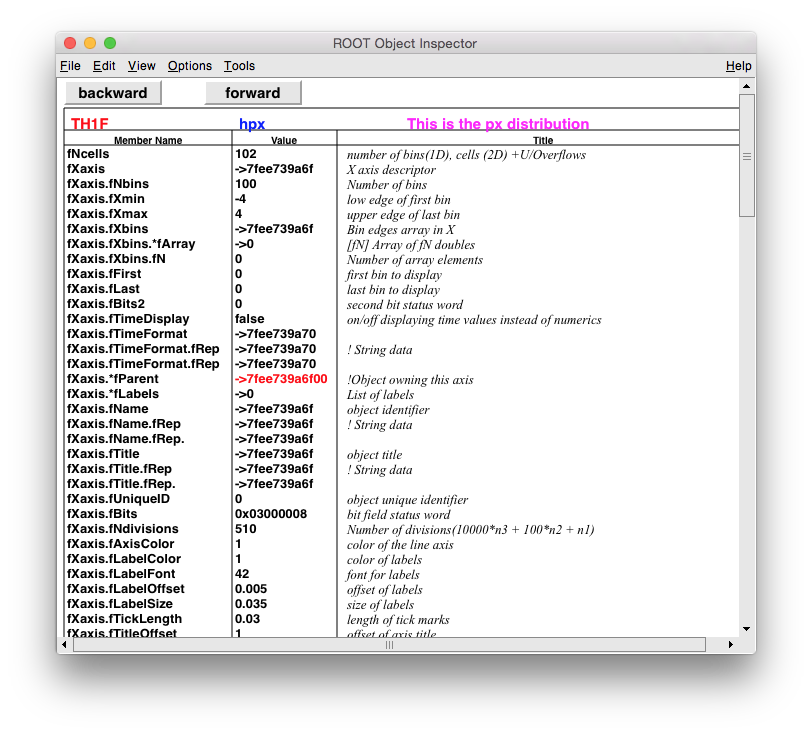
Same action as Dump but in a graphical form. In addition pointers to other objects can be followed.
The following picture is the Inspect of a histogram object:
Reimplemented in ROOT::Experimental::XRooFit::xRooNode, TGFrame, TInspectorObject, and TSystemFile.
Definition at line 570 of file TObject.cxx.
|
inlineinherited |
IsDestructed.
Default equal comparison (objects are equal if they have the same address in memory).
More complicated classes might want to override this function.
Reimplemented in TGObject, TObjString, TPair, and TQCommand.
Definition at line 589 of file TObject.cxx.
|
virtualinherited |
Returns kTRUE in case object contains browsable objects (like containers or lists of other objects).
Reimplemented in ROOT::Experimental::XRooFit::xRooNode, ROOT::Internal::THnBaseBrowsable, TApplicationRemote, TAxis3D, TBaseClass, TBranch, TBranchClones, TBranchElement, TBranchObject, TBranchSTL, TBrowserObject, TCanvas, TClass, TCollection, TDatabasePDG, TDirectory, TFolder, TGeoManager, TGeometry, TGeoNode, TGeoNodeMatrix, TGeoOverlap, TGeoTrack, TGeoVolume, THbookFile, THbookKey, THnBase, TKey, TMapFile, TMultiDimFit, TNode, TPad, TPair, TParticleClassPDG, TPrincipal, TRemoteObject, TROOT, TRootIconList, TSPlot, TSystemDirectory, TTask, TTree, and TVirtualBranchBrowsable.
Definition at line 579 of file TObject.cxx.
|
inlinevirtualinherited |
Reimplemented in RooAbsArg, RooDouble, TCollection, TFileInfo, TGeoBranchArray, TGeoOverlap, TGFSFrameElement, TGLBFrameElement, TNamed, TObjString, TParameter< AParamType >, TParameter< Long64_t >, TPave, TStructNode, TStructNodeProperty, TUri, and TUrl.
| Value TKDTree< Index, Value >::KOrdStat | ( | Index | ntotal, |
| Value * | a, | ||
| Index | k, | ||
| Index * | index ) const |
copy of the TMath::KOrdStat because I need an Index work array
Definition at line 983 of file TKDTree.cxx.
|
virtualinherited |
The ls function lists the contents of a class on stdout.
Ls output is typically much less verbose then Dump().
Reimplemented in ROOT::Detail::TSchemaRuleSet, ROOT::Experimental::XRooFit::xRooBrowser, ROOT::TSchemaRule, TAnnotation, TApplication, TBox, TCanvas, TChain, TChainElement, TClass, TClassTree, TCollection, TColor, TDirectory, TDirectoryFile, TEllipse, TFile, TFolder, TFree, TFriendElement, TFunction, TGeometry, TGeoNode, TGFrameElement, TGLayoutHints, THbookFile, THStack, TImage, TKey, TLine, TMapFile, TMarker, TNamed, TNode, TPad, TParameter< AParamType >, TParameter< Long64_t >, TPave, TPolyLine3D, TPolyLine, TPolyMarker3D, TPolyMarker, TQCommand, TQConnection, TQConnectionList, TQSlot, TQUndoManager, TROOT, TStatistic, TStreamerBase, TStreamerElement, TStreamerInfo, TStreamerSTL, TTask, TText, TVirtualPad, and TVirtualStreamerInfo.
Definition at line 598 of file TObject.cxx.
| void TKDTree< Index, Value >::MakeBoundaries | ( | Value * | range = nullptr | ) |
Build boundaries for each node.
Note, that the boundaries here are built based on the splitting planes of the kd-tree, and don't necessarily pass through the points of the original dataset. For the latter functionality see function MakeBoundariesExact() Boundaries can be retrieved by calling GetBoundary(inode) function that would return an array of boundaries for the specified node, or GetBoundaries() function that would return the complete array.
Definition at line 1037 of file TKDTree.cxx.
Build boundaries for each node.
Unlike MakeBoundaries() function the boundaries built here always pass through a point of the original dataset So, for example, for a terminal node with just one point minimum and maximum for each dimension are the same. Boundaries can be retrieved by calling GetBoundaryExact(inode) function that would return an array of boundaries for the specified node, or GetBoundaries() function that would return the complete array.
Definition at line 1117 of file TKDTree.cxx.
|
inherited |
Use this method to signal that a method (defined in a base class) may not be called in a derived class (in principle against good design since a child class should not provide less functionality than its parent, however, sometimes it is necessary).
Definition at line 1160 of file TObject.cxx.
|
virtualinherited |
This method must be overridden to handle object notification (the base implementation is no-op).
Different objects in ROOT use the Notify method for different purposes, in coordination with other objects that call this method at the appropriate time.
For example, TLeaf uses it to load class information; TBranchRef to load contents of referenced branches TBranchRef; most notably, based on Notify, TChain implements a callback mechanism to inform interested parties when it switches to a new sub-tree.
Reimplemented in h1analysis, h1analysisTreeReader, TARInterruptHandler, TASInputHandler, TASInterruptHandler, TASLogHandler, TASSigPipeHandler, TBlinkTimer, TBranchElement, TBranchRef, TBreakLineCom, TBrowserTimer, TCollection, TDelCharCom, TDelTextCom, TFileHandler, TGContainerKeyboardTimer, TGContainerScrollTimer, TGInputHandler, TGLRedrawTimer, TGTextEditHist, TGuiBldDragManagerRepeatTimer, TIdleTimer, TInsCharCom, TInsTextCom, TInterruptHandler, TLeafObject, TMessageHandler, TNotifyLink< Type >, TNotifyLink< RNoCleanupNotifierHelper >, TNotifyLink< ROOT::Detail::TBranchProxy >, TNotifyLink< TTreeReader >, TPopupDelayTimer, TProcessEventTimer, TRefTable, TRepeatTimer, TSBRepeatTimer, TSelector, TSelectorDraw, TSelectorEntries, TSignalHandler, TSingleShotCleaner, TSocketHandler, TStdExceptionHandler, TSysEvtHandler, TTermInputHandler, TThreadTimer, TTimeOutTimer, TTimer, TTipDelayTimer, TTree, TTreeFormula, TTreeFormulaManager, TTreeReader, TViewTimer, and TViewUpdateTimer.
Definition at line 618 of file TObject.cxx.
|
inherited |
Use this method to declare a method obsolete.
Specify as of which version the method is obsolete and as from which version it will be removed.
Definition at line 1169 of file TObject.cxx.
|
inherited |
Operator delete for sized deallocation.
Definition at line 1234 of file TObject.cxx.
|
inherited |
Operator delete.
Definition at line 1212 of file TObject.cxx.
|
inherited |
Only called by placement new when throwing an exception.
Definition at line 1266 of file TObject.cxx.
|
inherited |
Operator delete [] for sized deallocation.
Definition at line 1245 of file TObject.cxx.
|
inherited |
Operator delete [].
Definition at line 1223 of file TObject.cxx.
|
inherited |
Only called by placement new[] when throwing an exception.
Definition at line 1274 of file TObject.cxx.
|
inlineinherited |
|
inlineinherited |
|
inlineinherited |
|
private |
|
virtualinherited |
This method must be overridden if a class wants to paint itself.
The difference between Paint() and Draw() is that when a object draws itself it is added to the display list of the pad in which it is drawn (and automatically redrawn whenever the pad is redrawn). While paint just draws the object without adding it to the pad display list.
Reimplemented in ROOT::Experimental::RTreeMapPainter, ROOT::RGeoPainter, TAnnotation, TArrow, TASImage, TASPaletteEditor::LimitLine, TASPaletteEditor::PaintPalette, TAxis3D, TBits, TBox, TButton, TCanvas, TClassTree, TCollection, TColorWheel, TCrown, TDiamond, TDirectory, TEfficiency, TEllipse, TEveArrow, TEveCaloViz, TEveDigitSet, TEveGeoShape, TEveGeoTopNode, TEvePlot3D, TEvePointSet, TEveProjectionAxes, TEveScene, TEveShape, TEveStraightLineSet, TEveText, TEveTriangleSet, TExec, TF1, TF2, TF3, TFile, TFileDrawMap, TFrame, TGaxis, TGenerator, TGeoBoolNode, TGeoIntersection, TGeoNode, TGeoOverlap, TGeoPainter, TGeoPhysicalNode, TGeoShape, TGeoSubtraction, TGeoTrack, TGeoUnion, TGeoVGShape, TGeoVolume, TGL5DDataSet, TGLHistPainter, TGLParametricEquation, TGLTH3Composition, TGraph2D, TGraph2DPainter, TGraph, TGraphEdge, TGraphNode, TGraphPolargram, TGraphTime, TH1, THistPainter, THStack, TLatex, TLegend, TLine, TMacro, TMarker3DBox, TMarker, TMathText, TMultiGraph, TNode, TNodeDiv, TPad, TPaletteAxis, TParallelCoord, TParallelCoordRange, TParallelCoordVar, TParticle, TPave, TPaveLabel, TPaveStats, TPavesText, TPaveText, TPie, TPolyLine3D, TPolyLine, TPolyMarker3D, TPolyMarker, TPrimary, TRatioPlot, TScatter2D, TScatter, TShape, TSpectrum2Painter, TSpider, TSpline, TSQLFile, TStyle, TText, TTreePerfStats, TVirtualGeoPainter, TVirtualGeoTrack, TVirtualHistPainter, TVirtualPad, TWbox, and TXMLFile.
Definition at line 631 of file TObject.cxx.
|
virtualinherited |
Pop on object drawn in a pad to the top of the display list.
I.e. it will be drawn last and on top of all other primitives.
Reimplemented in TFrame, TPad, and TVirtualPad.
Definition at line 640 of file TObject.cxx.
|
virtualinherited |
This method must be overridden when a class wants to print itself.
Reimplemented in Roo1DTable, RooAbsArg, RooAbsBinning, RooAbsCollection, RooAbsData, RooAbsDataStore, RooAbsGenContext, RooCatType, RooCmdArg, RooCurve, RooEllipse, RooFitResult, RooGenFitStudy, RooHist, RooLinkedList, RooMsgService, RooNumGenConfig, RooNumIntConfig, RooPlot, RooSharedProperties, RooStats::ModelConfig, ROOT::Experimental::REveTrans, ROOT::Experimental::XRooFit::xRooNLLVar::xRooHypoPoint, ROOT::Experimental::XRooFit::xRooNLLVar::xRooHypoSpace, ROOT::Experimental::XRooFit::xRooNode, ROOT::v5::TFormula, RooWorkspace, TAnnotation, TApplicationRemote, TAttParticle, TBenchmark, TBits, TBox, TBranch, TBranchClones, TBranchElement, TBranchObject, TBranchRef, TBranchSTL, TChain, TClassTable, TCling, TCollection, TColor, TDatabasePDG, TDecompBase, TDecompBK, TDecompChol, TDecompLU, TDecompQRH, TDecompSparse, TDecompSVD, TDirectory, TEllipse, TEnv, TEventList, TEveTrans, TF1, TFile, TFileCacheRead, TFileCacheWrite, TFileCollection, TFileInfo, TFileInfoMeta, TFitResult, TFoamCell, TFoamVect, TFormula, TFunction, TGCompositeFrame, TGDMLMatrix, TGeoBatemanSol, TGeoBorderSurface, TGeoBranchArray, TGeoDecayChannel, TGeoElement, TGeoElementRN, TGeoElementTable, TGeoIsotope, TGeoMatrix, TGeoOpticalSurface, TGeoOverlap, TGeoPhysicalNode, TGeoRegion, TGeoSkinSurface, TGeoTessellated, TGeoTrack, TGeoVolume, TGeoVoxelFinder, TGFont, TGFontPool, TGFrame, TGFrameElement, TGGC, TGGCPool, TGLayoutHints, TGMimeTypes, TGPicture, TGPicturePool, TGraph2D, TGraph2DAsymmErrors, TGraph2DErrors, TGraph, TGraphAsymmErrors, TGraphBentErrors, TGraphErrors, TGraphMultiErrors, TGTextEdit, TGWindow, TH1, THashTable, THbookTree, THelix, THnBase, THStack, TInetAddress, TKey, TLegend, TLegendEntry, TLine, TLorentzVector, TMacro, TMapFile, TMarker, TMatrixTBase< Element >, TMatrixTBase< Double_t >, TMatrixTBase< Float_t >, TMemFile, TMessageHandler, TMultiDimFit, TMultiGraph, TMVA::Event, TMVA::Option< T >, TMVA::Option< T * >, TMVA::OptionBase, TMVA::PDEFoamCell, TMVA::PDEFoamVect, TMVA::TNeuron, TNamed, TObjectTable, TObjString, TPad, TParallelCoordRange, TParallelCoordVar, TParameter< AParamType >, TParameter< Long64_t >, TParticle, TParticleClassPDG, TParticlePDG, TPave, TPaveText, TPluginHandler, TPluginManager, TPolyLine3D, TPolyLine, TPolyMarker3D, TPolyMarker, TPrimary, TPrincipal, TQpDataDens, TQpDataSparse, TQpVar, TQSlot, TQuaternion, TRolke, TRootBrowserHistoryCursor, TScatter2D, TScatter, TSpectrum2, TSpectrum3, TSpectrum, TSQLColumnInfo, TSQLFile, TSQLStructure, TSQLTableInfo, TStatistic, TStopwatch, TStreamerInfoActions::TActionSequence, TText, TTree, TTreeCache, TTreeCacheUnzip, TTreeIndex, TTreePerfStats, TUri, TUrl, TVector2, TVector3, TVectorT< Element >, TVectorT< Double_t >, TVectorT< Float_t >, TVirtualPad, TXMLFile, TXTRU, TZIPFile, and TZIPMember.
Definition at line 661 of file TObject.cxx.
|
virtualinherited |
Read contents of object with specified name from the current directory.
First the key with the given name is searched in the current directory, next the key buffer is deserialized into the object. The object must have been created before via the default constructor. See TObject::Write().
Reimplemented in TBuffer, TKey, TKeySQL, and TKeyXML.
Definition at line 673 of file TObject.cxx.
|
virtualinherited |
Recursively remove this object from a list.
Typically implemented by classes that can contain multiple references to a same object.
Reimplemented in RooAbsCollection, RooAbsData, RooLinkedList, RooMCStudy, ROOT::Internal::TCheckHashRecursiveRemoveConsistency, ROOT::RBrowserDataCleanup, RooWorkspace, TBrowser, TChain, TCling, TCollection, TDialogCanvas, TDirectory, TEfficiency, TFileMerger, TFitEditor, TFolder, TFriendElement, TGedEditor, TGeometry, TGFileBrowser, TGraph2D, TGraph, TH1, TH1Editor, TH2Editor, THashList, THistPainter, THStack, TInspectCanvas, TLegend, TList, TListOfDataMembers, TListOfEnums, TListOfEnumsWithLock, TListOfFunctions, TListOfFunctionTemplates, TMultiGraph, TNode, TObjArray, TObjectRefSpy, TObjectSpy, TPad, TProcessID, TROOT, TRootBrowser, TRootBrowserHistory, TRootBrowserLite, TRootContextMenu, TTree, TTreePlayer, TViewPubDataMembers, TViewPubFunctions, and TVirtualPad.
Definition at line 684 of file TObject.cxx.
|
virtualinherited |
Save this object in the file specified by filename.
otherwise the object is written to filename as a CINT/C++ script. The C++ code to rebuild this object is generated via SavePrimitive(). The "option" parameter is passed to SavePrimitive. By default it is an empty string. It can be used to specify the Draw option in the code generated by SavePrimitive.
The function is available via the object context menu.
Reimplemented in ROOT::Experimental::XRooFit::xRooNode, TClassTree, TFolder, TGeoVolume, TGObject, TGraph, TH1, TPad, TPaveClass, TSpline3, TSpline5, TSpline, TTreePerfStats, and TVirtualPad.
Definition at line 708 of file TObject.cxx.
|
virtualinherited |
Save a primitive as a C++ statement(s) on output stream "out".
Reimplemented in TAnnotation, TArc, TArrow, TASImage, TAxis3D, TBox, TButton, TCanvas, TChain, TCrown, TCurlyArc, TCurlyLine, TCutG, TDiamond, TEfficiency, TEllipse, TExec, TF12, TF1, TF2, TF3, TFrame, TGaxis, TGButton, TGButtonGroup, TGCanvas, TGCheckButton, TGColorSelect, TGColumnLayout, TGComboBox, TGCompositeFrame, TGContainer, TGDockableFrame, TGDoubleHSlider, TGDoubleVSlider, TGedMarkerSelect, TGedPatternSelect, TGeoArb8, TGeoBBox, TGeoBoolNode, TGeoCombiTrans, TGeoCompositeShape, TGeoCone, TGeoConeSeg, TGeoCtub, TGeoDecayChannel, TGeoElementRN, TGeoEltu, TGeoGtra, TGeoHalfSpace, TGeoHMatrix, TGeoHype, TGeoIdentity, TGeoIntersection, TGeoMaterial, TGeoMedium, TGeoMixture, TGeoPara, TGeoParaboloid, TGeoPatternCylPhi, TGeoPatternCylR, TGeoPatternParaX, TGeoPatternParaY, TGeoPatternParaZ, TGeoPatternSphPhi, TGeoPatternSphR, TGeoPatternSphTheta, TGeoPatternTrapZ, TGeoPatternX, TGeoPatternY, TGeoPatternZ, TGeoPcon, TGeoPgon, TGeoRotation, TGeoScaledShape, TGeoShapeAssembly, TGeoSphere, TGeoSubtraction, TGeoTessellated, TGeoTorus, TGeoTranslation, TGeoTrap, TGeoTrd1, TGeoTrd2, TGeoTube, TGeoTubeSeg, TGeoUnion, TGeoVolume, TGeoXtru, TGFileContainer, TGFont, TGFrame, TGFSComboBox, TGGC, TGGroupFrame, TGHButtonGroup, TGHorizontal3DLine, TGHorizontalFrame, TGHorizontalLayout, TGHProgressBar, TGHScrollBar, TGHSlider, TGHSplitter, TGHtml, TGIcon, TGLabel, TGLayoutHints, TGLineStyleComboBox, TGLineWidthComboBox, TGListBox, TGListDetailsLayout, TGListLayout, TGListTree, TGListView, TGLVContainer, TGMainFrame, TGMatrixLayout, TGMdiFrame, TGMdiMainFrame, TGMdiMenuBar, TGMenuBar, TGMenuTitle, TGNumberEntry, TGNumberEntryField, TGPictureButton, TGPopupMenu, TGProgressBar, TGRadioButton, TGraph2D, TGraph2DAsymmErrors, TGraph2DErrors, TGraph, TGraphAsymmErrors, TGraphBentErrors, TGraphEdge, TGraphErrors, TGraphMultiErrors, TGraphNode, TGraphPolar, TGraphPolargram, TGraphStruct, TGroupButton, TGRowLayout, TGShapedFrame, TGShutter, TGShutterItem, TGSplitFrame, TGStatusBar, TGTab, TGTabLayout, TGTableLayout, TGTableLayoutHints, TGTextButton, TGTextEdit, TGTextEntry, TGTextLBEntry, TGTextView, TGTileLayout, TGToolBar, TGTransientFrame, TGTripleHSlider, TGTripleVSlider, TGVButtonGroup, TGVertical3DLine, TGVerticalFrame, TGVerticalLayout, TGVFileSplitter, TGVProgressBar, TGVScrollBar, TGVSlider, TGVSplitter, TGXYLayout, TGXYLayoutHints, TH1, TH2Poly, THelix, THStack, TLatex, TLegend, TLine, TMacro, TMarker3DBox, TMarker, TMathText, TMultiGraph, TPad, TPaletteAxis, TParallelCoord, TParallelCoordVar, TPave, TPaveClass, TPaveLabel, TPaveStats, TPavesText, TPaveText, TPie, TPieSlice, TPolyLine3D, TPolyLine, TPolyMarker3D, TPolyMarker, TProfile2D, TProfile3D, TProfile, TRootContainer, TRootEmbeddedCanvas, TScatter2D, TScatter, TSlider, TSliderBox, TSpline3, TSpline5, TStyle, TText, TTreePerfStats, and TWbox.
Definition at line 858 of file TObject.cxx.
|
staticprotectedinherited |
Save object constructor in the output stream "out".
Can be used as first statement when implementing SavePrimitive() method for the object
Definition at line 777 of file TObject.cxx.
|
staticprotectedinherited |
Save invocation of primitive Draw() method Skipped if option contains "nodraw" string.
Definition at line 845 of file TObject.cxx.
|
staticprotectedinherited |
Save array in the output stream "out" as vector.
Create unique variable name based on prefix value Returns name of vector which can be used in constructor or in other places of C++ code If flag === kTRUE, just add empty line If flag === 111, check if array is empty and return nullptr or <vectorname>.data()
Definition at line 796 of file TObject.cxx.
Set or unset the user status bits as specified in f.
Definition at line 888 of file TObject.cxx.
| Int_t TKDTree< Index, Value >::SetData | ( | Index | idim, |
| Value * | data ) |
Set the coordinate #ndim of all points (the column #ndim of the data matrix) After setting all the data columns, proceed by calling Build() function Note, that calling this function after Build() is not possible Note also, that no checks on the array sizes is performed anywhere.
Definition at line 946 of file TKDTree.cxx.
| void TKDTree< Index, Value >::SetData | ( | Index | npoints, |
| Index | ndim, | ||
| UInt_t | bsize, | ||
| Value ** | data ) |
Set the data array. See the constructor function comments for details.
Definition at line 921 of file TKDTree.cxx.
|
virtualinherited |
Set drawing option for object.
This option only affects the drawing style and is stored in the option field of the TObjOptLink supporting a TPad's primitive list (TList). Note that it does not make sense to call object.SetDrawOption(option) before having called object.Draw().
Reimplemented in RooPlot, TAxis, TBrowser, TGedFrame, TGFrame, TPad, TPaveStats, TRootBrowserLite, TSystemDirectory, and TSystemFile.
Definition at line 871 of file TObject.cxx.
|
staticinherited |
Set destructor only flag.
Definition at line 1204 of file TObject.cxx.
|
staticinherited |
Turn on/off tracking of objects in the TObjectTable.
Definition at line 1188 of file TObject.cxx.
|
virtualinherited |
Set the unique object id.
Definition at line 899 of file TObject.cxx.
| void TKDTree< Index, Value >::Spread | ( | Index | ntotal, |
| Value * | a, | ||
| Index * | index, | ||
| Value & | min, | ||
| Value & | max ) const |
Calculate spread of the array a.
Definition at line 966 of file TKDTree.cxx.
|
overridevirtual |
Stream an object of class TObject.
Reimplemented from TObject.
|
virtualinherited |
Issue system error message.
Use "location" to specify the method where the system error occurred. Accepts standard printf formatting arguments.
Definition at line 1112 of file TObject.cxx.
|
private |
Update the nearest neighbors values by examining the node inode.
Definition at line 566 of file TKDTree.cxx.
|
private |
Internal recursive function with the implementation of range searches.
Definition at line 762 of file TKDTree.cxx.
|
virtualinherited |
|
virtualinherited |
Issue warning message.
Use "location" to specify the method where the warning occurred. Accepts standard printf formatting arguments.
Definition at line 1084 of file TObject.cxx.
|
virtualinherited |
Write this object to the current directory.
For more see the const version of this method.
Reimplemented in ROOT::TBufferMergerFile, TBuffer, TCollection, TDirectory, TDirectoryFile, TFile, TMap, TParallelMergingFile, TSQLFile, TTree, and TXMLFile.
Definition at line 989 of file TObject.cxx.
|
virtualinherited |
Write this object to the current directory.
The data structure corresponding to this object is serialized. The corresponding buffer is written to the current directory with an associated key with name "name".
Writing an object to a file involves the following steps:
Bufsize can be given to force a given buffer size to write this object. By default, the buffersize will be taken from the average buffer size of all objects written to the current file so far.
If a name is specified, it will be the name of the key. If name is not given, the name of the key will be the name as returned by GetName().
The option can be a combination of: kSingleKey, kOverwrite or kWriteDelete Using the kOverwrite option a previous key with the same name is overwritten. The previous key is deleted before writing the new object. Using the kWriteDelete option a previous key with the same name is deleted only after the new object has been written. This option is safer than kOverwrite but it is slower. NOTE: Neither kOverwrite nor kWriteDelete reduces the size of a TFile– the space is simply freed up to be overwritten; in the case of a TTree, it is more complicated. If one opens a TTree, appends some entries, then writes it out, the behaviour is effectively the same. If, however, one creates a new TTree and writes it out in this way, only the metadata is replaced, effectively making the old data invisible without deleting it. TTree::Delete() can be used to mark all disk space occupied by a TTree as free before overwriting its metadata this way. The kSingleKey option is only used by TCollection::Write() to write a container with a single key instead of each object in the container with its own key.
An object is read from the file into memory via TKey::Read() or via TObject::Read().
The function returns the total number of bytes written to the file. It returns 0 if the object cannot be written.
Reimplemented in TBuffer, TCollection, TDirectory, TDirectoryFile, TFile, TMap, TParallelMergingFile, TSQLFile, TTree, and TXMLFile.
Definition at line 964 of file TObject.cxx.
|
privateinherited |
|
staticprivateinherited |
|
privateinherited |