Implementation in C++ of the Minuit package written by Fred James. This is a straightforward conversion of the original Fortran version.
The main changes are:
The MINUIT package acts on a multiparameter Fortran function to which one must give the generic name FCN. In the ROOT implementation, the function FCN is defined via the MINUIT SetFCN member function when an Histogram.Fit command is invoked. The value of FCN will in general depend on one or more variable parameters.
To take a simple example, in case of ROOT histograms (classes TH1C,TH1S,TH1F,TH1D) the Fit function defines the Minuit fitting function as being H1FitChisquare or H1FitLikelihood depending on the options selected. H1FitChisquare calculates the chisquare between the user fitting function (gaussian, polynomial, user defined,etc) and the data for given values of the parameters. It is the task of MINUIT to find those values of the parameters which give the lowest value of chisquare.
For variable parameters with limits, MINUIT uses the following transformation:
\[P_{\mathrm{int}} = \arcsin \left( 2\: \frac{P_{\mathrm{ext}}-a}{b-a} - 1 \right) P_{\mathrm{ext}} = a + \frac{b - a}{2} \left( \sin P_{\mathrm{int}} + 1 \right) \]
so that the internal value \(P_{\mathrm{int}}\) can take on any value, while the external value \(P_{\mathrm{ext}}\) can take on values only between the lower limit \(a\) and the upper limit \(b\). Since the transformation is necessarily non-linear, it would transform a nice linear problem into a nasty non-linear one, which is the reason why limits should be avoided if not necessary. In addition, the transformation does require some computer time, so it slows down the computation a little bit, and more importantly, it introduces additional numerical inaccuracy into the problem in addition to what is introduced in the numerical calculation of the FCN value. The effects of non-linearity and numerical roundoff both become more important as the external value gets closer to one of the limits (expressed as the distance to nearest limit divided by distance between limits). The user must therefore be aware of the fact that, for example, if he puts limits of \((0,10^{10})\) on a parameter, then the values \(0.0\) and \(1.0\) will be indistinguishable to the accuracy of most machines.
The transformation also affects the parameter error matrix, of course, so Minuit does a transformation of the error matrix (and the ``parabolic'' parameter errors) when there are parameter limits. Users should however realize that the transformation is only a linear approximation, and that it cannot give a meaningful result if one or more parameters is very close to a limit, where \(\partial P_{\mathrm{ext}} / \partial P_{\mathrm{int}} \approx 0\). Therefore, it is recommended that:
MINUIT offers the user a choice of several minimization algorithms. The MIGRAD algorithm is in general the best minimizer for nearly all functions. It is a variable-metric method with inexact line search, a stable metric updating scheme, and checks for positive-definiteness. Its main weakness is that it depends heavily on knowledge of the first derivatives, and fails miserably if they are very inaccurate.
If parameter limits are needed, in spite of the side effects, then the user should be aware of the following techniques to alleviate problems caused by limits:
If MIGRAD converges normally to a point where no parameter is near one of its limits, then the existence of limits has probably not prevented MINUIT from finding the right minimum. On the other hand, if one or more parameters is near its limit at the minimum, this may be because the true minimum is indeed at a limit, or it may be because the minimizer has become ``blocked'' at a limit. This may normally happen only if the parameter is so close to a limit (internal value at an odd multiple of \(\pm \frac{\pi}{2}\) that MINUIT prints a warning to this effect when it prints the parameter values.
The minimizer can become blocked at a limit, because at a limit the derivative seen by the minimizer \(\partial F / \partial P_{\mathrm{int}}\) is zero no matter what the real derivative \(\partial F / \partial P_{\mathrm{ext}}\) is.
\[\frac{\partial F}{\partial P_{\mathrm{int}}} = \frac{\partial F}{\partial P_{\mathrm{ext}}} \frac{\partial P_{\mathrm{ext}}}{\partial P_{\mathrm{int}}} = \frac{\partial F}{\partial P_{\mathrm{ext}}} = 0 \]
In the best case, where the minimum is far from any limits, MINUIT will correctly transform the error matrix, and the parameter errors it reports should be accurate and very close to those you would have got without limits. In other cases (which should be more common, since otherwise you wouldn't need limits), the very meaning of parameter errors becomes problematic. Mathematically, since the limit is an absolute constraint on the parameter, a parameter at its limit has no error, at least in one direction. The error matrix, which can assign only symmetric errors, then becomes essentially meaningless.
There are two kinds of problems that can arise: the reliability of MINUIT's error estimates, and their statistical interpretation, assuming they are accurate.
For discussion of basic concepts, such as the meaning of the elements of the error matrix, or setting of exact confidence levels see:
MINUIT always carries around its own current estimates of the parameter errors, which it will print out on request, no matter how accurate they are at any given point in the execution. For example, at initialization, these estimates are just the starting step sizes as specified by the user. After a HESSE step, the errors are usually quite accurate, unless there has been a problem. MINUIT, when it prints out error values, also gives some indication of how reliable it thinks they are. For example, those marked CURRENT GUESS ERROR are only working values not to be believed, and APPROXIMATE ERROR means that they have been calculated but there is reason to believe that they may not be accurate.
If no mitigating adjective is given, then at least MINUIT believes the errors are accurate, although there is always a small chance that MINUIT has been fooled. Some visible signs that MINUIT may have been fooled are:
The best way to be absolutely sure of the errors, is to use independent'' calculations and compare them, or compare the calculated errors with a picture of the function. Theoretically, the covariance matrix for a physical'' function must be positive-definite at the minimum, although it may not be so for all points far away from the minimum, even for a well-determined physical problem. Therefore, if MIGRAD reports that it has found a non-positive-definite covariance matrix, this may be a sign of one or more of the following:
On its way to the minimum, MIGRAD may have traversed a region which has unphysical behaviour, which is of course not a serious problem as long as it recovers and leaves such a region.
If the matrix is not positive-definite even at the minimum, this may mean that the solution is not well-defined, for example that there are more unknowns than there are data points, or that the parameterisation of the fit contains a linear dependence. If this is the case, then MINUIT (or any other program) cannot solve your problem uniquely, and the error matrix will necessarily be largely meaningless, so the user must remove the under-determinedness by reformulating the parameterisation. MINUIT cannot do this itself.
It is possible that the apparent lack of positive-definiteness is in fact only due to excessive roundoff errors in numerical calculations in the user function or not enough precision. This is unlikely in general, but becomes more likely if the number of free parameters is very large, or if
the parameters are badly scaled (not all of the same order of magnitude), and correlations are also large. In any case, whether the non-positive-definiteness is real or only numerical is largely irrelevant, since in both cases the error matrix will be unreliable and the minimum suspicious.
For questions of parameter dependence, see the discussion above on positive-definiteness.
Possible other mathematical problems are the following:
Be especially careful of exponential and factorial functions which get big very quickly and lose accuracy.
The function may have unphysical local minima, especially at infinity in some variables.
This concerns the way Minuit reports the symmetric (or parabolic) errors on parameters. It does not apply to the errors reported from Minos, which are in general asymmetric.
The symmetric errors reported by Minuit are always calculated from the covariance matrix, assuming that this matrix has been calculated, usually as the result of a Migrad minimization or a direct calculation by Hesse which inverts the second derivative matrix.
When there are no limits on the parameter in question, the error reported by Minuit should therefore be exactly equal to the square root of the corresponding diagonal element of the error matrix reported by Minuit.
However, when there are limits on the parameter, there is a transformation between the internal parameter values seen by Minuit (which are unbounded) and the external parameter values seen by the user in FCN (which remain inside the desired limits). Therefore the internal error matrix kept by Minuit must be transformed to an external error matrix for the user. This is done by multiplying the (I,J)th element by DEXDIN(I)*DEXDIN(J), where DEXDIN is the derivative of the external value with respect to the internal value at the minimum. This is a linearisation of the transformation, and is the only way to produce an error matrix in external coordinates meaningful to the user. But when reporting the individual parabolic errors for limited parameters, Minuit can do a little better, so it does. In this case, Minuit actually transforms the ends of the internal "error bar" to external coordinates and reports the length of this transformed interval. Strictly speaking, it is now asymmetric, but since the origin of the asymmetry is only an artificial transformation it does not make much sense, so the transformed errors are symmetrized.
The result of all the above is that for parameters with limits, the error reported by Minuit is not exactly equal to the square root of the diagonal element of the error matrix. The difference is a measure of how much the limits deform the problem. If possible, it is suggested not to use limits on parameters, and the problem goes away. If for some reason limits are necessary, and you are sensitive to the difference between the two ways of calculating the errors, it is suggested to use Minos errors which take into account the non-linearities much more precisely.
*/
TMinuit *gMinuit;
static const char charal[29] = " .ABCDEFGHIJKLMNOPQRSTUVWXYZ";
////////////////////////////////////////////////////////////////////////////// / Minuit normal constructor /
TMinuit::TMinuit(): TNamed("MINUIT","The Minimization package") { if (TMinuit::Class()->IsCallingNew() != TClass::kRealNew) { preset all pointers to null fCpnam = nullptr; fU = nullptr; fAlim = nullptr; fBlim = nullptr; fPstar = nullptr; fGin = nullptr; fNvarl = nullptr; fNiofex = nullptr;
fNexofi = nullptr; fIpfix = nullptr; fErp = nullptr; fErn = nullptr; fWerr = nullptr; fGlobcc = nullptr; fX = nullptr; fXt = nullptr; fDirin = nullptr; fXs = nullptr; fXts = nullptr; fDirins = nullptr; fGrd = nullptr; fG2 = nullptr; fGstep = nullptr; fDgrd = nullptr; fGrds = nullptr; fG2s = nullptr; fGsteps = nullptr; fPstst = nullptr; fPbar = nullptr; fPrho = nullptr; fWord7 = nullptr; fVhmat = nullptr; fVthmat = nullptr; fP = nullptr; fXpt = nullptr; fYpt = nullptr; fChpt = nullptr; fCONTgcc = nullptr; fCONTw = nullptr; fFIXPyy = nullptr; fGRADgf = nullptr; fHESSyy = nullptr; fIMPRdsav = nullptr; fIMPRy = nullptr; fMATUvline = nullptr; fMIGRflnu = nullptr; fMIGRstep = nullptr; fMIGRgs = nullptr; fMIGRvg = nullptr; fMIGRxxs = nullptr; fMNOTxdev = nullptr; fMNOTw = nullptr; fMNOTgcc = nullptr; fPSDFs = nullptr; fSEEKxmid = nullptr; fSEEKxbest = nullptr; fSIMPy = nullptr; fVERTq = nullptr; fVERTs = nullptr; fVERTpp = nullptr; fCOMDplist = nullptr; fPARSplist = nullptr;
fUp = 0; fEpsi = 0; fApsi = 0; fXmidcr = 0; fYmidcr = 0; fXdircr = 0; fYdircr = 0;
fStatus = 0; fEmpty = 0; fObjectFit = nullptr; fMethodCall = nullptr; fPlot = nullptr; fGraphicsMode = kTRUE;
} else { BuildArrays(25);
fUp = 0; fEpsi = 0; fApsi = 0; fXmidcr = 0; fYmidcr = 0; fXdircr = 0; fYdircr = 0;
fStatus = 0; fEmpty = 0; fObjectFit = nullptr; fMethodCall = nullptr; fPlot = nullptr; fGraphicsMode = kTRUE; SetMaxIterations(); mninit(5,6,7); }
fFCN = nullptr; { TLockGuard R__guard LINE(gROOTMutex); (ROOT::GetROOT()) ->GetListOfSpecials()->Add(this); } gMinuit = this; }
////////////////////////////////////////////////////////////////////////////// / Minuit normal constructor / / maxpar is the maximum number of parameters used with this TMinuit object.
TMinuit::TMinuit(Int_t maxpar): TNamed("MINUIT","The Minimization package") { fFCN = nullptr;
BuildArrays(maxpar);
fStatus = 0; fEmpty = 0; fObjectFit = nullptr; fMethodCall = nullptr; fPlot = nullptr; fGraphicsMode = kTRUE; SetMaxIterations();
mninit(5,6,7); { TLockGuard R__guard LINE(gROOTMutex); (ROOT::GetROOT()) ->GetListOfSpecials()->Add(this); } gMinuit = this; }
////////////////////////////////////////////////////////////////////////////// / Private TMinuit copy ctor. TMinuit can not be copied.
TMinuit::TMinuit(const TMinuit &minuit) : TNamed(minuit) { Error("TMinuit", "can not copy construct TMinuit"); }
////////////////////////////////////////////////////////////////////////////// / Minuit default destructor
TMinuit::~TMinuit() { DeleteArrays(); delete fPlot; delete fMethodCall; { TLockGuard R__guard LINE(gROOTMutex); if ( (ROOT::GetROOT()) != nullptr && (ROOT::GetROOT()) ->GetListOfSpecials() != nullptr) (ROOT::GetROOT()) ->GetListOfSpecials()->Remove(this); } if (gMinuit == this) gMinuit = nullptr; }
////////////////////////////////////////////////////////////////////////////// / Create internal Minuit arrays for the maxpar parameters
void TMinuit::BuildArrays(Int_t maxpar) { fMaxpar = 25; if (maxpar >= fMaxpar) fMaxpar = maxpar+1; fMaxpar1= fMaxpar*(fMaxpar+1); fMaxpar2= 2*fMaxpar; fMaxpar5= fMaxpar1/2; fMaxcpt = 101; fCpnam = new TString[fMaxpar2]; fU = new Double_t[fMaxpar2]; fAlim = new Double_t[fMaxpar2]; fBlim = new Double_t[fMaxpar2]; fPstar = new Double_t[fMaxpar2]; fGin = new Double_t[fMaxpar2]; fNvarl = new Int_t[fMaxpar2]; fNiofex = new Int_t[fMaxpar2];
fNexofi = new Int_t[fMaxpar]; fIpfix = new Int_t[fMaxpar]; fErp = new Double_t[fMaxpar]; fErn = new Double_t[fMaxpar]; fWerr = new Double_t[fMaxpar]; fGlobcc = new Double_t[fMaxpar]; fX = new Double_t[fMaxpar]; fXt = new Double_t[fMaxpar]; fDirin = new Double_t[fMaxpar]; fXs = new Double_t[fMaxpar]; fXts = new Double_t[fMaxpar]; fDirins = new Double_t[fMaxpar]; fGrd = new Double_t[fMaxpar]; fG2 = new Double_t[fMaxpar]; fGstep = new Double_t[fMaxpar]; fDgrd = new Double_t[fMaxpar]; fGrds = new Double_t[fMaxpar]; fG2s = new Double_t[fMaxpar]; fGsteps = new Double_t[fMaxpar]; fPstst = new Double_t[fMaxpar]; fPbar = new Double_t[fMaxpar]; fPrho = new Double_t[fMaxpar]; fWord7 = new Double_t[fMaxpar]; fVhmat = new Double_t[fMaxpar5]; fVthmat = new Double_t[fMaxpar5]; fP = new Double_t[fMaxpar1]; fXpt = new Double_t[fMaxcpt]; fYpt = new Double_t[fMaxcpt]; fChpt = new char[fMaxcpt+1]; initialisation of dynamic arrays used internally in some functions these arrays had a fix dimension in Minuit fCONTgcc = new Double_t[fMaxpar]; fCONTw = new Double_t[fMaxpar]; fFIXPyy = new Double_t[fMaxpar]; fGRADgf = new Double_t[fMaxpar]; fHESSyy = new Double_t[fMaxpar]; fIMPRdsav = new Double_t[fMaxpar]; fIMPRy = new Double_t[fMaxpar]; fMATUvline = new Double_t[fMaxpar]; fMIGRflnu = new Double_t[fMaxpar]; fMIGRstep = new Double_t[fMaxpar]; fMIGRgs = new Double_t[fMaxpar]; fMIGRvg = new Double_t[fMaxpar]; fMIGRxxs = new Double_t[fMaxpar]; fMNOTxdev = new Double_t[fMaxpar]; fMNOTw = new Double_t[fMaxpar]; fMNOTgcc = new Double_t[fMaxpar]; fPSDFs = new Double_t[fMaxpar]; fSEEKxmid = new Double_t[fMaxpar]; fSEEKxbest = new Double_t[fMaxpar]; fSIMPy = new Double_t[fMaxpar]; fVERTq = new Double_t[fMaxpar]; fVERTs = new Double_t[fMaxpar]; fVERTpp = new Double_t[fMaxpar]; fCOMDplist = new Double_t[fMaxpar]; fPARSplist = new Double_t[fMaxpar];
for (int i = 0; i < fMaxpar; i++) { fErp[i] = 0; fErn[i] = 0; } }
////////////////////////////////////////////////////////////////////////////// / Make a clone of an object using the Streamer facility. / Function pointer is copied to Clone
TObject TMinuit::Clone(const char *newname) const { TMinuit *named = (TMinuit)TNamed::Clone(newname); named->fFCN=fFCN; return named; }
////////////////////////////////////////////////////////////////////////////// / Execute a Minuit command / / Equivalent to MNEXCM except that the command is given as a character string. / See TMinuit::mnhelp for the full list of available commands / See also the / complete documentation of all the available commands / / Returns the status of the execution: / - 0: command executed normally / - 1: command is blank, ignored / - 2: command line unreadable, ignored / - 3: unknown command, ignored / - 4: abnormal termination (e.g., MIGRAD not converged) / - 5: command is a request to read PARAMETER definitions / - 6: 'SET INPUT' command / - 7: 'SET TITLE' command / - 8: 'SET COVAR' command / - 9: reserved / - 10: END command / - 11: EXIT or STOP command / - 12: RETURN command
Int_t TMinuit::Command(const char *command) { Int_t status = 0; mncomd(command,status); return status; }
////////////////////////////////////////////////////////////////////////////// / Creates a TGraph object describing the n-sigma contour of a / TMinuit fit. The contour of the parameters pa1 and pa2 is calculated / using npoints (>=4) points. The TMinuit status will be / - 0 on success and / - -1 if errors in the calling sequence (pa1, pa2 not variable) / - 1 if less than four points can be found / - 2 if npoints<4 / - n>3 if only n points can be found (n < npoints) / The status can be obtained via TMinuit::GetStatus(). / / To get the n-sigma contour the ERRDEF parameter in Minuit has to set / to n^2. The fcn function has to be set before the routine is called. / / The TGraph object is created via the interpreter. The user must cast it / to a TGraph*. Note that the TGraph is created with npoints+1 in order to / close the contour (setting last point equal to first point). / / You can find an example in fitcont.C
TObject TMinuit::Contour(Int_t npoints, Int_t pa1, Int_t pa2) { if (npoints<4) { we need at least 4 points fStatus= 2; return (TObject *)nullptr; } Int_t npfound; Double_t *xcoor = new Double_t[npoints+1]; Double_t *ycoor = new Double_t[npoints+1]; mncont(pa1,pa2,npoints,xcoor,ycoor,npfound); if (npfound<4) { mncont did go wrong Warning("Contour","Cannot find more than 4 points, no TGraph returned"); fStatus= (npfound==0 ? 1 : npfound); delete [] xcoor; delete [] ycoor; return (TObject *)nullptr; } if (npfound!=npoints) { mncont did go wrong Warning("Contour","Returning a TGraph with %d points only",npfound); npoints = npfound; } fStatus=0; create graph via the PluginManager xcoor[npoints] = xcoor[0]; // add first point at end to get closed polyline ycoor[npoints] = ycoor[0]; TObject *gr = nullptr; TPluginHandler *h; if ((h = (ROOT::GetROOT()) ->GetPluginManager()->FindHandler("TMinuitGraph"))) { if (h->LoadPlugin() != -1) gr = (TObject)h->ExecPlugin(3,npoints+1,xcoor,ycoor); } delete [] xcoor; delete [] ycoor; return gr; }
////////////////////////////////////////////////////////////////////////////// / Define a parameter
Int_t TMinuit::DefineParameter( Int_t parNo, const char *name, Double_t initVal, Double_t initErr, Double_t lowerLimit, Double_t upperLimit ) { Int_t err;
TString sname = name; mnparm( parNo, sname, initVal, initErr, lowerLimit, upperLimit, err);
return err; }
////////////////////////////////////////////////////////////////////////////// / Delete internal Minuit arrays
void TMinuit::DeleteArrays() { if (fEmpty) return; delete [] fCpnam; delete [] fU; delete [] fAlim; delete [] fBlim; delete [] fErp; delete [] fErn; delete [] fWerr; delete [] fGlobcc; delete [] fNvarl; delete [] fNiofex; delete [] fNexofi; delete [] fX; delete [] fXt; delete [] fDirin; delete [] fXs; delete [] fXts; delete [] fDirins; delete [] fGrd; delete [] fG2; delete [] fGstep; delete [] fGin; delete [] fDgrd; delete [] fGrds; delete [] fG2s; delete [] fGsteps; delete [] fIpfix; delete [] fVhmat; delete [] fVthmat; delete [] fP; delete [] fPstar; delete [] fPstst; delete [] fPbar; delete [] fPrho; delete [] fWord7; delete [] fXpt; delete [] fYpt; delete [] fChpt;
delete [] fCONTgcc; delete [] fCONTw; delete [] fFIXPyy; delete [] fGRADgf; delete [] fHESSyy; delete [] fIMPRdsav; delete [] fIMPRy; delete [] fMATUvline; delete [] fMIGRflnu; delete [] fMIGRstep; delete [] fMIGRgs; delete [] fMIGRvg; delete [] fMIGRxxs; delete [] fMNOTxdev; delete [] fMNOTw; delete [] fMNOTgcc; delete [] fPSDFs; delete [] fSEEKxmid; delete [] fSEEKxbest; delete [] fSIMPy; delete [] fVERTq; delete [] fVERTs; delete [] fVERTpp; delete [] fCOMDplist; delete [] fPARSplist;
fEmpty = 1; }
////////////////////////////////////////////////////////////////////////////// / Evaluate the minimisation function / Input parameters: / - npar: number of currently variable parameters / - par: array of (constant and variable) parameters / - flag: Indicates what is to be calculated (see example below) / - grad: array of gradients / Output parameters: / - fval: The calculated function value. / - grad: The (optional) vector of first derivatives). / / The meaning of the parameters par is of course defined by the user, / who uses the values of those parameters to calculate their function value. / The starting values must be specified by the user. / Later values are determined by Minuit as it searches for the minimum / or performs whatever analysis is requested by the user. / / Note that this virtual function may be redefined in a class derived from TMinuit. / The default function calls the function specified in SetFCN / / Example of Minimisation function:
Int_t TMinuit::Eval(Int_t npar, Double_t <em>grad, Double_t &fval, Double_t *par, Int_t flag) { / if (flag == 1) { read input data, calculate any necessary constants, etc. } if (flag == 2) { calculate GRAD, the first derivatives of FVAL (this is optional) } Always calculate the value of the function, FVAL, which is usually a chisquare or log likelihood. if (iflag == 3) { will come here only after the fit is finished. Perform any final calculations, output fitted data, etc. }
Public Types | |
| enum | { kMAXWARN =100 } |
| enum | { kSingleKey = (1ULL << (0)) , kOverwrite = (1ULL << (1)) , kWriteDelete = (1ULL << (2)) } |
| enum | { kIsOnHeap = 0x01000000 , kNotDeleted = 0x02000000 , kZombie = 0x04000000 , kInconsistent = 0x08000000 , kBitMask = 0x00ffffff } |
| enum | EDeprecatedStatusBits { kObjInCanvas = (1ULL << (3)) } |
| enum | EStatusBits { kCanDelete = (1ULL << (0)) , kMustCleanup = (1ULL << (3)) , kIsReferenced = (1ULL << (4)) , kHasUUID = (1ULL << (5)) , kCannotPick = (1ULL << (6)) , kNoContextMenu = (1ULL << (8)) , kInvalidObject = (1ULL << (13)) } |
Public Member Functions | |
| TMinuit () | |
| TMinuit (Int_t maxpar) | |
| ~TMinuit () override | |
| void | AbstractMethod (const char *method) const |
| Call this function within a function that you don't want to define as purely virtual, in order not to force all users deriving from that class to implement that maybe (on their side) unused function; but at the same time, emit a run-time warning if they try to call it, telling that it is not implemented in the derived class: action must thus be taken on the user side to override it. | |
| virtual void | AppendPad (Option_t *option="") |
| Append graphics object to current pad. | |
| virtual void | Browse (TBrowser *b) |
| Browse object. May be overridden for another default action. | |
| virtual void | BuildArrays (Int_t maxpar=15) |
| ULong_t | CheckedHash () |
| Check and record whether this class has a consistent Hash/RecursiveRemove setup (*) and then return the regular Hash value for this object. | |
| virtual const char * | ClassName () const |
| Returns name of class to which the object belongs. | |
| void | Clear (Option_t *option="") override |
| Set name and title to empty strings (""). | |
| TObject * | Clone (const char *newname="") const override |
| Make a clone of an object using the Streamer facility. | |
| virtual Int_t | Command (const char *command) |
| Int_t | Compare (const TObject *obj) const override |
| Compare two TNamed objects. | |
| virtual TObject * | Contour (Int_t npoints=10, Int_t pa1=0, Int_t pa2=1) |
| void | Copy (TObject &named) const override |
| Copy this to obj. | |
| virtual Int_t | DefineParameter (Int_t parNo, const char *name, Double_t initVal, Double_t initErr, Double_t lowerLimit, Double_t upperLimit) |
| virtual void | Delete (Option_t *option="") |
| Delete this object. | |
| virtual void | DeleteArrays () |
| virtual Int_t | DistancetoPrimitive (Int_t px, Int_t py) |
| Computes distance from point (px,py) to the object. | |
| virtual void | Draw (Option_t *option="") |
| Default Draw method for all objects. | |
| virtual void | DrawClass () const |
| Draw class inheritance tree of the class to which this object belongs. | |
| virtual TObject * | DrawClone (Option_t *option="") const |
| Draw a clone of this object in the current selected pad with: gROOT->SetSelectedPad(c1). | |
| virtual void | Dump () const |
| Dump contents of object on stdout. | |
| virtual void | Error (const char *method, const char *msgfmt,...) const |
| Issue error message. | |
| virtual Int_t | Eval (Int_t npar, Double_t *grad, Double_t &fval, Double_t *par, Int_t flag) |
| virtual void | Execute (const char *method, const char *params, Int_t *error=nullptr) |
| Execute method on this object with the given parameter string, e.g. | |
| virtual void | Execute (TMethod *method, TObjArray *params, Int_t *error=nullptr) |
| Execute method on this object with parameters stored in the TObjArray. | |
| virtual void | ExecuteEvent (Int_t event, Int_t px, Int_t py) |
| Execute action corresponding to an event at (px,py). | |
| virtual void | Fatal (const char *method, const char *msgfmt,...) const |
| Issue fatal error message. | |
| virtual void | FillBuffer (char *&buffer) |
| Encode TNamed into output buffer. | |
| virtual TObject * | FindObject (const char *name) const |
| Must be redefined in derived classes. | |
| virtual TObject * | FindObject (const TObject *obj) const |
| Must be redefined in derived classes. | |
| virtual Int_t | FixParameter (Int_t parNo) |
| fix a parameter | |
| virtual Option_t * | GetDrawOption () const |
| Get option used by the graphics system to draw this object. | |
| virtual const char * | GetIconName () const |
| Returns mime type name of object. | |
| Int_t | GetMaxIterations () const |
| TMethodCall * | GetMethodCall () const |
| const char * | GetName () const override |
| Returns name of object. | |
| virtual Int_t | GetNumFixedPars () const |
| returns the number of currently fixed parameters | |
| virtual Int_t | GetNumFreePars () const |
| returns the number of currently free parameters | |
| virtual Int_t | GetNumPars () const |
| returns the total number of parameters that have been defined as fixed or free. The constant parameters are not counted. | |
| TObject * | GetObjectFit () const |
| virtual char * | GetObjectInfo (Int_t px, Int_t py) const |
| Returns string containing info about the object at position (px,py). | |
| virtual Option_t * | GetOption () const |
| virtual Int_t | GetParameter (Int_t parNo, Double_t ¤tValue, Double_t ¤tError) const |
| return parameter value and error | |
| virtual TObject * | GetPlot () const |
| Int_t | GetStatus () const |
| const char * | GetTitle () const override |
| Returns title of object. | |
| virtual UInt_t | GetUniqueID () const |
| Return the unique object id. | |
| virtual Bool_t | HandleTimer (TTimer *timer) |
| Execute action in response of a timer timing out. | |
| ULong_t | Hash () const override |
| Return hash value for this object. | |
| Bool_t | HasInconsistentHash () const |
| Return true is the type of this object is known to have an inconsistent setup for Hash and RecursiveRemove (i.e. | |
| virtual void | Info (const char *method, const char *msgfmt,...) const |
| Issue info message. | |
| virtual Bool_t | InheritsFrom (const char *classname) const |
| Returns kTRUE if object inherits from class "classname". | |
| virtual Bool_t | InheritsFrom (const TClass *cl) const |
| Returns kTRUE if object inherits from TClass cl. | |
| virtual void | Inspect () const |
| Dump contents of this object in a graphics canvas. | |
| void | InvertBit (UInt_t f) |
| TClass * | IsA () const override |
| Bool_t | IsDestructed () const |
| IsDestructed. | |
| virtual Bool_t | IsEqual (const TObject *obj) const |
| Default equal comparison (objects are equal if they have the same address in memory). | |
| virtual Bool_t | IsFolder () const |
| Returns kTRUE in case object contains browsable objects (like containers or lists of other objects). | |
| Bool_t | IsOnHeap () const |
| Bool_t | IsSortable () const override |
| Bool_t | IsZombie () const |
| void | ls (Option_t *option="") const override |
| List TNamed name and title. | |
| void | MayNotUse (const char *method) const |
| Use this method to signal that a method (defined in a base class) may not be called in a derived class (in principle against good design since a child class should not provide less functionality than its parent, however, sometimes it is necessary). | |
| virtual Int_t | Migrad () |
| invokes the MIGRAD minimizer | |
| virtual void | mnamin () |
| Initialize AMIN. | |
| virtual void | mnbins (Double_t a1, Double_t a2, Int_t naa, Double_t &bl, Double_t &bh, Int_t &nb, Double_t &bwid) |
| Compute reasonable histogram intervals. | |
| virtual void | mncalf (Double_t *pvec, Double_t &ycalf) |
| Transform FCN to find further minima. | |
| virtual void | mncler () |
| Resets the parameter list to UNDEFINED. | |
| virtual void | mncntr (Int_t ke1, Int_t ke2, Int_t &ierrf) |
| Print function contours in two variables, on line printer. | |
| virtual void | mncomd (const char *crdbin, Int_t &icondn) |
| Reads a command string and executes. | |
| virtual void | mncont (Int_t ke1, Int_t ke2, Int_t nptu, Double_t *xptu, Double_t *yptu, Int_t &ierrf) |
| Find points along a contour where FCN is minimum. | |
| virtual void | mncrck (TString crdbuf, Int_t maxcwd, TString &comand, Int_t &lnc, Int_t mxp, Double_t *plist, Int_t &llist, Int_t &ierr, Int_t isyswr) |
| Cracks the free-format input. | |
| virtual void | mncros (Double_t &aopt, Int_t &iercr) |
| Find point where MNEVAL=AMIN+UP. | |
| virtual void | mncuve () |
| Makes sure that the current point is a local minimum. | |
| virtual void | mnderi () |
| Calculates the first derivatives of FCN (GRD). | |
| virtual void | mndxdi (Double_t pint, Int_t ipar, Double_t &dxdi) |
| Calculates the transformation factor between ext/internal values. | |
| virtual void | mneig (Double_t *a, Int_t ndima, Int_t n, Int_t mits, Double_t *work, Double_t precis, Int_t &ifault) |
| Compute matrix eigen values. | |
| virtual void | mnemat (Double_t *emat, Int_t ndim) |
| Calculates the external error matrix from the internal matrix. | |
| virtual void | mnerrs (Int_t number, Double_t &eplus, Double_t &eminus, Double_t &eparab, Double_t &gcc) |
| Utility routine to get MINOS errors. | |
| virtual void | mneval (Double_t anext, Double_t &fnext, Int_t &ierev) |
| Evaluates the function being analysed by MNCROS. | |
| virtual void | mnexcm (const char *comand, Double_t *plist, Int_t llist, Int_t &ierflg) |
| Interprets a command and takes appropriate action. | |
| virtual void | mnexin (Double_t *pint) |
| Transforms the external parameter values U to internal values. | |
| virtual void | mnfixp (Int_t iint, Int_t &ierr) |
| Removes parameter IINT from the internal parameter list. | |
| virtual void | mnfree (Int_t k) |
| Restores one or more fixed parameter(s) to variable status. | |
| virtual void | mngrad () |
| Interprets the SET GRAD command. | |
| virtual void | mnhelp (const char *command="") |
| interface to Minuit help | |
| virtual void | mnhelp (TString comd) |
| HELP routine for MINUIT interactive commands. | |
| virtual void | mnhes1 () |
| Calculate first derivatives (GRD) and uncertainties (DGRD). | |
| virtual void | mnhess () |
| Calculates the full second-derivative matrix of FCN. | |
| virtual void | mnimpr () |
| Attempts to improve on a good local minimum. | |
| virtual void | mninex (Double_t *pint) |
| Transforms from internal coordinates (PINT) to external (U). | |
| virtual void | mninit (Int_t i1, Int_t i2, Int_t i3) |
| Main initialization member function for MINUIT. | |
| virtual void | mnlims () |
| Interprets the SET LIM command, to reset the parameter limits. | |
| virtual void | mnline (Double_t *start, Double_t fstart, Double_t *step, Double_t slope, Double_t toler) |
| Perform a line search from position START. | |
| virtual void | mnmatu (Int_t kode) |
| Prints the covariance matrix v when KODE=1. | |
| virtual void | mnmigr () |
| Performs a local function minimization. | |
| virtual void | mnmnos () |
| Performs a MINOS error analysis. | |
| virtual void | mnmnot (Int_t ilax, Int_t ilax2, Double_t &val2pl, Double_t &val2mi) |
| Performs a MINOS error analysis on one parameter. | |
| virtual void | mnparm (Int_t k, TString cnamj, Double_t uk, Double_t wk, Double_t a, Double_t b, Int_t &ierflg) |
| Implements one parameter definition. | |
| virtual void | mnpars (TString &crdbuf, Int_t &icondn) |
| Implements one parameter definition. | |
| virtual void | mnpfit (Double_t *parx2p, Double_t *pary2p, Int_t npar2p, Double_t *coef2p, Double_t &sdev2p) |
| To fit a parabola to npar2p points. | |
| virtual void | mnpint (Double_t &pexti, Int_t i, Double_t &pinti) |
| Calculates the internal parameter value PINTI. | |
| virtual void | mnplot (Double_t *xpt, Double_t *ypt, char *chpt, Int_t nxypt, Int_t npagwd, Int_t npagln) |
| Plots points in array xypt onto one page with labelled axes. | |
| virtual void | mnpout (Int_t iuext, TString &chnam, Double_t &val, Double_t &err, Double_t &xlolim, Double_t &xuplim, Int_t &iuint) const |
| Provides the user with information concerning the current status. | |
| virtual void | mnprin (Int_t inkode, Double_t fval) |
| Prints the values of the parameters at the time of the call. | |
| virtual void | mnpsdf () |
| Calculates the eigenvalues of v to see if positive-def. | |
| virtual void | mnrazz (Double_t ynew, Double_t *pnew, Double_t *y, Int_t &jh, Int_t &jl) |
| Called only by MNSIMP (and MNIMPR) to add a new point. | |
| virtual void | mnrn15 (Double_t &val, Int_t &inseed) |
| This is a super-portable random number generator. | |
| virtual void | mnrset (Int_t iopt) |
| Resets function value and errors to UNDEFINED. | |
| virtual void | mnsave () |
| Writes current parameter values and step sizes onto file ISYSSA. | |
| virtual void | mnscan () |
| Scans the values of FCN as a function of one parameter. | |
| virtual void | mnseek () |
| Performs a rough (but global) minimization by monte carlo search. | |
| virtual void | mnset () |
| Interprets the commands that start with SET and SHOW. | |
| virtual void | mnsimp () |
| Minimization using the simplex method of Nelder and Mead. | |
| virtual void | mnstat (Double_t &fmin, Double_t &fedm, Double_t &errdef, Int_t &npari, Int_t &nparx, Int_t &istat) |
| Returns concerning the current status of the minimization. | |
| virtual void | mntiny (Double_t epsp1, Double_t &epsbak) |
| To find the machine precision. | |
| Bool_t | mnunpt (TString &cfname) |
| Returns .TRUE. | |
| virtual void | mnvert (Double_t *a, Int_t l, Int_t m, Int_t n, Int_t &ifail) |
| Inverts a symmetric matrix. | |
| virtual void | mnwarn (const char *copt, const char *corg, const char *cmes) |
| Prints Warning messages. | |
| virtual void | mnwerr () |
| Calculates the WERR, external parameter errors. | |
| virtual Bool_t | Notify () |
| This method must be overridden to handle object notification (the base implementation is no-op). | |
| void | Obsolete (const char *method, const char *asOfVers, const char *removedFromVers) const |
| Use this method to declare a method obsolete. | |
| void | operator delete (void *, size_t) |
| Operator delete for sized deallocation. | |
| void | operator delete (void *ptr) |
| Operator delete. | |
| void | operator delete (void *ptr, void *vp) |
| Only called by placement new when throwing an exception. | |
| void | operator delete[] (void *, size_t) |
| Operator delete [] for sized deallocation. | |
| void | operator delete[] (void *ptr) |
| Operator delete []. | |
| void | operator delete[] (void *ptr, void *vp) |
| Only called by placement new[] when throwing an exception. | |
| void * | operator new (size_t sz) |
| void * | operator new (size_t sz, void *vp) |
| void * | operator new[] (size_t sz) |
| void * | operator new[] (size_t sz, void *vp) |
| virtual void | Paint (Option_t *option="") |
| This method must be overridden if a class wants to paint itself. | |
| virtual void | Pop () |
| Pop on object drawn in a pad to the top of the display list. | |
| void | Print (Option_t *option="") const override |
| Print TNamed name and title. | |
| virtual Int_t | Read (const char *name) |
| Read contents of object with specified name from the current directory. | |
| virtual void | RecursiveRemove (TObject *obj) |
| Recursively remove this object from a list. | |
| virtual Int_t | Release (Int_t parNo) |
| release a parameter | |
| void | ResetBit (UInt_t f) |
| virtual void | SaveAs (const char *filename="", Option_t *option="") const |
| Save this object in the file specified by filename. | |
| virtual void | SavePrimitive (std::ostream &out, Option_t *option="") |
| Save a primitive as a C++ statement(s) on output stream "out". | |
| void | SetBit (UInt_t f) |
| void | SetBit (UInt_t f, Bool_t set) |
| Set or unset the user status bits as specified in f. | |
| virtual void | SetDrawOption (Option_t *option="") |
| Set drawing option for object. | |
| virtual Int_t | SetErrorDef (Double_t up) |
| To get the n-sigma contour the error def parameter "up" has to set to n^2. | |
| virtual void | SetFCN (void(*fcn)(Int_t &, Double_t *, Double_t &f, Double_t *, Int_t)) |
| To set the address of the minimization function. | |
| virtual void | SetGraphicsMode (Bool_t mode=kTRUE) |
| virtual void | SetMaxIterations (Int_t maxiter=500) |
| virtual void | SetName (const char *name) |
| Set the name of the TNamed. | |
| virtual void | SetNameTitle (const char *name, const char *title) |
| Set all the TNamed parameters (name and title). | |
| virtual void | SetObjectFit (TObject *obj) |
| virtual Int_t | SetPrintLevel (Int_t printLevel=0) |
| set Minuit print level. | |
| virtual void | SetTitle (const char *title="") |
| Set the title of the TNamed. | |
| virtual void | SetUniqueID (UInt_t uid) |
| Set the unique object id. | |
| virtual Int_t | Sizeof () const |
| Return size of the TNamed part of the TObject. | |
| void | Streamer (TBuffer &) override |
| Stream an object of class TObject. | |
| void | StreamerNVirtual (TBuffer &ClassDef_StreamerNVirtual_b) |
| virtual void | SysError (const char *method, const char *msgfmt,...) const |
| Issue system error message. | |
| Bool_t | TestBit (UInt_t f) const |
| Int_t | TestBits (UInt_t f) const |
| virtual void | UseCurrentStyle () |
| Set current style settings in this object This function is called when either TCanvas::UseCurrentStyle or TROOT::ForceStyle have been invoked. | |
| virtual void | Warning (const char *method, const char *msgfmt,...) const |
| Issue warning message. | |
| virtual Int_t | Write (const char *name=nullptr, Int_t option=0, Int_t bufsize=0) |
| Write this object to the current directory. | |
| virtual Int_t | Write (const char *name=nullptr, Int_t option=0, Int_t bufsize=0) const |
| Write this object to the current directory. | |
Static Public Member Functions | |
| static TClass * | Class () |
| static const char * | Class_Name () |
| static constexpr Version_t | Class_Version () |
| static const char * | DeclFileName () |
| static Longptr_t | GetDtorOnly () |
| Return destructor only flag. | |
| static Bool_t | GetObjectStat () |
| Get status of object stat flag. | |
| static void | SetDtorOnly (void *obj) |
| Set destructor only flag. | |
| static void | SetObjectStat (Bool_t stat) |
| Turn on/off tracking of objects in the TObjectTable. | |
Protected Types | |
| enum | { kOnlyPrepStep = (1ULL << (3)) } |
Protected Member Functions | |
| virtual void | DoError (int level, const char *location, const char *fmt, va_list va) const |
| Interface to ErrorHandler (protected). | |
| void | MakeZombie () |
| void | SavePrimitiveNameTitle (std::ostream &out, const char *variable_name) |
| Save object name and title into the output stream "out". | |
Static Protected Member Functions | |
| static void | SavePrimitiveConstructor (std::ostream &out, TClass *cl, const char *variable_name, const char *constructor_agrs="", Bool_t empty_line=kTRUE) |
| Save object constructor in the output stream "out". | |
| static void | SavePrimitiveDraw (std::ostream &out, const char *variable_name, Option_t *option=nullptr) |
| Save invocation of primitive Draw() method Skipped if option contains "nodraw" string. | |
| static TString | SavePrimitiveVector (std::ostream &out, const char *prefix, Int_t len, Double_t *arr, Int_t flag=0) |
| Save array in the output stream "out" as vector. | |
Protected Attributes | |
| TString | fName |
| TString | fTitle |
Private Member Functions | |
| TMinuit (const TMinuit &m) | |
| TMinuit & | operator= (const TMinuit &m) |
Static Private Member Functions | |
| static void | AddToTObjectTable (TObject *) |
| Private helper function which will dispatch to TObjectTable::AddObj. | |
Private Attributes | |
| UInt_t | fBits |
| bit field status word | |
| UInt_t | fUniqueID |
| object unique identifier | |
Static Private Attributes | |
| static Longptr_t | fgDtorOnly = 0 |
| object for which to call dtor only (i.e. no delete) | |
| static Bool_t | fgObjectStat = kTRUE |
| if true keep track of objects in TObjectTable | |
|
protectedinherited |
|
inherited |
|
inherited |
|
inherited |
|
inherited |
|
private |
| TMinuit::TMinuit | ( | ) |
| TMinuit::TMinuit | ( | Int_t | maxpar | ) |
|
override |
|
inherited |
Call this function within a function that you don't want to define as purely virtual, in order not to force all users deriving from that class to implement that maybe (on their side) unused function; but at the same time, emit a run-time warning if they try to call it, telling that it is not implemented in the derived class: action must thus be taken on the user side to override it.
In other word, this method acts as a "runtime purely virtual" warning instead of a "compiler purely virtual" error.
Definition at line 1149 of file TObject.cxx.
|
staticprivateinherited |
Private helper function which will dispatch to TObjectTable::AddObj.
Included here to avoid circular dependency between header files.
Definition at line 195 of file TObject.cxx.
|
virtualinherited |
Append graphics object to current pad.
In case no current pad is set yet, create a default canvas with the name "c1".
Definition at line 204 of file TObject.cxx.
|
virtualinherited |
Browse object. May be overridden for another default action.
Reimplemented in RooPlot, ROOT::Experimental::XRooFit::xRooNode, ROOT::Internal::THnBaseBrowsable, TApplicationRemote, TASImage, TAxis3D, TBaseClass, TBranch, TBranchClones, TBranchElement, TBranchObject, TBranchSTL, TBrowserObject, TCanvas, TChain, TClass, TCollection, TCollectionPropertyBrowsable, TDatabasePDG, TDirectory, TDirectoryFile, TEfficiency, TF1, TFolder, TGenerator, TGeoManager, TGeometry, TGeoNode, TGeoOverlap, TGeoTrack, TGeoVolume, TGraph2D, TGraph, TH1, THbookBranch, THbookFile, THbookKey, THnBase, THStack, TKey, TKeyMapFile, TLeaf, TMacro, TMapFile, TMultiDimFit, TMultiGraph, TNode, TNtuple, TNtupleD, TPad, TPair, TParticleClassPDG, TPrincipal, TRecorder, TRemoteObject, TROOT, TRootIconList, TSPlot, TStyle, TSystemDirectory, TSystemFile, TTask, TTree, TTreePerfStats, and TVirtualBranchBrowsable.
Definition at line 218 of file TObject.cxx.
|
virtual |
|
inlineinherited |
Check and record whether this class has a consistent Hash/RecursiveRemove setup (*) and then return the regular Hash value for this object.
The intent is for this routine to be called instead of directly calling the function Hash during "insert" operations. See TObject::HasInconsistenTObjectHash();
(*) The setup is consistent when all classes in the class hierarchy that overload TObject::Hash do call ROOT::CallRecursiveRemoveIfNeeded in their destructor. i.e. it is safe to call the Hash virtual function during the RecursiveRemove operation.
|
static |
|
static |
|
inlinestaticconstexpr |
|
virtualinherited |
Returns name of class to which the object belongs.
Definition at line 227 of file TObject.cxx.
|
overridevirtualinherited |
Set name and title to empty strings ("").
Reimplemented from TObject.
Reimplemented in TPrincipal, TProcessID, TStreamerInfo, TTask, TVirtualFitter, and TVirtualStreamerInfo.
Definition at line 63 of file TNamed.cxx.
|
overridevirtual |
Make a clone of an object using the Streamer facility.
If the object derives from TNamed, this function is called by TNamed::Clone. TNamed::Clone uses the optional argument to set a new name to the newly created object.
If the object class has a DirectoryAutoAdd function, it will be called at the end of the function with the parameter gDirectory. This usually means that the object will be appended to the current ROOT directory.
Reimplemented from TObject.
|
virtual |
Compare two TNamed objects.
Returns 0 when equal, -1 when this is smaller and +1 when bigger (like strcmp).
Reimplemented from TObject.
Reimplemented in TStructNodeProperty.
Definition at line 84 of file TNamed.cxx.
|
overridevirtualinherited |
Copy this to obj.
Reimplemented from TObject.
Reimplemented in TPieSlice, TProfile2D, TProfile3D, TProfile, TStyle, TSystemDirectory, TSystemFile, TText, and TXTRU.
Definition at line 93 of file TNamed.cxx.
|
inlinestatic |
|
virtual |
|
virtualinherited |
Delete this object.
Typically called as a command via the interpreter. Normally use "delete" operator when object has been allocated on the heap.
Reimplemented in RooLinkedList, TAxis, TBtree, TCanvas, TClonesArray, TCollection, TDirectory, TDirectoryFile, TExMap, TFile, TGFrame, TGItemContext, TGTextEdit, THashList, THashTable, TKey, TKeySQL, TKeyXML, TList, TListOfDataMembers, TListOfEnums, TListOfEnumsWithLock, TListOfFunctions, TListOfFunctionTemplates, TMap, TMVA::Results, TObjArray, TObjectTable, TOrdCollection, TProtoClass, TQCommand, TRefArray, TSystemDirectory, TSystemFile, TThread, TTree, TTreeViewer, TViewPubDataMembers, and TViewPubFunctions.
Definition at line 268 of file TObject.cxx.
|
virtual |
Computes distance from point (px,py) to the object.
This member function must be implemented for each graphics primitive. This default function returns a big number (999999).
Reimplemented in TASImage, TAxis3D, TAxis, TBox, TBRIK, TColorWheel, TCrown, TCurlyArc, TCurlyLine, TDiamond, TEfficiency, TEllipse, TF1, TF2, TF3, TFileDrawMap, TGenerator, TGeoBBox, TGeoCompositeShape, TGeoCone, TGeoConeSeg, TGeoEltu, TGeoHalfSpace, TGeoHype, TGeoNode, TGeoOverlap, TGeoParaboloid, TGeoPcon, TGeoPgon, TGeoScaledShape, TGeoShape, TGeoShapeAssembly, TGeoSphere, TGeoTessellated, TGeoTorus, TGeoTrack, TGeoTube, TGeoTubeSeg, TGeoVGShape, TGeoVolume, TGeoXtru, TGL5DDataSet, TGLHistPainter, TGLParametricEquation, TGLScenePad, TGLTH3Composition, TGLViewer, TGraph2D, TGraph, TGraphEdge, TGraphNode, TGraphPolargram, TH1, THistPainter, THStack, TLine, TMarker3DBox, TMarker, TMultiGraph, TNode, TPad, TPaletteAxis, TParallelCoord, TParallelCoordRange, TParallelCoordVar, TParticle, TPave, TPCON, TPie, TPieSlice, TPoints3DABC, TPolyLine3D, TPolyLine, TPolyMarker3D, TPolyMarker, TPrimary, TScatter2D, TScatter, TSPHE, TSpider, TSpline, TStyle, TText, TTreePerfStats, TTUBE, TTUBS, TVirtualHistPainter, and TXTRU.
Definition at line 284 of file TObject.cxx.
|
protectedvirtualinherited |
Interface to ErrorHandler (protected).
Reimplemented in TThread, and TTreeViewer.
Definition at line 1059 of file TObject.cxx.
|
virtualinherited |
Default Draw method for all objects.
Reimplemented in RooAbsData, RooPlot, RooStats::HypoTestInverterPlot, RooStats::SamplingDistPlot, ROOT::Experimental::XRooFit::xRooNLLVar::xRooHypoPoint, ROOT::Experimental::XRooFit::xRooNLLVar::xRooHypoSpace, ROOT::Experimental::XRooFit::xRooNode, ROOT::RGeoPainter, TArrow, TASImage, TBox, TBrowser, TButton, TCanvas, TChain, TClass, TClassTree, TCollection, TColorWheel, TDiamond, TDirectory, TEfficiency, TEllipse, TEveGeoNode, TEveGeoTopNode, TF1, TF2, TF3, TFile, TFITSHDU, TFrame, TGenerator, TGeoBatemanSol, TGeometry, TGeoNode, TGeoOverlap, TGeoPainter, TGeoParallelWorld, TGeoPhysicalNode, TGeoPolygon, TGeoShape, TGeoTrack, TGeoVGShape, TGeoVolume, TGItemContext, TGListTree, TGPicture, TGraph2D, TGraph, TGraphPolar, TGraphPolargram, TGraphStruct, TGraphTime, TH1, THelix, THStack, TLegend, TMarker, TMatrixTBase< Element >, TMatrixTBase< Double_t >, TMatrixTBase< Float_t >, TMultiDimFit, TMultiGraph, TMultiLayerPerceptron, TNode, TNodeDiv, TPad, TParallelCoord, TParallelCoordRange, TParallelCoordVar, TPave, TPaveLabel, TPavesText, TPaveText, TPie, TPolyLine3D, TPolyLine, TPolyMarker3D, TPolyMarker, TRatioPlot, TSpider, TSpline, TStructViewer, TStructViewerGUI, TTree, TTreePerfStats, TVectorT< Element >, TVectorT< Double_t >, TVectorT< Float_t >, TVirtualPad, and TWbox.
Definition at line 293 of file TObject.cxx.
|
virtualinherited |
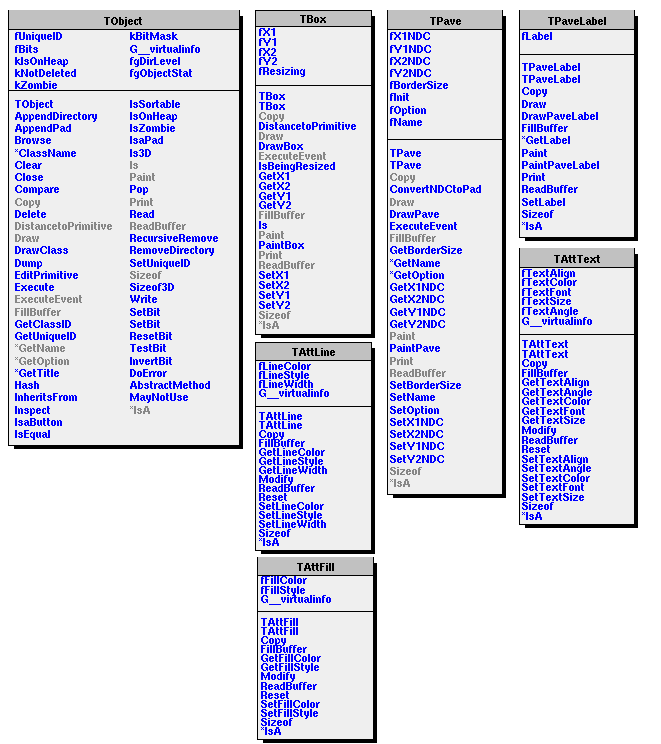
Draw class inheritance tree of the class to which this object belongs.
If a class B inherits from a class A, description of B is drawn on the right side of description of A. Member functions overridden by B are shown in class A with a blue line crossing-out the corresponding member function. The following picture is the class inheritance tree of class TPaveLabel:
Reimplemented in TGFrame, TSystemDirectory, and TSystemFile.
Definition at line 308 of file TObject.cxx.
Draw a clone of this object in the current selected pad with: gROOT->SetSelectedPad(c1).
If pad was not selected - gPad will be used.
Reimplemented in TAxis, TCanvas, TGFrame, TSystemDirectory, and TSystemFile.
Definition at line 319 of file TObject.cxx.
|
virtualinherited |
Dump contents of object on stdout.
Using the information in the object dictionary (class TClass) each data member is interpreted. If a data member is a pointer, the pointer value is printed
The following output is the Dump of a TArrow object:
Reimplemented in TClass, TCollection, TGFrame, TGPack, and TSystemFile.
Definition at line 367 of file TObject.cxx.
|
virtualinherited |
Issue error message.
Use "location" to specify the method where the error occurred. Accepts standard printf formatting arguments.
Reimplemented in TFitResult.
Definition at line 1098 of file TObject.cxx.
|
virtual |
Reimplemented in TMVA::MinuitWrapper.
|
virtualinherited |
Execute method on this object with the given parameter string, e.g.
"3.14,1,\"text\"".
Reimplemented in ROOT::R::TRInterface, TCling, TContextMenu, TInterpreter, and TMethodCall.
Definition at line 378 of file TObject.cxx.
|
virtualinherited |
Execute method on this object with parameters stored in the TObjArray.
The TObjArray should contain an argv vector like:
Reimplemented in ROOT::R::TRInterface, TCling, TContextMenu, TInterpreter, and TMethodCall.
Definition at line 398 of file TObject.cxx.
Execute action corresponding to an event at (px,py).
This method must be overridden if an object can react to graphics events.
Reimplemented in TASImage, TASPaletteEditor::LimitLine, TAxis3D, TAxis, TBox, TButton, TCanvas, TCrown, TCurlyArc, TCurlyLine, TDiamond, TEfficiency, TEllipse, TF1, TF2, TF3, TFrame, TGenerator, TGeoManager, TGeoNode, TGeoOverlap, TGeoShape, TGeoTrack, TGeoVolume, TGL5DDataSet, TGLEventHandler, TGLHistPainter, TGLParametricEquation, TGLScenePad, TGLTH3Composition, TGLViewer, TGraph2D, TGraph, TGraphEdge, TGraphNode, TGraphPolargram, TGroupButton, TH1, THistPainter, TLine, TLink, TMarker3DBox, TMarker, TNode, TPad, TPaletteAxis, TParallelCoord, TParallelCoordRange, TParallelCoordVar, TParticle, TPave, TPie, TPolyLine3D, TPolyLine, TPolyMarker3D, TPolyMarker, TPrimary, TScatter2D, TScatter, TSliderBox, TSpider, TSpline, TText, TTreePerfStats, TView3D, TView, TVirtualHistPainter, and TWbox.
Definition at line 415 of file TObject.cxx.
|
virtualinherited |
Issue fatal error message.
Use "location" to specify the method where the fatal error occurred. Accepts standard printf formatting arguments.
Definition at line 1126 of file TObject.cxx.
|
virtualinherited |
Encode TNamed into output buffer.
Reimplemented in TDirectoryFile, TFile, TKey, TKeySQL, TKeyXML, TSQLFile, and TXMLFile.
Definition at line 103 of file TNamed.cxx.
|
virtualinherited |
Must be redefined in derived classes.
This function is typically used with TCollections, but can also be used to find an object by name inside this object.
Reimplemented in RooAbsCollection, RooLinkedList, TBtree, TCollection, TDirectory, TFolder, TGeometry, TGraph2D, TGraph, TH1, THashList, THashTable, THbookFile, TList, TListOfDataMembers, TListOfEnums, TListOfEnumsWithLock, TListOfFunctions, TListOfFunctionTemplates, TListOfTypes, TMap, TObjArray, TPad, TROOT, TViewPubDataMembers, and TViewPubFunctions.
Definition at line 425 of file TObject.cxx.
Must be redefined in derived classes.
This function is typically used with TCollections, but can also be used to find an object inside this object.
Reimplemented in RooAbsCollection, RooLinkedList, TBtree, TCollection, TDirectory, TFolder, TGeometry, TGraph2D, TGraph, TH1, THashList, THashTable, THbookFile, TList, TListOfDataMembers, TListOfEnums, TListOfEnumsWithLock, TListOfFunctions, TListOfFunctionTemplates, TListOfTypes, TMap, TObjArray, TPad, TROOT, TViewPubDataMembers, and TViewPubFunctions.
Definition at line 435 of file TObject.cxx.
fix a parameter
Definition at line 826 of file TMinuit.cxx.
|
virtualinherited |
Get option used by the graphics system to draw this object.
Note that before calling object.GetDrawOption(), you must have called object.Draw(..) before in the current pad.
Reimplemented in TBrowser, TFitEditor, TGedFrame, TGFileBrowser, TRootBrowser, and TRootBrowserLite.
Definition at line 445 of file TObject.cxx.
|
staticinherited |
Return destructor only flag.
Definition at line 1196 of file TObject.cxx.
|
virtualinherited |
Returns mime type name of object.
Used by the TBrowser (via TGMimeTypes class). Override for class of which you would like to have different icons for objects of the same class.
Reimplemented in ROOT::Experimental::XRooFit::xRooNode, TASImage, TBranch, TBranchElement, TGeoVolume, TGMainFrame, TKey, TMethodBrowsable, TSystemFile, and TVirtualBranchBrowsable.
Definition at line 472 of file TObject.cxx.
|
inline |
|
inlineoverridevirtualinherited |
|
virtual |
returns the number of currently fixed parameters
Definition at line 854 of file TMinuit.cxx.
|
virtual |
returns the number of currently free parameters
Definition at line 862 of file TMinuit.cxx.
|
virtual |
returns the total number of parameters that have been defined as fixed or free. The constant parameters are not counted.
Definition at line 871 of file TMinuit.cxx.
Returns string containing info about the object at position (px,py).
This method is typically overridden by classes of which the objects can report peculiarities for different positions. Returned string will be re-used (lock in MT environment).
Reimplemented in TASImage, TAxis3D, TColorWheel, TF1, TF2, TFileDrawMap, TGeoNode, TGeoTrack, TGeoVolume, TGL5DDataSet, TGLHistPainter, TGLParametricEquation, TGLTH3Composition, TGraph, TH1, THistPainter, TNode, TPaletteAxis, TParallelCoordVar, and TVirtualHistPainter.
Definition at line 491 of file TObject.cxx.
|
staticinherited |
Get status of object stat flag.
Definition at line 1181 of file TObject.cxx.
|
inlinevirtualinherited |
Reimplemented in TArrow, TAxis3D, TFile, TGaxis, TGeoVolume, TH1, THelix, TLegendEntry, TMapFile, TNode, TPave, TPoints3DABC, TPolyLine3D, TPolyLine, TPolyMarker3D, TPolyMarker, TPSocket, TSelector, TSocket, and TUDPSocket.
|
virtual |
return parameter value and error
Definition at line 840 of file TMinuit.cxx.
|
inlinevirtual |
|
inlineoverridevirtualinherited |
|
virtualinherited |
Return the unique object id.
Definition at line 480 of file TObject.cxx.
Execute action in response of a timer timing out.
This method must be overridden if an object has to react to timers.
Reimplemented in TGCommandPlugin, TGDNDManager, TGFileContainer, TGHtml, TGLEventHandler, TGPopupMenu, TGraphTime, TGScrollBar, TGShutter, TGTextEdit, TGTextEditor, TGTextEntry, TGTextView, TGToolTip, TGuiBldDragManager, TGWindow, and TTreeViewer.
Definition at line 516 of file TObject.cxx.
|
inlineoverridevirtualinherited |
Return hash value for this object.
Note: If this routine is overloaded in a derived class, this derived class should also add
Otherwise, when RecursiveRemove is called (by ~TObject or example) for this type of object, the transversal of THashList and THashTable containers will will have to be done without call Hash (and hence be linear rather than logarithmic complexity). You will also see warnings like
Reimplemented from TObject.
|
inlineinherited |
Return true is the type of this object is known to have an inconsistent setup for Hash and RecursiveRemove (i.e.
missing call to RecursiveRemove in destructor).
Note: Since the consistency is only tested for during inserts, this routine will return true for object that have never been inserted whether or not they have a consistent setup. This has no negative side-effect as searching for the object with the right or wrong Hash will always yield a not-found answer (Since anyway no hash can be guaranteed unique, there is always a check)
|
virtualinherited |
Issue info message.
Use "location" to specify the method where the warning occurred. Accepts standard printf formatting arguments.
Definition at line 1072 of file TObject.cxx.
|
virtualinherited |
Returns kTRUE if object inherits from class "classname".
Reimplemented in TClass.
Definition at line 549 of file TObject.cxx.
Returns kTRUE if object inherits from TClass cl.
Reimplemented in TClass.
Definition at line 557 of file TObject.cxx.
|
virtualinherited |
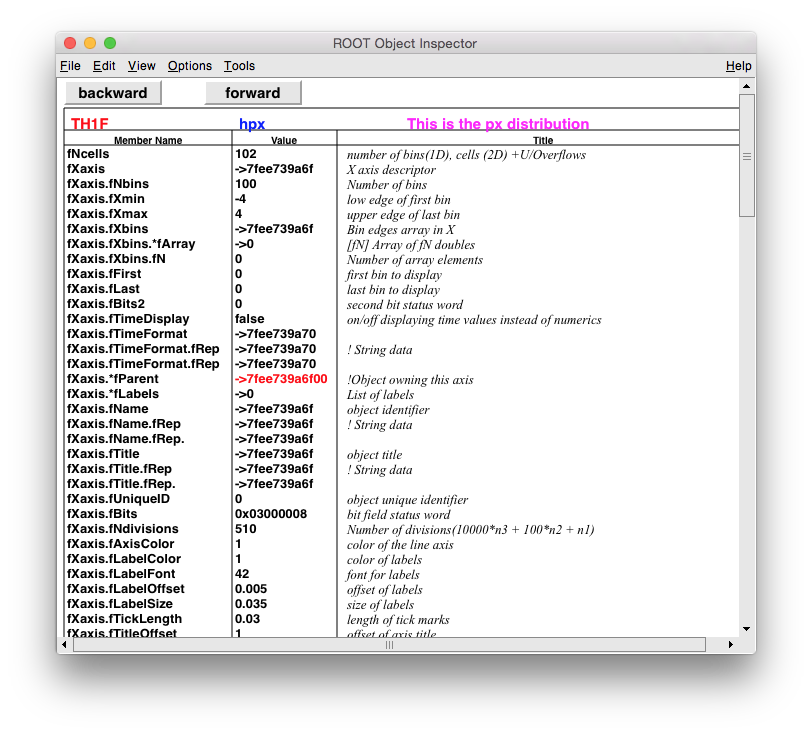
Dump contents of this object in a graphics canvas.
Same action as Dump but in a graphical form. In addition pointers to other objects can be followed.
The following picture is the Inspect of a histogram object:
Reimplemented in ROOT::Experimental::XRooFit::xRooNode, TGFrame, TInspectorObject, and TSystemFile.
Definition at line 570 of file TObject.cxx.
|
inlineoverridevirtual |
|
inlineinherited |
IsDestructed.
Default equal comparison (objects are equal if they have the same address in memory).
More complicated classes might want to override this function.
Reimplemented in TGObject, TObjString, TPair, and TQCommand.
Definition at line 589 of file TObject.cxx.
|
virtualinherited |
Returns kTRUE in case object contains browsable objects (like containers or lists of other objects).
Reimplemented in ROOT::Experimental::XRooFit::xRooNode, ROOT::Internal::THnBaseBrowsable, TApplicationRemote, TAxis3D, TBaseClass, TBranch, TBranchClones, TBranchElement, TBranchObject, TBranchSTL, TBrowserObject, TCanvas, TClass, TCollection, TDatabasePDG, TDirectory, TFolder, TGeoManager, TGeometry, TGeoNode, TGeoNodeMatrix, TGeoOverlap, TGeoTrack, TGeoVolume, THbookFile, THbookKey, THnBase, TKey, TMapFile, TMultiDimFit, TNode, TPad, TPair, TParticleClassPDG, TPrincipal, TRemoteObject, TROOT, TRootIconList, TSPlot, TSystemDirectory, TTask, TTree, and TVirtualBranchBrowsable.
Definition at line 579 of file TObject.cxx.
|
inlineoverridevirtualinherited |
Reimplemented from TObject.
Reimplemented in TStructNodeProperty.
|
overridevirtualinherited |
List TNamed name and title.
Reimplemented from TObject.
Reimplemented in ROOT::Experimental::XRooFit::xRooBrowser, TNode, TROOT, TStreamerBase, TStreamerElement, TStreamerInfo, TStreamerSTL, TTask, TText, and TVirtualStreamerInfo.
Definition at line 112 of file TNamed.cxx.
|
inherited |
Use this method to signal that a method (defined in a base class) may not be called in a derived class (in principle against good design since a child class should not provide less functionality than its parent, however, sometimes it is necessary).
Definition at line 1160 of file TObject.cxx.
|
virtual |
invokes the MIGRAD minimizer
Definition at line 879 of file TMinuit.cxx.
|
virtual |
Initialize AMIN.
Called from many places. Initializes the value of AMIN by calling the user function. Prints out the function value and parameter values if Print Flag value is high enough.
Definition at line 971 of file TMinuit.cxx.
|
virtual |
Compute reasonable histogram intervals.
Function TO DETERMINE REASONABLE HISTOGRAM INTERVALS GIVEN ABSOLUTE UPPER AND LOWER BOUNDS A1 AND A2 AND DESIRED MAXIMUM NUMBER OF BINS NAA PROGRAM MAKES REASONABLE BINNING FROM BL TO BH OF WIDTH BWID F. JAMES, AUGUST, 1974 , stolen for Minuit, 1988
Definition at line 996 of file TMinuit.cxx.
Transform FCN to find further minima.
Called only from MNIMPR. Transforms the function FCN by dividing out the quadratic part in order to find further minima. Calculates ycalf = (f-fmin)/(x-xmin)*v*(x-xmin)
Definition at line 1069 of file TMinuit.cxx.
|
virtual |
Resets the parameter list to UNDEFINED.
Called from MINUIT and by option from MNEXCM
Definition at line 1102 of file TMinuit.cxx.
Print function contours in two variables, on line printer.
input arguments: parx, pary, devs, ngrid
Definition at line 1131 of file TMinuit.cxx.
|
virtual |
Reads a command string and executes.
Called by user. 'Reads' a command string and executes.
Equivalent to MNEXCM except that the command is given as a character string.
ICONDN =
Definition at line 1309 of file TMinuit.cxx.
|
virtual |
Find points along a contour where FCN is minimum.
Find NPTU points along a contour where the function
        FMIN (X(KE1),X(KE2)) =  AMIN+UP

  where FMIN is the minimum of FCN with respect to all
  the other NPAR-2 variable parameters (if any).
IERRF on return will be equal to the number of points found:
input arguments: parx, pary, devs, ngrid
Definition at line 1394 of file TMinuit.cxx.
|
virtual |
Cracks the free-format input.
Cracks the free-format input, expecting zero or more alphanumeric fields (which it joins into COMAND(1:LNC)) followed by one or more numeric fields separated by blanks and/or one comma. The numeric fields are put into the LLIST (but at most MXP) elements of PLIST.
IERR :
Definition at line 1676 of file TMinuit.cxx.
Find point where MNEVAL=AMIN+UP.
Find point where MNEVAL=AMIN+UP, along the line through XMIDCR,YMIDCR with direction XDIRCR,YDIRCR, where X and Y are parameters KE1CR and KE2CR. If KE2CR=0 (from MINOS), only KE1CR is varied. From MNCONT, both are varied. Crossing point is at
(U(KE1),U(KE2)) = (XMID,YMID) + AOPT*(XDIR,YDIR)
Definition at line 1797 of file TMinuit.cxx.
|
virtual |
Makes sure that the current point is a local minimum.
Makes sure that the current point is a local minimum and that the error matrix exists, or at least something good enough for MINOS and MNCONT
Definition at line 2129 of file TMinuit.cxx.
|
virtual |
Calculates the first derivatives of FCN (GRD).
Calculates the first derivatives of FCN (GRD), either by finite differences or by transforming the user- supplied derivatives to internal coordinates, according to whether fISW[2] is zero or one.
Definition at line 2177 of file TMinuit.cxx.
Calculates the transformation factor between ext/internal values.
calculates the transformation factor between external and internal parameter values. this factor is one for parameters which are not limited. called from MNEMAT.
Definition at line 2292 of file TMinuit.cxx.
|
virtual |
Compute matrix eigen values.
Definition at line 2304 of file TMinuit.cxx.
Calculates the external error matrix from the internal matrix.
Note that if the matrix is declared like Double_t matrix[5][5] in the calling program, one has to call mnemat with, eg
gMinuit->mnemat(&matrix[0][0],5);
Definition at line 2500 of file TMinuit.cxx.
|
virtual |
Utility routine to get MINOS errors.
Called by user.
NUMBER is the parameter number
values returned by MNERRS:
Definition at line 2577 of file TMinuit.cxx.
Evaluates the function being analysed by MNCROS.
Evaluates the function being analysed by MNCROS, which is generally the minimum of FCN with respect to all remaining variable parameters. The class data members contains the data necessary to know the values of U(KE1CR) and U(KE2CR) to be used, namely U(KE1CR) = XMIDCR + ANEXT*XDIRCR and (if KE2CR .NE. 0) U(KE2CR) = YMIDCR + ANEXT*YDIRCR
Definition at line 2619 of file TMinuit.cxx.
|
virtual |
Interprets a command and takes appropriate action.
either directly by skipping to the corresponding code in
MNEXCM, or by setting up a call to a function
recognized MINUIT commands: obsolete commands: IERFLG is now (94.5) defined the same as ICONDN in MNCOMD =
see also the possible list of all Minuit commands.
Definition at line 2663 of file TMinuit.cxx.
|
virtual |
Transforms the external parameter values U to internal values.
Transforms the external parameter values U to internal values in the dense array PINT.
Definition at line 3150 of file TMinuit.cxx.
Removes parameter IINT from the internal parameter list.
and arranges the rest of the list to fill the hole.
Definition at line 3168 of file TMinuit.cxx.
|
virtual |
Restores one or more fixed parameter(s) to variable status.
Restores one or more fixed parameter(s) to variable status by inserting it into the internal parameter list at the appropriate place.
 -  K = 0 means restore all parameters
 -  K = 1 means restore the last parameter fixed
 -  K = -I means restore external parameter I (if possible)
 -  IQ = fix-location where internal parameters were stored
 -  IR = external number of parameter being restored
 -  IS = internal number of parameter being restored
Definition at line 3255 of file TMinuit.cxx.
|
virtual |
Interprets the SET GRAD command.
Definition at line 3361 of file TMinuit.cxx.
|
virtual |
interface to Minuit help
Definition at line 3421 of file TMinuit.cxx.
|
virtual |
HELP routine for MINUIT interactive commands.
COMD =Command_name: print detailed help for one command. Note that at least 3 characters must be given for the command name.
Author: Rene Brun comments extracted from the MINUIT documentation file.
Definition at line 3438 of file TMinuit.cxx.
|
virtual |
Calculate first derivatives (GRD) and uncertainties (DGRD).
and appropriate step sizes GSTEP Called from MNHESS and MNGRAD
Definition at line 4217 of file TMinuit.cxx.
|
virtual |
Calculates the full second-derivative matrix of FCN.
by taking finite differences. When calculating diagonal elements, it may iterate so that step size is nearly that which gives function change= UP/10. The first derivatives of course come as a free side effect, but with a smaller step size in order to obtain a known accuracy.
Definition at line 3992 of file TMinuit.cxx.
|
virtual |
Attempts to improve on a good local minimum.
Attempts to improve on a good local minimum by finding a better one. The quadratic part of FCN is removed by MNCALF and this transformed function is minimised using the simplex method from several random starting points.
ref. – Goldstein and Price, Math.Comp. 25, 569 (1971)
Definition at line 4294 of file TMinuit.cxx.
|
virtual |
Transforms from internal coordinates (PINT) to external (U).
The minimising routines which work in internal coordinates call this routine before calling FCN.
Definition at line 4505 of file TMinuit.cxx.
Main initialization member function for MINUIT.
It initializes some constants (including the logical I/O unit nos.),
Definition at line 4525 of file TMinuit.cxx.
|
virtual |
Interprets the SET LIM command, to reset the parameter limits.
Called from MNSET
Definition at line 4615 of file TMinuit.cxx.
|
virtual |
Perform a line search from position START.
along direction STEP, where the length of vector STEP gives the expected position of minimum.
SLAMBG and ALPHA control the maximum individual steps allowed. The first step is always =1. The max length of second step is SLAMBG. The max size of subsequent steps is the maximum previous successful step multiplied by ALPHA + the size of most recent successful step, but cannot be smaller than SLAMBG.
Definition at line 4735 of file TMinuit.cxx.
|
virtual |
Prints the covariance matrix v when KODE=1.
always prints the global correlations, and calculates and prints the individual correlation coefficients
Definition at line 4967 of file TMinuit.cxx.
|
virtual |
Performs a local function minimization.
Performs a local function minimization using basically the method of Davidon-Fletcher-Powell as modified by Fletcher
ref. – Fletcher, Comp.J. 13,317 (1970) "switching method"
Definition at line 5047 of file TMinuit.cxx.
|
virtual |
Performs a MINOS error analysis.
Performs a MINOS error analysis on those parameters for which it is requested on the MINOS command by calling MNMNOT for each parameter requested.
Definition at line 5387 of file TMinuit.cxx.
Performs a MINOS error analysis on one parameter.
The parameter ILAX is varied, and the minimum of the function with respect to the other parameters is followed until it crosses the value FMIN+UP.
Definition at line 5462 of file TMinuit.cxx.
|
virtual |
Implements one parameter definition.
Called from MNPARS and user-callable Implements one parameter definition, that is:
Definition at line 5664 of file TMinuit.cxx.
Implements one parameter definition.
Called from MNREAD and user-callable Implements one parameter definition, that is: parses the string CRDBUF and calls MNPARM
output conditions:
Definition at line 5866 of file TMinuit.cxx.
|
virtual |
To fit a parabola to npar2p points.
Definition at line 5955 of file TMinuit.cxx.
Calculates the internal parameter value PINTI.
corresponding to the external value PEXTI for parameter I.
Definition at line 6011 of file TMinuit.cxx.
|
virtual |
Plots points in array xypt onto one page with labelled axes.
CHPT(I) = character to be plotted at this position the input point arrays XPT, YPT, CHPT are destroyed.
If fGraphicsmode is true (default), a TGraph object is produced via the Plug-in handler. To get the plot, you can do:
Definition at line 6062 of file TMinuit.cxx.
|
virtual |
Provides the user with information concerning the current status.
of parameter number IUEXT. Namely, it returns:
Note also: If IUEXT is negative, then it is -internal parameter number, and IUINT is returned as the EXTERNAL number. Except for IUINT, this is exactly the inverse of MNPARM User-called
Definition at line 6241 of file TMinuit.cxx.
Prints the values of the parameters at the time of the call.
also prints other relevant information such as function value, estimated distance to minimum, parameter errors, step sizes.
According to the value of IKODE, the printout is: IKODE=INKODE=
when INKODE=5, MNPRIN chooses IKODE=1,2, or 3, according to fISW[1]
Definition at line 6298 of file TMinuit.cxx.
|
virtual |
Calculates the eigenvalues of v to see if positive-def.
if not, adds constant along diagonal to make positive.
Definition at line 6488 of file TMinuit.cxx.
|
virtual |
Called only by MNSIMP (and MNIMPR) to add a new point.
and remove an old one from the current simplex, and get the estimated distance to minimum.
Definition at line 6562 of file TMinuit.cxx.
This is a super-portable random number generator.
It should not overflow on any 32-bit machine. The cycle is only ~10**9, so use with care! Note especially that VAL must not be undefined on input.
Set Default Starting Seed
Definition at line 6613 of file TMinuit.cxx.
|
virtual |
Resets function value and errors to UNDEFINED.
Definition at line 6655 of file TMinuit.cxx.
|
virtual |
Writes current parameter values and step sizes onto file ISYSSA.
in format which can be reread by Minuit for restarting. The covariance matrix is also output if it exists.
Definition at line 6689 of file TMinuit.cxx.
|
virtual |
Scans the values of FCN as a function of one parameter.
and plots the resulting values as a curve using MNPLOT. It may be called to scan one parameter or all parameters. retains the best function and parameter values found.
Definition at line 6702 of file TMinuit.cxx.
|
virtual |
Performs a rough (but global) minimization by monte carlo search.
Each time a new minimum is found, the search area is shifted to be centered at the best value. Random points are chosen uniformly over a hypercube determined by current step sizes. The Metropolis algorithm accepts a worse point with probability exp(-d/UP), where d is the degradation. Improved points are of course always accepted. Actual steps are random multiples of the nominal steps (DIRIN).
Definition at line 6812 of file TMinuit.cxx.
|
virtual |
Interprets the commands that start with SET and SHOW.
Called from MNEXCM file characteristics for SET INPUT 'SET ' or 'SHOW', 'ON ' or 'OFF', 'SUPPRESSED' or 'REPORTED ' explanation of print level numbers -1:3 and strategies 0:2 identification of debug options things that can be set or shown options not intended for normal users
Definition at line 6907 of file TMinuit.cxx.
|
virtual |
Minimization using the simplex method of Nelder and Mead.
Performs a minimization using the simplex method of Nelder and Mead (ref. – Comp. J. 7,308 (1965)).
Definition at line 7425 of file TMinuit.cxx.
|
virtual |
Returns concerning the current status of the minimization.
User-called Namely, it returns:
Definition at line 7632 of file TMinuit.cxx.
To find the machine precision.
Compares its argument with the value 1.0, and returns the value .TRUE. if they are equal. To find EPSMAC safely by foiling the Fortran optimiser
Definition at line 7655 of file TMinuit.cxx.
Returns .TRUE.
if CFNAME contains unprintable characters
Definition at line 7664 of file TMinuit.cxx.
Inverts a symmetric matrix.
inverts a symmetric matrix. matrix is first scaled to have all ones on the diagonal (equivalent to change of units) but no pivoting is done since matrix is positive-definite.
Definition at line 7690 of file TMinuit.cxx.
|
virtual |
Prints Warning messages.
Definition at line 7778 of file TMinuit.cxx.
|
virtual |
Calculates the WERR, external parameter errors.
and the global correlation coefficients, to be called whenever a new covariance matrix is available.
Definition at line 7855 of file TMinuit.cxx.
|
virtualinherited |
This method must be overridden to handle object notification (the base implementation is no-op).
Different objects in ROOT use the Notify method for different purposes, in coordination with other objects that call this method at the appropriate time.
For example, TLeaf uses it to load class information; TBranchRef to load contents of referenced branches TBranchRef; most notably, based on Notify, TChain implements a callback mechanism to inform interested parties when it switches to a new sub-tree.
Reimplemented in h1analysis, h1analysisTreeReader, TARInterruptHandler, TASInputHandler, TASInterruptHandler, TASLogHandler, TASSigPipeHandler, TBlinkTimer, TBranchElement, TBranchRef, TBreakLineCom, TBrowserTimer, TCollection, TDelCharCom, TDelTextCom, TFileHandler, TGContainerKeyboardTimer, TGContainerScrollTimer, TGInputHandler, TGLRedrawTimer, TGTextEditHist, TGuiBldDragManagerRepeatTimer, TIdleTimer, TInsCharCom, TInsTextCom, TInterruptHandler, TLeafObject, TMessageHandler, TNotifyLink< Type >, TNotifyLink< RNoCleanupNotifierHelper >, TNotifyLink< ROOT::Detail::TBranchProxy >, TNotifyLink< TTreeReader >, TPopupDelayTimer, TProcessEventTimer, TRefTable, TRepeatTimer, TSBRepeatTimer, TSelector, TSelectorDraw, TSelectorEntries, TSignalHandler, TSingleShotCleaner, TSocketHandler, TStdExceptionHandler, TSysEvtHandler, TTermInputHandler, TThreadTimer, TTimeOutTimer, TTimer, TTipDelayTimer, TTree, TTreeFormula, TTreeFormulaManager, TTreeReader, TViewTimer, and TViewUpdateTimer.
Definition at line 618 of file TObject.cxx.
|
inherited |
Use this method to declare a method obsolete.
Specify as of which version the method is obsolete and as from which version it will be removed.
Definition at line 1169 of file TObject.cxx.
|
inherited |
Operator delete for sized deallocation.
Definition at line 1234 of file TObject.cxx.
|
inherited |
Operator delete.
Definition at line 1212 of file TObject.cxx.
|
inherited |
Only called by placement new when throwing an exception.
Definition at line 1266 of file TObject.cxx.
|
inherited |
Operator delete [] for sized deallocation.
Definition at line 1245 of file TObject.cxx.
|
inherited |
Operator delete [].
Definition at line 1223 of file TObject.cxx.
|
inherited |
Only called by placement new[] when throwing an exception.
Definition at line 1274 of file TObject.cxx.
|
inlineinherited |
|
inlineinherited |
|
inlineinherited |
|
virtualinherited |
This method must be overridden if a class wants to paint itself.
The difference between Paint() and Draw() is that when a object draws itself it is added to the display list of the pad in which it is drawn (and automatically redrawn whenever the pad is redrawn). While paint just draws the object without adding it to the pad display list.
Reimplemented in ROOT::Experimental::RTreeMapPainter, ROOT::RGeoPainter, TAnnotation, TArrow, TASImage, TASPaletteEditor::LimitLine, TASPaletteEditor::PaintPalette, TAxis3D, TBits, TBox, TButton, TCanvas, TClassTree, TCollection, TColorWheel, TCrown, TDiamond, TDirectory, TEfficiency, TEllipse, TEveArrow, TEveCaloViz, TEveDigitSet, TEveGeoShape, TEveGeoTopNode, TEvePlot3D, TEvePointSet, TEveProjectionAxes, TEveScene, TEveShape, TEveStraightLineSet, TEveText, TEveTriangleSet, TExec, TF1, TF2, TF3, TFile, TFileDrawMap, TFrame, TGaxis, TGenerator, TGeoBoolNode, TGeoIntersection, TGeoNode, TGeoOverlap, TGeoPainter, TGeoPhysicalNode, TGeoShape, TGeoSubtraction, TGeoTrack, TGeoUnion, TGeoVGShape, TGeoVolume, TGL5DDataSet, TGLHistPainter, TGLParametricEquation, TGLTH3Composition, TGraph2D, TGraph2DPainter, TGraph, TGraphEdge, TGraphNode, TGraphPolargram, TGraphTime, TH1, THistPainter, THStack, TLatex, TLegend, TLine, TMacro, TMarker3DBox, TMarker, TMathText, TMultiGraph, TNode, TNodeDiv, TPad, TPaletteAxis, TParallelCoord, TParallelCoordRange, TParallelCoordVar, TParticle, TPave, TPaveLabel, TPaveStats, TPavesText, TPaveText, TPie, TPolyLine3D, TPolyLine, TPolyMarker3D, TPolyMarker, TPrimary, TRatioPlot, TScatter2D, TScatter, TShape, TSpectrum2Painter, TSpider, TSpline, TSQLFile, TStyle, TText, TTreePerfStats, TVirtualGeoPainter, TVirtualGeoTrack, TVirtualHistPainter, TVirtualPad, TWbox, and TXMLFile.
Definition at line 631 of file TObject.cxx.
|
virtualinherited |
Pop on object drawn in a pad to the top of the display list.
I.e. it will be drawn last and on top of all other primitives.
Reimplemented in TFrame, TPad, and TVirtualPad.
Definition at line 640 of file TObject.cxx.
|
overridevirtualinherited |
Print TNamed name and title.
Reimplemented from TObject.
Reimplemented in ROOT::Experimental::XRooFit::xRooNLLVar::xRooHypoPoint, ROOT::Experimental::XRooFit::xRooNLLVar::xRooHypoSpace, ROOT::Experimental::XRooFit::xRooNode, TParallelCoordRange, TParallelCoordVar, TParticleClassPDG, TParticlePDG, TPrincipal, TScatter2D, TScatter, TSpectrum2, TSpectrum3, TSpectrum, TSQLColumnInfo, TSQLFile, TSQLTableInfo, TText, TTree, TTreeIndex, TXMLFile, and TXTRU.
Definition at line 127 of file TNamed.cxx.
|
virtualinherited |
Read contents of object with specified name from the current directory.
First the key with the given name is searched in the current directory, next the key buffer is deserialized into the object. The object must have been created before via the default constructor. See TObject::Write().
Reimplemented in TBuffer, TKey, TKeySQL, and TKeyXML.
Definition at line 673 of file TObject.cxx.
|
virtualinherited |
Recursively remove this object from a list.
Typically implemented by classes that can contain multiple references to a same object.
Reimplemented in RooAbsCollection, RooAbsData, RooLinkedList, RooMCStudy, ROOT::Internal::TCheckHashRecursiveRemoveConsistency, ROOT::RBrowserDataCleanup, RooWorkspace, TBrowser, TChain, TCling, TCollection, TDialogCanvas, TDirectory, TEfficiency, TFileMerger, TFitEditor, TFolder, TFriendElement, TGedEditor, TGeometry, TGFileBrowser, TGraph2D, TGraph, TH1, TH1Editor, TH2Editor, THashList, THistPainter, THStack, TInspectCanvas, TLegend, TList, TListOfDataMembers, TListOfEnums, TListOfEnumsWithLock, TListOfFunctions, TListOfFunctionTemplates, TMultiGraph, TNode, TObjArray, TObjectRefSpy, TObjectSpy, TPad, TProcessID, TROOT, TRootBrowser, TRootBrowserHistory, TRootBrowserLite, TRootContextMenu, TTree, TTreePlayer, TViewPubDataMembers, TViewPubFunctions, and TVirtualPad.
Definition at line 684 of file TObject.cxx.
release a parameter
Definition at line 893 of file TMinuit.cxx.
|
virtualinherited |
Save this object in the file specified by filename.
otherwise the object is written to filename as a CINT/C++ script. The C++ code to rebuild this object is generated via SavePrimitive(). The "option" parameter is passed to SavePrimitive. By default it is an empty string. It can be used to specify the Draw option in the code generated by SavePrimitive.
The function is available via the object context menu.
Reimplemented in ROOT::Experimental::XRooFit::xRooNode, TClassTree, TFolder, TGeoVolume, TGObject, TGraph, TH1, TPad, TPaveClass, TSpline3, TSpline5, TSpline, TTreePerfStats, and TVirtualPad.
Definition at line 708 of file TObject.cxx.
|
virtualinherited |
Save a primitive as a C++ statement(s) on output stream "out".
Reimplemented in TAnnotation, TArc, TArrow, TASImage, TAxis3D, TBox, TButton, TCanvas, TChain, TCrown, TCurlyArc, TCurlyLine, TCutG, TDiamond, TEfficiency, TEllipse, TExec, TF12, TF1, TF2, TF3, TFrame, TGaxis, TGButton, TGButtonGroup, TGCanvas, TGCheckButton, TGColorSelect, TGColumnLayout, TGComboBox, TGCompositeFrame, TGContainer, TGDockableFrame, TGDoubleHSlider, TGDoubleVSlider, TGedMarkerSelect, TGedPatternSelect, TGeoArb8, TGeoBBox, TGeoBoolNode, TGeoCombiTrans, TGeoCompositeShape, TGeoCone, TGeoConeSeg, TGeoCtub, TGeoDecayChannel, TGeoElementRN, TGeoEltu, TGeoGtra, TGeoHalfSpace, TGeoHMatrix, TGeoHype, TGeoIdentity, TGeoIntersection, TGeoMaterial, TGeoMedium, TGeoMixture, TGeoPara, TGeoParaboloid, TGeoPatternCylPhi, TGeoPatternCylR, TGeoPatternParaX, TGeoPatternParaY, TGeoPatternParaZ, TGeoPatternSphPhi, TGeoPatternSphR, TGeoPatternSphTheta, TGeoPatternTrapZ, TGeoPatternX, TGeoPatternY, TGeoPatternZ, TGeoPcon, TGeoPgon, TGeoRotation, TGeoScaledShape, TGeoShapeAssembly, TGeoSphere, TGeoSubtraction, TGeoTessellated, TGeoTorus, TGeoTranslation, TGeoTrap, TGeoTrd1, TGeoTrd2, TGeoTube, TGeoTubeSeg, TGeoUnion, TGeoVolume, TGeoXtru, TGFileContainer, TGFont, TGFrame, TGFSComboBox, TGGC, TGGroupFrame, TGHButtonGroup, TGHorizontal3DLine, TGHorizontalFrame, TGHorizontalLayout, TGHProgressBar, TGHScrollBar, TGHSlider, TGHSplitter, TGHtml, TGIcon, TGLabel, TGLayoutHints, TGLineStyleComboBox, TGLineWidthComboBox, TGListBox, TGListDetailsLayout, TGListLayout, TGListTree, TGListView, TGLVContainer, TGMainFrame, TGMatrixLayout, TGMdiFrame, TGMdiMainFrame, TGMdiMenuBar, TGMenuBar, TGMenuTitle, TGNumberEntry, TGNumberEntryField, TGPictureButton, TGPopupMenu, TGProgressBar, TGRadioButton, TGraph2D, TGraph2DAsymmErrors, TGraph2DErrors, TGraph, TGraphAsymmErrors, TGraphBentErrors, TGraphEdge, TGraphErrors, TGraphMultiErrors, TGraphNode, TGraphPolar, TGraphPolargram, TGraphStruct, TGroupButton, TGRowLayout, TGShapedFrame, TGShutter, TGShutterItem, TGSplitFrame, TGStatusBar, TGTab, TGTabLayout, TGTableLayout, TGTableLayoutHints, TGTextButton, TGTextEdit, TGTextEntry, TGTextLBEntry, TGTextView, TGTileLayout, TGToolBar, TGTransientFrame, TGTripleHSlider, TGTripleVSlider, TGVButtonGroup, TGVertical3DLine, TGVerticalFrame, TGVerticalLayout, TGVFileSplitter, TGVProgressBar, TGVScrollBar, TGVSlider, TGVSplitter, TGXYLayout, TGXYLayoutHints, TH1, TH2Poly, THelix, THStack, TLatex, TLegend, TLine, TMacro, TMarker3DBox, TMarker, TMathText, TMultiGraph, TPad, TPaletteAxis, TParallelCoord, TParallelCoordVar, TPave, TPaveClass, TPaveLabel, TPaveStats, TPavesText, TPaveText, TPie, TPieSlice, TPolyLine3D, TPolyLine, TPolyMarker3D, TPolyMarker, TProfile2D, TProfile3D, TProfile, TRootContainer, TRootEmbeddedCanvas, TScatter2D, TScatter, TSlider, TSliderBox, TSpline3, TSpline5, TStyle, TText, TTreePerfStats, and TWbox.
Definition at line 858 of file TObject.cxx.
|
staticprotectedinherited |
Save object constructor in the output stream "out".
Can be used as first statement when implementing SavePrimitive() method for the object
Definition at line 777 of file TObject.cxx.
|
staticprotectedinherited |
Save invocation of primitive Draw() method Skipped if option contains "nodraw" string.
Definition at line 845 of file TObject.cxx.
|
protectedinherited |
Save object name and title into the output stream "out".
Definition at line 135 of file TNamed.cxx.
|
staticprotectedinherited |
Save array in the output stream "out" as vector.
Create unique variable name based on prefix value Returns name of vector which can be used in constructor or in other places of C++ code If flag === kTRUE, just add empty line If flag === 111, check if array is empty and return nullptr or <vectorname>.data()
Definition at line 796 of file TObject.cxx.
Set or unset the user status bits as specified in f.
Definition at line 888 of file TObject.cxx.
|
virtualinherited |
Set drawing option for object.
This option only affects the drawing style and is stored in the option field of the TObjOptLink supporting a TPad's primitive list (TList). Note that it does not make sense to call object.SetDrawOption(option) before having called object.Draw().
Reimplemented in RooPlot, TAxis, TBrowser, TGedFrame, TGFrame, TPad, TPaveStats, TRootBrowserLite, TSystemDirectory, and TSystemFile.
Definition at line 871 of file TObject.cxx.
|
staticinherited |
Set destructor only flag.
Definition at line 1204 of file TObject.cxx.
To get the n-sigma contour the error def parameter "up" has to set to n^2.
Definition at line 907 of file TMinuit.cxx.
To set the address of the minimization function.
Definition at line 919 of file TMinuit.cxx.
|
inlinevirtual |
|
virtualinherited |
Set the name of the TNamed.
WARNING: if the object is a member of a THashTable or THashList container the container must be Rehash()'ed after SetName(). For example the list of objects in the current directory is a THashList.
Reimplemented in RooAbsArg, RooAbsData, RooDataHist, RooDataSet, RooFitResult, RooPlot, ROOT::Experimental::XRooFit::xRooNode, TChain, TColor, TDirectory, TEfficiency, TEventList, TEveScene, TFormula, TGraph2D, TGraph, TH1, TNode, TRotMatrix, TShape, TSystemDirectory, TSystemFile, and TTree.
Definition at line 149 of file TNamed.cxx.
|
virtualinherited |
Set all the TNamed parameters (name and title).
WARNING: if the name is changed and the object is a member of a THashTable or THashList container the container must be Rehash()'ed after SetName(). For example the list of objects in the current directory is a THashList.
Reimplemented in RooAbsArg, RooAbsData, RooDataHist, RooDataSet, RooFitResult, RooPlot, TContextMenu, TGraph2D, TGraph, TH1, and TNode.
Definition at line 163 of file TNamed.cxx.
|
inlinevirtual |
|
staticinherited |
Turn on/off tracking of objects in the TObjectTable.
Definition at line 1188 of file TObject.cxx.
set Minuit print level.
printlevel:
Definition at line 951 of file TMinuit.cxx.
|
virtualinherited |
Set the title of the TNamed.
Reimplemented in Axis2, RooPlot, ROOT::Experimental::XRooFit::xRooNode, ROOT::TSchemaRule::TSources, TASImage, TEfficiency, TF1, TGraph2D, TGraph, TH1, THnBase, TParallelCoordVar, TSystemDirectory, and TSystemFile.
Definition at line 173 of file TNamed.cxx.
|
virtualinherited |
Set the unique object id.
Definition at line 899 of file TObject.cxx.
|
virtualinherited |
Return size of the TNamed part of the TObject.
Reimplemented in TDirectory, TDirectoryFile, TFile, TKey, TSQLFile, and TXMLFile.
Definition at line 182 of file TNamed.cxx.
|
overridevirtual |
Stream an object of class TObject.
Reimplemented from TObject.
|
inline |
|
virtualinherited |
Issue system error message.
Use "location" to specify the method where the system error occurred. Accepts standard printf formatting arguments.
Definition at line 1112 of file TObject.cxx.
|
virtualinherited |
|
virtualinherited |
Issue warning message.
Use "location" to specify the method where the warning occurred. Accepts standard printf formatting arguments.
Definition at line 1084 of file TObject.cxx.
|
virtualinherited |
Write this object to the current directory.
For more see the const version of this method.
Reimplemented in ROOT::TBufferMergerFile, TBuffer, TCollection, TDirectory, TDirectoryFile, TFile, TMap, TParallelMergingFile, TSQLFile, TTree, and TXMLFile.
Definition at line 989 of file TObject.cxx.
|
virtualinherited |
Write this object to the current directory.
The data structure corresponding to this object is serialized. The corresponding buffer is written to the current directory with an associated key with name "name".
Writing an object to a file involves the following steps:
Bufsize can be given to force a given buffer size to write this object. By default, the buffersize will be taken from the average buffer size of all objects written to the current file so far.
If a name is specified, it will be the name of the key. If name is not given, the name of the key will be the name as returned by GetName().
The option can be a combination of: kSingleKey, kOverwrite or kWriteDelete Using the kOverwrite option a previous key with the same name is overwritten. The previous key is deleted before writing the new object. Using the kWriteDelete option a previous key with the same name is deleted only after the new object has been written. This option is safer than kOverwrite but it is slower. NOTE: Neither kOverwrite nor kWriteDelete reduces the size of a TFile– the space is simply freed up to be overwritten; in the case of a TTree, it is more complicated. If one opens a TTree, appends some entries, then writes it out, the behaviour is effectively the same. If, however, one creates a new TTree and writes it out in this way, only the metadata is replaced, effectively making the old data invisible without deleting it. TTree::Delete() can be used to mark all disk space occupied by a TTree as free before overwriting its metadata this way. The kSingleKey option is only used by TCollection::Write() to write a container with a single key instead of each object in the container with its own key.
An object is read from the file into memory via TKey::Read() or via TObject::Read().
The function returns the total number of bytes written to the file. It returns 0 if the object cannot be written.
Reimplemented in TBuffer, TCollection, TDirectory, TDirectoryFile, TFile, TMap, TParallelMergingFile, TSQLFile, TTree, and TXMLFile.
Definition at line 964 of file TObject.cxx.
|
privateinherited |
| char* TMinuit::fChpt |
|
staticprivateinherited |
| TMethodCall* TMinuit::fMethodCall |
|
privateinherited |