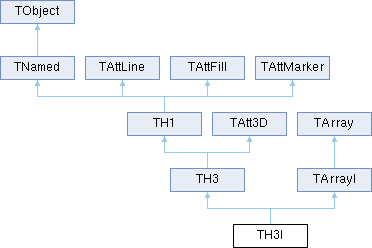
Public Types | |
| enum | { kNoAxis = 0 , kXaxis = (1ULL << (0)) , kYaxis = (1ULL << (1)) , kZaxis = (1ULL << (2)) , kAllAxes = kXaxis | kYaxis | kZaxis } |
| Enumeration specifying which axes can be extended. More... | |
| enum | { kSingleKey = (1ULL << (0)) , kOverwrite = (1ULL << (1)) , kWriteDelete = (1ULL << (2)) } |
| enum | { kNstat = 13 } |
| Size of statistics data (size of array used in GetStats()/ PutStats ). More... | |
| enum | { kIsOnHeap = 0x01000000 , kNotDeleted = 0x02000000 , kZombie = 0x04000000 , kInconsistent = 0x08000000 , kBitMask = 0x00ffffff } |
| enum | EBinErrorOpt { kNormal = 0 , kPoisson = 1 , kPoisson2 = 2 } |
| Enumeration specifying type of statistics for bin errors. More... | |
| enum | EDeprecatedStatusBits { kObjInCanvas = (1ULL << (3)) } |
| enum | EInconsistencyBits { kFullyConsistent = 0 , kDifferentLabels = (1ULL << (0)) , kDifferentBinLimits = (1ULL << (1)) , kDifferentAxisLimits = (1ULL << (2)) , kDifferentNumberOfBins = (1ULL << (3)) , kDifferentDimensions = (1ULL << (4)) } |
| Enumeration specifying inconsistencies between two histograms, in increasing severity. More... | |
| enum | EStatOverflows { kIgnore = 0 , kConsider = 1 , kNeutral = 2 } |
| Enumeration specifying the way to treat statoverflow. More... | |
| enum | EStatusBits { kNoStats = (1ULL << (9)) , kUserContour = (1ULL << (10)) , kLogX = (1ULL << (15)) , kIsZoomed = (1ULL << (16)) , kNoTitle = (1ULL << (17)) , kIsAverage = (1ULL << (18)) , kIsNotW = (1ULL << (19)) , kAutoBinPTwo = (1ULL << (20)) , kIsHighlight = (1ULL << (21)) } |
| TH1 status bits. More... | |
Public Member Functions | |
| TH3I () | |
| Constructor. | |
| TH3I (const char *name, const char *title, Int_t nbinsx, const Double_t *xbins, Int_t nbinsy, const Double_t *ybins, Int_t nbinsz, const Double_t *zbins) | |
| Constructor for variable bin size 3-D histograms (see TH3::TH3 for explanation of parameters). | |
| TH3I (const char *name, const char *title, Int_t nbinsx, const Float_t *xbins, Int_t nbinsy, const Float_t *ybins, Int_t nbinsz, const Float_t *zbins) | |
| Constructor for variable bin size 3-D histograms (see TH3::TH3 for explanation of parameters). | |
| TH3I (const char *name, const char *title, Int_t nbinsx, Double_t xlow, Double_t xup, Int_t nbinsy, Double_t ylow, Double_t yup, Int_t nbinsz, Double_t zlow, Double_t zup) | |
| Constructor for fix bin size 3-D histograms (see TH3::TH3 for explanation of parameters). | |
| TH3I (const TH3I &h3i) | |
| Copy constructor. | |
| ~TH3I () override | |
| Destructor. | |
| void | AbstractMethod (const char *method) const |
| Call this function within a function that you don't want to define as purely virtual, in order not to force all users deriving from that class to implement that maybe (on their side) unused function; but at the same time, emit a run-time warning if they try to call it, telling that it is not implemented in the derived class: action must thus be taken on the user side to override it. | |
| virtual Bool_t | Add (const TH1 *h, const TH1 *h2, Double_t c1=1, Double_t c2=1) |
| Replace contents of this histogram by the addition of h1 and h2. | |
| virtual Bool_t | Add (const TH1 *h1, Double_t c1=1) |
| Performs the operation: this = this + c1*h1 If errors are defined (see TH1::Sumw2), errors are also recalculated. | |
| virtual Bool_t | Add (TF1 *h1, Double_t c1=1, Option_t *option="") |
| Performs the operation: this = this + c1*f1 if errors are defined (see TH1::Sumw2), errors are also recalculated. | |
| void | AddAt (Int_t c, Int_t i) |
| Add Int_t c at position i. Check for out of bounds. | |
| void | AddBinContent (Int_t bin) override |
| Increment bin content by 1. | |
| void | AddBinContent (Int_t bin, Double_t w) override |
| Increment bin content by w. | |
| void | AddBinContent (Int_t binx, Int_t biny, Int_t binz) |
| Increment 3D bin content by 1. | |
| void | AddBinContent (Int_t binx, Int_t biny, Int_t binz, Double_t w) |
| Increment 3D bin content by a weight w. | |
| void | Adopt (Int_t n, Int_t *array) |
| Adopt array arr into TArrayI, i.e. | |
| virtual Double_t | AndersonDarlingTest (const TH1 *h2, Double_t &advalue) const |
| virtual Double_t | AndersonDarlingTest (const TH1 *h2, Option_t *option="") const |
| virtual void | AppendPad (Option_t *option="") |
| Append graphics object to current pad. | |
| Int_t | At (Int_t i) const |
| void | Browse (TBrowser *b) override |
| Browse the Histogram object. | |
| Int_t | BufferEmpty (Int_t action=0) override |
| Fill histogram with all entries in the buffer. | |
| virtual Bool_t | CanExtendAllAxes () const |
| ULong_t | CheckedHash () |
| Check and record whether this class has a consistent Hash/RecursiveRemove setup (*) and then return the regular Hash value for this object. | |
| virtual Double_t | Chi2Test (const TH1 *h2, Option_t *option="UU", Double_t *res=nullptr) const |
| virtual Double_t | Chi2TestX (const TH1 *h2, Double_t &chi2, Int_t &ndf, Int_t &igood, Option_t *option="UU", Double_t *res=nullptr) const |
| virtual Double_t | Chisquare (TF1 *f1, Option_t *option="") const |
| virtual const char * | ClassName () const |
| Returns name of class to which the object belongs. | |
| void | Clear (Option_t *option="") override |
| Set name and title to empty strings (""). | |
| virtual void | ClearUnderflowAndOverflow () |
| TObject * | Clone (const char *newname="") const override |
| Make a clone of an object using the Streamer facility. | |
| Int_t | Compare (const TObject *obj) const override |
| Compare two TNamed objects. | |
| virtual Double_t | ComputeIntegral (Bool_t onlyPositive=false, Option_t *option="") |
| void | Copy (TArrayI &array) const |
| void | Copy (TAttFill &attfill) const |
| void | Copy (TAttLine &attline) const |
| void | Copy (TAttMarker &attmarker) const |
| void | Copy (TObject &hnew) const override |
| Copy this 3-D histogram structure to newth3. | |
| virtual void | Delete (Option_t *option="") |
| Delete this object. | |
| virtual void | DirectoryAutoAdd (TDirectory *) |
| Int_t | DistancetoLine (Int_t px, Int_t py, Double_t xp1, Double_t yp1, Double_t xp2, Double_t yp2) |
| Int_t | DistancetoPrimitive (Int_t px, Int_t py) override |
| Computes distance from point (px,py) to the object. | |
| virtual Bool_t | Divide (const TH1 *h1) |
| virtual Bool_t | Divide (const TH1 *h1, const TH1 *h2, Double_t c1=1, Double_t c2=1, Option_t *option="") |
| virtual Bool_t | Divide (TF1 *f1, Double_t c1=1) |
| void | Draw (Option_t *option="") override |
| Default Draw method for all objects. | |
| virtual void | DrawClass () const |
| Draw class inheritance tree of the class to which this object belongs. | |
| virtual TObject * | DrawClone (Option_t *option="") const |
| Draw a clone of this object in the current selected pad with: gROOT->SetSelectedPad(c1). | |
| virtual TH1 * | DrawCopy (Option_t *option="", const char *name_postfix="_copy") const |
| virtual TH1 * | DrawNormalized (Option_t *option="", Double_t norm=1) const |
| virtual void | DrawPanel () |
| virtual void | Dump () const |
| Dump contents of object on stdout. | |
| virtual void | Error (const char *method, const char *msgfmt,...) const |
| Issue error message. | |
| virtual void | Eval (TF1 *f1, Option_t *option="") |
| virtual void | Execute (const char *method, const char *params, Int_t *error=nullptr) |
| Execute method on this object with the given parameter string, e.g. | |
| virtual void | Execute (TMethod *method, TObjArray *params, Int_t *error=nullptr) |
| Execute method on this object with parameters stored in the TObjArray. | |
| void | ExecuteEvent (Int_t event, Int_t px, Int_t py) override |
| Execute action corresponding to an event at (px,py). | |
| virtual void | ExtendAxis (Double_t x, TAxis *axis) |
| virtual void | Fatal (const char *method, const char *msgfmt,...) const |
| Issue fatal error message. | |
| virtual TH1 * | FFT (TH1 *h_output, Option_t *option) |
| virtual Int_t | Fill (const char *namex, const char *namey, const char *namez, Double_t w) |
| Increment cell defined by namex,namey,namez by a weight w. | |
| virtual Int_t | Fill (const char *namex, const char *namey, Double_t z, Double_t w) |
| Increment cell defined by namex,namey,z by a weight w. | |
| virtual Int_t | Fill (const char *namex, Double_t y, const char *namez, Double_t w) |
| Increment cell defined by namex,y,namez by a weight w. | |
| virtual Int_t | Fill (const char *namex, Double_t y, Double_t z, Double_t w) |
| Increment cell defined by namex , y ,z by a weight w. | |
| virtual Int_t | Fill (Double_t x, const char *namey, const char *namez, Double_t w) |
| Increment cell defined by x,namey,namez by a weight w. | |
| virtual Int_t | Fill (Double_t x, const char *namey, Double_t z, Double_t w) |
| Increment cell defined by x,namey,z by a weight w. | |
| virtual Int_t | Fill (Double_t x, Double_t y, const char *namez, Double_t w) |
| Increment cell defined by x,y,namez by a weight w. | |
| virtual Int_t | Fill (Double_t x, Double_t y, Double_t z) |
| Increment cell defined by x,y,z by 1 . | |
| virtual Int_t | Fill (Double_t x, Double_t y, Double_t z, Double_t w) |
| Increment cell defined by x,y,z by a weight w. | |
| virtual void | FillBuffer (char *&buffer) |
| Encode TNamed into output buffer. | |
| virtual void | FillN (Int_t ntimes, const Double_t *x, const Double_t *w, Int_t stride=1) |
| virtual void | FillN (Int_t, const Double_t *, const Double_t *, const Double_t *, Int_t) |
| void | FillRandom (const char *fname, Int_t ntimes=5000, TRandom *rng=nullptr) |
| void | FillRandom (TF1 *f1, Int_t ntimes=5000, TRandom *rng=nullptr) override |
| Fill histogram following distribution in function fname. | |
| void | FillRandom (TH1 *h, Int_t ntimes=5000, TRandom *rng=nullptr) override |
| Fill histogram following distribution in histogram h. | |
| virtual Int_t | FindBin (Double_t x, Double_t y=0, Double_t z=0) |
| virtual Int_t | FindFirstBinAbove (Double_t threshold=0, Int_t axis=1, Int_t firstBin=1, Int_t lastBin=-1) const |
| virtual Int_t | FindFixBin (Double_t x, Double_t y=0, Double_t z=0) const |
| virtual Int_t | FindLastBinAbove (Double_t threshold=0, Int_t axis=1, Int_t firstBin=1, Int_t lastBin=-1) const |
| TObject * | FindObject (const char *name) const override |
| Must be redefined in derived classes. | |
| TObject * | FindObject (const TObject *obj) const override |
| Must be redefined in derived classes. | |
| virtual TFitResultPtr | Fit (const char *formula, Option_t *option="", Option_t *goption="", Double_t xmin=0, Double_t xmax=0) |
| virtual TFitResultPtr | Fit (TF1 *f1, Option_t *option="", Option_t *goption="", Double_t xmin=0, Double_t xmax=0) |
| virtual void | FitPanel () |
| virtual void | FitSlicesZ (TF1 *f1=nullptr, Int_t binminx=1, Int_t binmaxx=0, Int_t binminy=1, Int_t binmaxy=0, Int_t cut=0, Option_t *option="QNR") |
| Project slices along Z in case of a 3-D histogram, then fit each slice with function f1 and make a 2-d histogram for each fit parameter Only cells in the bin range [binminx,binmaxx] and [binminy,binmaxy] are considered. | |
| Int_t * | GetArray () |
| const Int_t * | GetArray () const |
| TH1 * | GetAsymmetry (TH1 *h2, Double_t c2=1, Double_t dc2=0) |
| Double_t | GetAt (Int_t i) const override |
| virtual Color_t | GetAxisColor (Option_t *axis="X") const |
| Return the number of divisions for "axis". | |
| virtual Float_t | GetBarOffset () const |
| virtual Float_t | GetBarWidth () const |
| Int_t | GetBin (Int_t binx, Int_t biny, Int_t binz) const override |
| See comments in TH1::GetBin. | |
| virtual Double_t | GetBinCenter (Int_t bin) const |
| virtual Double_t | GetBinContent (Int_t bin) const |
| virtual Double_t | GetBinContent (Int_t bin, Int_t) const |
| Double_t | GetBinContent (Int_t binx, Int_t biny, Int_t binz) const override |
| virtual Double_t | GetBinError (Int_t bin) const |
| virtual Double_t | GetBinError (Int_t binx, Int_t biny) const |
| virtual Double_t | GetBinError (Int_t binx, Int_t biny, Int_t binz) const |
| virtual Double_t | GetBinErrorLow (Int_t bin) const |
| virtual Double_t | GetBinErrorLow (Int_t binx, Int_t biny, Int_t binz) |
| virtual EBinErrorOpt | GetBinErrorOption () const |
| virtual Double_t | GetBinErrorUp (Int_t bin) const |
| virtual Double_t | GetBinErrorUp (Int_t binx, Int_t biny, Int_t binz) |
| virtual Double_t | GetBinLowEdge (Int_t bin) const |
| virtual Double_t | GetBinWidth (Int_t bin) const |
| virtual Double_t | GetBinWithContent (Double_t c, Int_t &binx, Int_t firstx=0, Int_t lastx=0, Double_t maxdiff=0) const |
| virtual Double_t | GetBinWithContent3 (Double_t c, Int_t &binx, Int_t &biny, Int_t &binz, Int_t firstx=0, Int_t lastx=0, Int_t firsty=0, Int_t lasty=0, Int_t firstz=0, Int_t lastz=0, Double_t maxdiff=0) const |
| Compute first cell (binx,biny,binz) in the range [firstx,lastx](firsty,lasty][firstz,lastz] for which diff = abs(cell_content-c) <= maxdiff In case several cells in the specified range with diff=0 are found the first cell found is returned in binx,biny,binz. | |
| virtual void | GetBinXYZ (Int_t binglobal, Int_t &binx, Int_t &biny, Int_t &binz) const |
| const Double_t * | GetBuffer () const |
| Int_t | GetBufferLength () const |
| Int_t | GetBufferSize () const |
| virtual Double_t | GetCellContent (Int_t binx, Int_t biny) const |
| virtual Double_t | GetCellError (Int_t binx, Int_t biny) const |
| virtual void | GetCenter (Double_t *center) const |
| virtual Int_t | GetContour (Double_t *levels=nullptr) |
| virtual Double_t | GetContourLevel (Int_t level) const |
| virtual Double_t | GetContourLevelPad (Int_t level) const |
| virtual Double_t | GetCorrelationFactor (Int_t axis1=1, Int_t axis2=2) const |
| Return correlation factor between axis1 and axis2. | |
| virtual Double_t | GetCovariance (Int_t axis1=1, Int_t axis2=2) const |
| Return covariance between axis1 and axis2. | |
| TH1 * | GetCumulative (Bool_t forward=kTRUE, const char *suffix="_cumulative") const |
| virtual Int_t | GetDimension () const |
| TDirectory * | GetDirectory () const |
| virtual Option_t * | GetDrawOption () const |
| Get option used by the graphics system to draw this object. | |
| virtual Double_t | GetEffectiveEntries () const |
| virtual Double_t | GetEntries () const |
| virtual Color_t | GetFillColor () const |
| Return the fill area color. | |
| virtual Style_t | GetFillStyle () const |
| Return the fill area style. | |
| virtual TF1 * | GetFunction (const char *name) const |
| virtual const char * | GetIconName () const |
| Returns mime type name of object. | |
| virtual Double_t * | GetIntegral () |
| virtual Double_t | GetKurtosis (Int_t axis=1) const |
| virtual Color_t | GetLabelColor (Option_t *axis="X") const |
| Return the "axis" label color. | |
| virtual Style_t | GetLabelFont (Option_t *axis="X") const |
| Return the "axis" label font. | |
| virtual Float_t | GetLabelOffset (Option_t *axis="X") const |
| Return the "axis" label offset. | |
| virtual Float_t | GetLabelSize (Option_t *axis="X") const |
| Return the "axis" label size. | |
| virtual Color_t | GetLineColor () const |
| Return the line color. | |
| virtual Style_t | GetLineStyle () const |
| Return the line style. | |
| virtual Width_t | GetLineWidth () const |
| Return the line width. | |
| TList * | GetListOfFunctions () const |
| virtual void | GetLowEdge (Double_t *edge) const |
| virtual Color_t | GetMarkerColor () const |
| Return the marker color. | |
| virtual Size_t | GetMarkerSize () const |
| Return the marker size. | |
| virtual Style_t | GetMarkerStyle () const |
| Return the marker style. | |
| virtual Double_t | GetMaximum (Double_t maxval=FLT_MAX) const |
| virtual Int_t | GetMaximumBin () const |
| virtual Int_t | GetMaximumBin (Int_t &locmax, Int_t &locmay, Int_t &locmaz) const |
| virtual Double_t | GetMaximumStored () const |
| virtual Double_t | GetMean (Int_t axis=1) const |
| virtual Double_t | GetMeanError (Int_t axis=1) const |
| virtual Double_t | GetMinimum (Double_t minval=-FLT_MAX) const |
| virtual void | GetMinimumAndMaximum (Double_t &min, Double_t &max) const |
| virtual Int_t | GetMinimumBin () const |
| virtual Int_t | GetMinimumBin (Int_t &locmix, Int_t &locmiy, Int_t &locmiz) const |
| virtual Double_t | GetMinimumStored () const |
| const char * | GetName () const override |
| Returns name of object. | |
| virtual Int_t | GetNbinsX () const |
| virtual Int_t | GetNbinsY () const |
| virtual Int_t | GetNbinsZ () const |
| virtual Int_t | GetNcells () const |
| virtual Int_t | GetNdivisions (Option_t *axis="X") const |
| Return the number of divisions for "axis". | |
| virtual Double_t | GetNormFactor () const |
| char * | GetObjectInfo (Int_t px, Int_t py) const override |
| Returns string containing info about the object at position (px,py). | |
| Option_t * | GetOption () const override |
| TVirtualHistPainter * | GetPainter (Option_t *option="") |
| virtual Int_t | GetQuantiles (Int_t n, Double_t *xp, const Double_t *p=nullptr) |
| virtual Double_t | GetRandom (TRandom *rng=nullptr, Option_t *option="") const |
| virtual void | GetRandom3 (Double_t &x, Double_t &y, Double_t &, TRandom *rng=nullptr, Option_t *option="") |
| Return 3 random numbers along axis x, y and z distributed according to the cell-contents of this 3-dim histogram. | |
| Double_t | GetRMS (Int_t axis=1) const |
| This function returns the Standard Deviation (Sigma) of the distribution not the Root Mean Square (RMS). | |
| Double_t | GetRMSError (Int_t axis=1) const |
| Int_t | GetSize () const |
| virtual Double_t | GetSkewness (Int_t axis=1) const |
| EStatOverflows | GetStatOverflows () const |
| Get the behaviour adopted by the object about the statoverflows. See EStatOverflows for more information. | |
| void | GetStats (Double_t *stats) const override |
| Fill the array stats from the contents of this histogram The array stats must be correctly dimensioned in the calling program. | |
| virtual Double_t | GetStdDev (Int_t axis=1) const |
| virtual Double_t | GetStdDevError (Int_t axis=1) const |
| Stat_t | GetSum () const |
| Double_t | GetSumOfAllWeights (const bool includeOverflow, Double_t *sumWeightSquare=nullptr) const |
| virtual Double_t | GetSumOfWeights () const |
| Return the sum of weights across all bins excluding under/overflows. | |
| virtual TArrayD * | GetSumw2 () |
| virtual const TArrayD * | GetSumw2 () const |
| virtual Int_t | GetSumw2N () const |
| virtual Float_t | GetTickLength (Option_t *axis="X") const |
| Return the "axis" tick length. | |
| const char * | GetTitle () const override |
| Returns title of object. | |
| virtual Style_t | GetTitleFont (Option_t *axis="X") const |
| Return the "axis" title font. | |
| virtual Float_t | GetTitleOffset (Option_t *axis="X") const |
| Return the "axis" title offset. | |
| virtual Float_t | GetTitleSize (Option_t *axis="X") const |
| Return the "axis" title size. | |
| virtual UInt_t | GetUniqueID () const |
| Return the unique object id. | |
| TAxis * | GetXaxis () |
| const TAxis * | GetXaxis () const |
| TAxis * | GetYaxis () |
| const TAxis * | GetYaxis () const |
| TAxis * | GetZaxis () |
| const TAxis * | GetZaxis () const |
| virtual Bool_t | HandleTimer (TTimer *timer) |
| Execute action in response of a timer timing out. | |
| ULong_t | Hash () const override |
| Return hash value for this object. | |
| Bool_t | HasInconsistentHash () const |
| Return true is the type of this object is known to have an inconsistent setup for Hash and RecursiveRemove (i.e. | |
| virtual void | Info (const char *method, const char *msgfmt,...) const |
| Issue info message. | |
| virtual Bool_t | InheritsFrom (const char *classname) const |
| Returns kTRUE if object inherits from class "classname". | |
| virtual Bool_t | InheritsFrom (const TClass *cl) const |
| Returns kTRUE if object inherits from TClass cl. | |
| virtual void | Inspect () const |
| Dump contents of this object in a graphics canvas. | |
| virtual Double_t | Integral (Int_t binx1, Int_t binx2, Int_t biny1, Int_t biny2, Int_t binz1, Int_t binz2, Option_t *option="") const |
| Return integral of bin contents in range [binx1,binx2],[biny1,biny2],[binz1,binz2] for a 3-D histogram By default the integral is computed as the sum of bin contents in the range. | |
| Double_t | Integral (Option_t *option="") const override |
| Return integral of bin contents. | |
| virtual Double_t | IntegralAndError (Int_t binx1, Int_t binx2, Int_t biny1, Int_t biny2, Int_t binz1, Int_t binz2, Double_t &err, Option_t *option="") const |
| Return integral of bin contents in range [binx1,binx2],[biny1,biny2],[binz1,binz2] for a 3-D histogram. | |
| Double_t | Interpolate (Double_t x, Double_t y, Double_t z) const override |
| Given a point P(x,y,z), Interpolate approximates the value via trilinear interpolation based on the 8 nearest bin center points (corner of the cube surrounding the points). | |
| void | InvertBit (UInt_t f) |
| TClass * | IsA () const override |
| Bool_t | IsBinOverflow (Int_t bin, Int_t axis=0) const |
| Bool_t | IsBinUnderflow (Int_t bin, Int_t axis=0) const |
| Bool_t | IsDestructed () const |
| IsDestructed. | |
| virtual Bool_t | IsEqual (const TObject *obj) const |
| Default equal comparison (objects are equal if they have the same address in memory). | |
| virtual Bool_t | IsFolder () const |
| Returns kTRUE in case object contains browsable objects (like containers or lists of other objects). | |
| virtual Bool_t | IsHighlight () const |
| Bool_t | IsOnHeap () const |
| Bool_t | IsSortable () const override |
| virtual Bool_t | IsTransparent () const |
| Bool_t | IsZombie () const |
| Double_t | KolmogorovTest (const TH1 *h2, Option_t *option="") const override |
| Statistical test of compatibility in shape between THIS histogram and h2, using Kolmogorov test. | |
| virtual void | LabelsDeflate (Option_t *axis="X") |
| virtual void | LabelsInflate (Option_t *axis="X") |
| virtual void | LabelsOption (Option_t *option="h", Option_t *axis="X") |
| void | ls (Option_t *option="") const override |
| List TNamed name and title. | |
| void | MayNotUse (const char *method) const |
| Use this method to signal that a method (defined in a base class) may not be called in a derived class (in principle against good design since a child class should not provide less functionality than its parent, however, sometimes it is necessary). | |
| virtual Long64_t | Merge (TCollection *list) |
| Long64_t | Merge (TCollection *list, Option_t *option) |
| virtual void | Modify () |
| virtual void | Modify () |
| virtual void | Modify () |
| virtual void | ModifyOn (TVirtualPad &pad) |
| virtual void | ModifyOn (TVirtualPad &pad) |
| virtual void | ModifyOn (TVirtualPad &pad) |
| virtual Bool_t | Multiply (const TH1 *h1) |
| virtual Bool_t | Multiply (const TH1 *h1, const TH1 *h2, Double_t c1=1, Double_t c2=1, Option_t *option="") |
| virtual Bool_t | Multiply (TF1 *f1, Double_t c1=1) |
| virtual void | Normalize (Option_t *option="") |
| virtual Bool_t | Notify () |
| This method must be overridden to handle object notification (the base implementation is no-op). | |
| void | Obsolete (const char *method, const char *asOfVers, const char *removedFromVers) const |
| Use this method to declare a method obsolete. | |
| void | operator delete (void *, size_t) |
| Operator delete for sized deallocation. | |
| void | operator delete (void *ptr) |
| Operator delete. | |
| void | operator delete (void *ptr, void *vp) |
| Only called by placement new when throwing an exception. | |
| void | operator delete[] (void *, size_t) |
| Operator delete [] for sized deallocation. | |
| void | operator delete[] (void *ptr) |
| Operator delete []. | |
| void | operator delete[] (void *ptr, void *vp) |
| Only called by placement new[] when throwing an exception. | |
| void * | operator new (size_t sz) |
| void * | operator new (size_t sz, void *vp) |
| void * | operator new[] (size_t sz) |
| void * | operator new[] (size_t sz, void *vp) |
| TH3I & | operator= (const TH3I &h1) |
| Operator =. | |
| Int_t & | operator[] (Int_t i) |
| Int_t | operator[] (Int_t i) const |
| void | Paint (Option_t *option="") override |
| This method must be overridden if a class wants to paint itself. | |
| virtual void | Pop () |
| Pop on object drawn in a pad to the top of the display list. | |
| void | Print (Option_t *option="") const override |
| This method must be overridden when a class wants to print itself. | |
| virtual TH1 * | Project3D (Option_t *option="x") const |
| Project a 3-d histogram into 1 or 2-d histograms depending on the option parameter, which may contain a combination of the characters x,y,z,e. | |
| virtual TProfile2D * | Project3DProfile (Option_t *option="xy") const |
| Project a 3-d histogram into a 2-d profile histograms depending on the option parameter option may contain a combination of the characters x,y,z option = "xy" return the x versus y projection into a TProfile2D histogram option = "yx" return the y versus x projection into a TProfile2D histogram option = "xz" return the x versus z projection into a TProfile2D histogram option = "zx" return the z versus x projection into a TProfile2D histogram option = "yz" return the y versus z projection into a TProfile2D histogram option = "zy" return the z versus y projection into a TProfile2D histogram NB: the notation "a vs b" means "a" vertical and "b" horizontal. | |
| virtual TH1D * | ProjectionX (const char *name="_px", Int_t iymin=0, Int_t iymax=-1, Int_t izmin=0, Int_t izmax=-1, Option_t *option="") const |
| Project a 3-D histogram into a 1-D histogram along X (integration along Y and Z). | |
| virtual TH1D * | ProjectionY (const char *name="_py", Int_t ixmin=0, Int_t ixmax=-1, Int_t izmin=0, Int_t izmax=-1, Option_t *option="") const |
| Project a 3-D histogram into a 1-D histogram along Y (integration along X and Z). | |
| virtual TH1D * | ProjectionZ (const char *name="_pz", Int_t ixmin=0, Int_t ixmax=-1, Int_t iymin=0, Int_t iymax=-1, Option_t *option="") const |
| Project a 3-D histogram into a 1-D histogram along Z (integration along X and Y). | |
| void | PutStats (Double_t *stats) override |
| Replace current statistics with the values in array stats. | |
| virtual Int_t | Read (const char *name) |
| Read contents of object with specified name from the current directory. | |
| virtual TH1 * | Rebin (Int_t ngroup=2, const char *newname="", const Double_t *xbins=nullptr) |
| virtual TH3 * | Rebin3D (Int_t nxgroup=2, Int_t nygroup=2, Int_t nzgroup=2, const char *newname="") |
| Rebin this histogram grouping nxgroup/nygroup/nzgroup bins along the xaxis/yaxis/zaxis together. | |
| virtual void | RebinAxis (Double_t x, TAxis *axis) |
| TH3 * | RebinX (Int_t ngroup=2, const char *newname="") override |
| Rebin only the X axis see Rebin3D. | |
| virtual TH3 * | RebinY (Int_t ngroup=2, const char *newname="") |
| Rebin only the Y axis see Rebin3D. | |
| virtual TH3 * | RebinZ (Int_t ngroup=2, const char *newname="") |
| Rebin only the Z axis see Rebin3D. | |
| virtual void | Rebuild (Option_t *option="") |
| void | RecursiveRemove (TObject *obj) override |
| Recursively remove this object from a list. | |
| void | Reset () |
| void | Reset (Int_t val) |
| void | Reset (Option_t *option="") override |
| Reset this histogram: contents, errors, etc. | |
| virtual void | ResetAttFill (Option_t *option="") |
| virtual void | ResetAttLine (Option_t *option="") |
| virtual void | ResetAttMarker (Option_t *toption="") |
| void | ResetBit (UInt_t f) |
| virtual void | ResetStats () |
| void | SaveAs (const char *filename="hist", Option_t *option="") const override |
| Save this object in the file specified by filename. | |
| virtual void | SaveFillAttributes (std::ostream &out, const char *name, Int_t coldef=1, Int_t stydef=1001) |
| virtual void | SaveLineAttributes (std::ostream &out, const char *name, Int_t coldef=1, Int_t stydef=1, Int_t widdef=1) |
| virtual void | SaveMarkerAttributes (std::ostream &out, const char *name, Int_t coldef=1, Int_t stydef=1, Int_t sizdef=1) |
| void | SavePrimitive (std::ostream &out, Option_t *option="") override |
| Save a primitive as a C++ statement(s) on output stream "out". | |
| virtual void | Scale (Double_t c1=1, Option_t *option="") |
| void | Set (Int_t n) override |
| Set size of this array to n ints. | |
| void | Set (Int_t n, const Int_t *array) |
| Set size of this array to n ints and set the contents. | |
| void | SetAt (Double_t v, Int_t i) override |
| virtual void | SetAxisColor (Color_t color=1, Option_t *axis="X") |
| Set color to draw the axis line and tick marks. | |
| virtual void | SetAxisRange (Double_t xmin, Double_t xmax, Option_t *axis="X") |
| Set the "axis" range. | |
| virtual void | SetBarOffset (Float_t offset=0.25) |
| virtual void | SetBarWidth (Float_t width=0.5) |
| void | SetBinContent (Int_t bin, Double_t content) override |
| Set bin content. | |
| void | SetBinContent (Int_t bin, Int_t, Double_t content) override |
| void | SetBinContent (Int_t binx, Int_t biny, Int_t binz, Double_t content) override |
| virtual void | SetBinError (Int_t bin, Double_t error) |
| virtual void | SetBinError (Int_t binx, Int_t biny, Double_t error) |
| virtual void | SetBinError (Int_t binx, Int_t biny, Int_t binz, Double_t error) |
| virtual void | SetBinErrorOption (EBinErrorOpt type) |
| virtual void | SetBins (Int_t nx, const Double_t *xBins) |
| virtual void | SetBins (Int_t nx, const Double_t *xBins, Int_t ny, const Double_t *yBins) |
| virtual void | SetBins (Int_t nx, const Double_t *xBins, Int_t ny, const Double_t *yBins, Int_t nz, const Double_t *zBins) |
| virtual void | SetBins (Int_t nx, Double_t xmin, Double_t xmax) |
| virtual void | SetBins (Int_t nx, Double_t xmin, Double_t xmax, Int_t ny, Double_t ymin, Double_t ymax) |
| virtual void | SetBins (Int_t nx, Double_t xmin, Double_t xmax, Int_t ny, Double_t ymin, Double_t ymax, Int_t nz, Double_t zmin, Double_t zmax) |
| void | SetBinsLength (Int_t n=-1) override |
| Set total number of bins including under/overflow Reallocate bin contents array. | |
| void | SetBit (UInt_t f) |
| void | SetBit (UInt_t f, Bool_t set) |
| Set or unset the user status bits as specified in f. | |
| virtual void | SetBuffer (Int_t bufsize, Option_t *option="") |
| virtual UInt_t | SetCanExtend (UInt_t extendBitMask) |
| virtual void | SetCellContent (Int_t binx, Int_t biny, Double_t content) |
| virtual void | SetCellError (Int_t binx, Int_t biny, Double_t content) |
| virtual void | SetColors (Color_t linecolor=-1, Color_t markercolor=-1, Color_t fillcolor=-1) |
| virtual void | SetContent (const Double_t *content) |
| virtual void | SetContour (Int_t nlevels, const Double_t *levels=nullptr) |
| virtual void | SetContourLevel (Int_t level, Double_t value) |
| virtual void | SetDirectory (TDirectory *dir) |
| virtual void | SetDrawOption (Option_t *option="") |
| Set drawing option for object. | |
| virtual void | SetEntries (Double_t n) |
| virtual void | SetError (const Double_t *error) |
| virtual void | SetFillAttributes () |
| virtual void | SetFillColor (Color_t fcolor) |
| Set the fill area color. | |
| void | SetFillColor (TColorNumber) |
| virtual void | SetFillColorAlpha (Color_t fcolor, Float_t falpha) |
| virtual void | SetFillStyle (Style_t fstyle) |
| Set the fill area style. | |
| virtual void | SetHighlight (Bool_t set=kTRUE) |
| virtual void | SetLabelColor (Color_t color=1, Option_t *axis="X") |
| Set axis labels color. | |
| virtual void | SetLabelFont (Style_t font=62, Option_t *axis="X") |
| Set font number used to draw axis labels. | |
| virtual void | SetLabelOffset (Float_t offset=0.005, Option_t *axis="X") |
| Set offset between axis and axis' labels. | |
| virtual void | SetLabelSize (Float_t size=0.02, Option_t *axis="X") |
| Set size of axis' labels. | |
| virtual void | SetLineAttributes () |
| virtual void | SetLineColor (Color_t lcolor) |
| Set the line color. | |
| void | SetLineColor (TColorNumber lcolor) |
| virtual void | SetLineColorAlpha (Color_t lcolor, Float_t lalpha) |
| virtual void | SetLineStyle (Style_t lstyle) |
| Set the line style. | |
| virtual void | SetLineWidth (Width_t lwidth) |
| Set the line width. | |
| virtual void | SetMarkerAttributes () |
| virtual void | SetMarkerColor (Color_t mcolor=1) |
| Set the marker color. | |
| void | SetMarkerColor (TColorNumber lcolor) |
| virtual void | SetMarkerColorAlpha (Color_t mcolor, Float_t malpha) |
| virtual void | SetMarkerSize (Size_t msize=1) |
| Set the marker size. | |
| virtual void | SetMarkerStyle (Style_t mstyle=1) |
| Set the marker style. | |
| virtual void | SetMaximum (Double_t maximum=-1111) |
| virtual void | SetMinimum (Double_t minimum=-1111) |
| void | SetName (const char *name) override |
| Set the name of the TNamed. | |
| void | SetNameTitle (const char *name, const char *title) override |
| Set all the TNamed parameters (name and title). | |
| virtual void | SetNdivisions (Int_t n=510, Option_t *axis="X") |
| Set the number of divisions to draw an axis. | |
| virtual void | SetNormFactor (Double_t factor=1) |
| virtual void | SetOption (Option_t *option=" ") |
| virtual void | SetShowProjection (const char *option="xy", Int_t nbins=1) |
| When the mouse is moved in a pad containing a 3-d view of this histogram a second canvas shows a projection type given as option. | |
| void | SetStatOverflows (EStatOverflows statOverflows) |
| See GetStatOverflows for more information. | |
| virtual void | SetStats (Bool_t stats=kTRUE) |
| virtual void | SetTickLength (Float_t length=0.02, Option_t *axis="X") |
| Set the axis' tick marks length. | |
| void | SetTitle (const char *title) override |
| Set the title of the TNamed. | |
| virtual void | SetTitleFont (Style_t font=62, Option_t *axis="X") |
| Set the axis' title font. | |
| virtual void | SetTitleOffset (Float_t offset=1, Option_t *axis="X") |
| Specify a parameter offset to control the distance between the axis and the axis' title. | |
| virtual void | SetTitleSize (Float_t size=0.02, Option_t *axis="X") |
| Set the axis' title size. | |
| virtual void | SetUniqueID (UInt_t uid) |
| Set the unique object id. | |
| virtual void | SetXTitle (const char *title) |
| virtual void | SetYTitle (const char *title) |
| virtual void | SetZTitle (const char *title) |
| virtual TH1 * | ShowBackground (Int_t niter=20, Option_t *option="same") |
| virtual TH1 * | ShowBackground3D (Int_t nIterX=20, Int_t nIterY=20, Int_t nIterZ=20, Option_t *option="same") |
| This function calculates the background spectrum in this histogram. | |
| virtual Int_t | ShowPeaks (Double_t sigma=2, Option_t *option="", Double_t threshold=0.05) |
| std::size_t | size () const |
| virtual Int_t | Sizeof () const |
| Return size of the TNamed part of the TObject. | |
| virtual void | Sizeof3D () const |
| Set total size of this 3D object (used by X3D interface). | |
| virtual void | Smooth (Int_t ntimes=1, Option_t *option="") |
| void | Streamer (TBuffer &) override |
| Stream an object of class TH3. | |
| void | StreamerNVirtual (TBuffer &ClassDef_StreamerNVirtual_b) |
| virtual void | Sumw2 (Bool_t flag=kTRUE) |
| virtual void | SysError (const char *method, const char *msgfmt,...) const |
| Issue system error message. | |
| Bool_t | TestBit (UInt_t f) const |
| Int_t | TestBits (UInt_t f) const |
| void | UseCurrentStyle () override |
| Set current style settings in this object This function is called when either TCanvas::UseCurrentStyle or TROOT::ForceStyle have been invoked. | |
| virtual void | Warning (const char *method, const char *msgfmt,...) const |
| Issue warning message. | |
| virtual Int_t | Write (const char *name=nullptr, Int_t option=0, Int_t bufsize=0) |
| Write this object to the current directory. | |
| virtual Int_t | Write (const char *name=nullptr, Int_t option=0, Int_t bufsize=0) const |
| Write this object to the current directory. | |
Static Public Member Functions | |
| static void | AddDirectory (Bool_t add=kTRUE) |
| Sets the flag controlling the automatic add of histograms in memory. | |
| static Bool_t | AddDirectoryStatus () |
| Check whether TH1-derived classes should register themselves to the current gDirectory. | |
| static Int_t | CheckConsistency (const TH1 *h1, const TH1 *h2) |
| Check histogram compatibility. | |
| static TClass * | Class () |
| static const char * | Class_Name () |
| static constexpr Version_t | Class_Version () |
| static const char * | DeclFileName () |
| static Int_t | FitOptionsMake (Option_t *option, Foption_t &Foption) |
| static Int_t | GetDefaultBufferSize () |
| static Bool_t | GetDefaultSumw2 () |
| static Longptr_t | GetDtorOnly () |
| Return destructor only flag. | |
| static Width_t | GetMarkerLineWidth (Style_t style) |
| static Style_t | GetMarkerStyleBase (Style_t style) |
| static Bool_t | GetObjectStat () |
| Get status of object stat flag. | |
| static TArray * | ReadArray (TBuffer &b, const TClass *clReq) |
| Read TArray object from buffer. | |
| static void | SavePrimitiveFunctions (std::ostream &out, const char *varname, TList *lst) |
| static void | SetDefaultBufferSize (Int_t bufsize=1000) |
| static void | SetDefaultSumw2 (Bool_t sumw2=kTRUE) |
| static void | SetDtorOnly (void *obj) |
| Set destructor only flag. | |
| static void | SetObjectStat (Bool_t stat) |
| Turn on/off tracking of objects in the TObjectTable. | |
| static void | SmoothArray (Int_t NN, Double_t *XX, Int_t ntimes=1) |
| static void | StatOverflows (Bool_t flag=kTRUE) |
| static TH1 * | TransformHisto (TVirtualFFT *fft, TH1 *h_output, Option_t *option) |
| static void | WriteArray (TBuffer &b, const TArray *a) |
| Write TArray object to buffer. | |
Public Attributes | |
| Int_t * | fArray |
| Int_t | fN |
Protected Types | |
| enum | { kOnlyPrepStep = (1ULL << (3)) } |
Protected Member Functions | |
| virtual Int_t | AutoP2FindLimits (Double_t min, Double_t max) |
| Buffer-based estimate of the histogram range using the power of 2 algorithm. | |
| Int_t | AxisChoice (Option_t *axis) const |
| Choose an axis according to "axis". | |
| Bool_t | BoundsOk (const char *where, Int_t at) const |
| virtual Int_t | BufferFill (Double_t x, Double_t y, Double_t z, Double_t w) |
| Accumulate arguments in buffer. | |
| Int_t | BufferFill (Double_t, Double_t) override |
| accumulate arguments in buffer. | |
| virtual Int_t | BufferFill (Double_t, Double_t, Double_t) |
| virtual void | DoError (int level, const char *location, const char *fmt, va_list va) const |
| Interface to ErrorHandler (protected). | |
| virtual void | DoFillN (Int_t ntimes, const Double_t *x, const Double_t *w, Int_t stride=1) |
| void | DoFillProfileProjection (TProfile2D *p2, const TAxis &a1, const TAxis &a2, const TAxis &a3, Int_t bin1, Int_t bin2, Int_t bin3, Int_t inBin, Bool_t useWeights) const |
| internal function to fill the bins of the projected profile 2D histogram called from DoProjectProfile2D | |
| virtual Double_t | DoIntegral (Int_t ix1, Int_t ix2, Int_t iy1, Int_t iy2, Int_t iz1, Int_t iz2, Double_t &err, Option_t *opt, Bool_t doerr=kFALSE) const |
| virtual TH1D * | DoProject1D (const char *name, const char *title, const TAxis *projAxis, const TAxis *axis1, const TAxis *axis2, bool computeErrors, bool originalRange, bool useUF, bool useOF, bool useWidth) const |
| internal method performing the projection to 1D histogram called from other TH3::DoProject1D | |
| virtual TH1D * | DoProject1D (const char *name, const char *title, int imin1, int imax1, int imin2, int imax2, const TAxis *projAxis, const TAxis *axis1, const TAxis *axis2, Option_t *option) const |
| internal method performing the projection to 1D histogram called from TH3::Project3D | |
| virtual TH2D * | DoProject2D (const char *name, const char *title, const TAxis *projX, const TAxis *projY, bool computeErrors, bool originalRange, bool useUF, bool useOF, bool useWidth) const |
| internal method performing the projection to a 2D histogram called from TH3::Project3D | |
| virtual TProfile2D * | DoProjectProfile2D (const char *name, const char *title, const TAxis *projX, const TAxis *projY, bool originalRange, bool useUF, bool useOF, bool useWidth) const |
| internal method to project to a 2D Profile called from TH3::Project3DProfile | |
| Int_t | Fill (const char *, const char *, Double_t) |
| Int_t | Fill (const char *, Double_t) override |
| Int_t | Fill (const char *, Double_t, Double_t) |
| Int_t | Fill (Double_t) override |
| Invalid Fill method. | |
| Int_t | Fill (Double_t, const char *, Double_t) |
| Int_t | Fill (Double_t, Double_t) override |
| virtual Bool_t | FindNewAxisLimits (const TAxis *axis, const Double_t point, Double_t &newMin, Double_t &newMax) |
| UInt_t | GetAxisLabelStatus () const |
| virtual Double_t | GetBinErrorSqUnchecked (Int_t bin) const |
| Bool_t | GetStatOverflowsBehaviour () const |
| Double_t | Interpolate (Double_t x) const override |
| Not yet implemented. | |
| Double_t | Interpolate (Double_t x, Double_t y) const override |
| Not yet implemented. | |
| Bool_t | IsEmpty () const |
| int | LoggedInconsistency (const char *name, const TH1 *h1, const TH1 *h2, bool useMerge=false) const |
| void | MakeZombie () |
| Bool_t | OutOfBoundsError (const char *where, Int_t i) const |
| Generate an out-of-bounds error. Always returns false. | |
| TString | ProvideSaveName (Option_t *option, Bool_t testfdir=kFALSE) |
| Double_t | RetrieveBinContent (Int_t bin) const override |
| Raw retrieval of bin content on internal data structure see convention for numbering bins in TH1::GetBin. | |
| virtual void | SavePrimitiveHelp (std::ostream &out, const char *hname, Option_t *option="") |
| void | SavePrimitiveNameTitle (std::ostream &out, const char *variable_name) |
| Save object name and title into the output stream "out". | |
| void | UpdateBinContent (Int_t bin, Double_t content) override |
| Raw update of bin content on internal data structure see convention for numbering bins in TH1::GetBin. | |
Static Protected Member Functions | |
| static Int_t | AutoP2GetBins (Int_t n) |
| Auxiliary function to get the next power of 2 integer value larger then n. | |
| static Double_t | AutoP2GetPower2 (Double_t x, Bool_t next=kTRUE) |
| Auxiliary function to get the power of 2 next (larger) or previous (smaller) a given x. | |
| static bool | CheckAxisLimits (const TAxis *a1, const TAxis *a2) |
| Check that the axis limits of the histograms are the same. | |
| static bool | CheckBinLabels (const TAxis *a1, const TAxis *a2) |
| Check that axis have same labels. | |
| static bool | CheckBinLimits (const TAxis *a1, const TAxis *a2) |
| Check bin limits. | |
| static bool | CheckConsistentSubAxes (const TAxis *a1, Int_t firstBin1, Int_t lastBin1, const TAxis *a2, Int_t firstBin2=0, Int_t lastBin2=0) |
| Check that two sub axis are the same. | |
| static bool | CheckEqualAxes (const TAxis *a1, const TAxis *a2) |
| Check that the axis are the same. | |
| static TH1D * | DoProject1D (const TH3 &h, const char *name, const char *title, const TAxis *projX, bool computeErrors, bool originalRange, bool useUF, bool useOF, bool useWidth) |
| static method performing the projection to 1D histogram | |
| static TH2D * | DoProject2D (const TH3 &h, const char *name, const char *title, const TAxis *projX, const TAxis *projY, bool computeErrors, bool originalRange, bool useUF, bool useOF, bool useWidth) |
| static method performing the projection to 2D histogram | |
| static Bool_t | RecomputeAxisLimits (TAxis &destAxis, const TAxis &anAxis) |
| static Bool_t | SameLimitsAndNBins (const TAxis &axis1, const TAxis &axis2) |
| static void | SavePrimitiveConstructor (std::ostream &out, TClass *cl, const char *variable_name, const char *constructor_agrs="", Bool_t empty_line=kTRUE) |
| Save object constructor in the output stream "out". | |
| static void | SavePrimitiveDraw (std::ostream &out, const char *variable_name, Option_t *option=nullptr) |
| Save invocation of primitive Draw() method Skipped if option contains "nodraw" string. | |
| static TString | SavePrimitiveVector (std::ostream &out, const char *prefix, Int_t len, Double_t *arr, Int_t flag=0) |
| Save array in the output stream "out" as vector. | |
Protected Attributes | |
| Short_t | fBarOffset |
| (1000*offset) for bar charts or legos | |
| Short_t | fBarWidth |
| (1000*width) for bar charts or legos | |
| EBinErrorOpt | fBinStatErrOpt |
| Option for bin statistical errors. | |
| Double_t * | fBuffer |
| [fBufferSize] entry buffer | |
| Int_t | fBufferSize |
| fBuffer size | |
| TArrayD | fContour |
| Array to display contour levels. | |
| Int_t | fDimension |
| ! Histogram dimension (1, 2 or 3 dim) | |
| TDirectory * | fDirectory |
| ! Pointer to directory holding this histogram | |
| Double_t | fEntries |
| Number of entries. | |
| Color_t | fFillColor |
| Fill area color. | |
| Style_t | fFillStyle |
| Fill area style. | |
| TList * | fFunctions |
| ->Pointer to list of functions (fits and user) | |
| Double_t * | fIntegral |
| ! Integral of bins used by GetRandom | |
| Color_t | fLineColor |
| Line color. | |
| Style_t | fLineStyle |
| Line style. | |
| Width_t | fLineWidth |
| Line width. | |
| Color_t | fMarkerColor |
| Marker color. | |
| Size_t | fMarkerSize |
| Marker size. | |
| Style_t | fMarkerStyle |
| Marker style. | |
| Double_t | fMaximum |
| Maximum value for plotting. | |
| Double_t | fMinimum |
| Minimum value for plotting. | |
| TString | fName |
| Int_t | fNcells |
| Number of bins(1D), cells (2D) +U/Overflows. | |
| Double_t | fNormFactor |
| Normalization factor. | |
| TString | fOption |
| Histogram options. | |
| TVirtualHistPainter * | fPainter |
| ! Pointer to histogram painter | |
| EStatOverflows | fStatOverflows |
| Per object flag to use under/overflows in statistics. | |
| TArrayD | fSumw2 |
| Array of sum of squares of weights. | |
| TString | fTitle |
| Double_t | fTsumw |
| Total Sum of weights. | |
| Double_t | fTsumw2 |
| Total Sum of squares of weights. | |
| Double_t | fTsumwx |
| Total Sum of weight*X. | |
| Double_t | fTsumwx2 |
| Total Sum of weight*X*X. | |
| Double_t | fTsumwxy |
| Total Sum of weight*X*Y. | |
| Double_t | fTsumwxz |
| Total Sum of weight*X*Z. | |
| Double_t | fTsumwy |
| Total Sum of weight*Y. | |
| Double_t | fTsumwy2 |
| Total Sum of weight*Y*Y. | |
| Double_t | fTsumwyz |
| Total Sum of weight*Y*Z. | |
| Double_t | fTsumwz |
| Total Sum of weight*Z. | |
| Double_t | fTsumwz2 |
| Total Sum of weight*Z*Z. | |
| TAxis | fXaxis |
| X axis descriptor. | |
| TAxis | fYaxis |
| Y axis descriptor. | |
| TAxis | fZaxis |
| Z axis descriptor. | |
Static Protected Attributes | |
| static Bool_t | fgAddDirectory = kTRUE |
| ! Flag to add histograms to the directory | |
| static Int_t | fgBufferSize = 1000 |
| ! Default buffer size for automatic histograms | |
| static Bool_t | fgDefaultSumw2 = kFALSE |
| ! Flag to call TH1::Sumw2 automatically at histogram creation time | |
| static Bool_t | fgStatOverflows = kFALSE |
| ! Flag to use under/overflows in statistics | |
Private Member Functions | |
| void | Build () |
| Creates histogram basic data structure. | |
| virtual Double_t | Integral (Int_t binx1, Int_t binx2, Option_t *option="") const |
| virtual Double_t | IntegralAndError (Int_t binx1, Int_t binx2, Double_t &err, Option_t *option="") const |
| template<typename ValueType> | |
| void | SetSliceContent (const std::vector< Double_t > &values, const std::vector< std::pair< Int_t, Int_t > > &sliceEdges, ValueType *dataArray) |
| Sets the content of a slice of bins in a histogram. | |
| template<typename ValueType> | |
| void | SliceHistoInPlace (std::vector< Int_t > &args, ValueType *&dataArray, Int_t &fN) |
| Slices a histogram in place based on the specified bin ranges for each dimension. | |
Static Private Member Functions | |
| static void | AddToTObjectTable (TObject *) |
| Private helper function which will dispatch to TObjectTable::AddObj. | |
Private Attributes | |
| UInt_t | fBits |
| bit field status word | |
| UInt_t | fUniqueID |
| object unique identifier | |
Static Private Attributes | |
| static Longptr_t | fgDtorOnly = 0 |
| object for which to call dtor only (i.e. no delete) | |
| static Bool_t | fgObjectStat = kTRUE |
| if true keep track of objects in TObjectTable | |
Friends | |
| TH3I | operator* (Float_t c1, TH3I const &h1) |
| Operator *. | |
| TH3I | operator* (TH3I const &h1, Float_t c1) |
| TH3I | operator* (TH3I const &h1, TH3I const &h2) |
| Operator *. | |
| TH3I | operator+ (TH3I const &h1, TH3I const &h2) |
| Operator +. | |
| TH3I | operator- (TH3I const &h1, TH3I const &h2) |
| Operator _. | |
| TH3I | operator/ (TH3I const &h1, TH3I const &h2) |
| Operator /. | |
|
inherited |
|
protectedinherited |
|
inherited |
|
inherited |
Size of statistics data (size of array used in GetStats()/ PutStats ).
| Enumerator | |
|---|---|
| kNstat | Size of statistics data (up to TProfile3D). |
|
inherited |
|
inherited |
|
inherited |
|
inherited |
|
inherited |
|
inherited |
TH1 status bits.
| TH3I::TH3I | ( | const TH3I & | h3i | ) |
|
inherited |
Call this function within a function that you don't want to define as purely virtual, in order not to force all users deriving from that class to implement that maybe (on their side) unused function; but at the same time, emit a run-time warning if they try to call it, telling that it is not implemented in the derived class: action must thus be taken on the user side to override it.
In other word, this method acts as a "runtime purely virtual" warning instead of a "compiler purely virtual" error.
Definition at line 1149 of file TObject.cxx.
|
virtualinherited |
Replace contents of this histogram by the addition of h1 and h2.
this = c1*h1 + c2*h2 if errors are defined (see TH1::Sumw2), errors are also recalculated
Note that if h1 or h2 have Sumw2 set, Sumw2 is automatically called for this if not already set.
Note also that adding histogram with labels is not supported, histogram will be added merging them by bin number independently of the labels. For adding histogram ith labels one should use TH1::Merge
SPECIAL CASE (Average/Efficiency histograms) For histograms representing averages or efficiencies, one should compute the average of the two histograms and not the sum. One can mark a histogram to be an average histogram by setting its bit kIsAverage with myhist.SetBit(TH1::kIsAverage); Note that the two histograms must have their kIsAverage bit set
IMPORTANT NOTE: If you intend to use the errors of this histogram later you should call Sumw2 before making this operation. This is particularly important if you fit the histogram after TH1::Add
IMPORTANT NOTE2: You should be careful about the statistics of the returned histogram, whose statistics may be binned or unbinned, depending on whether c1 is negative, whether TAxis::kAxisRange is true, and whether TH1::ResetStats has been called on either this or h1. See TH1::GetStats.
ANOTHER SPECIAL CASE : h1 = h2 and c2 < 0 do a scaling this = c1 * h1 / (bin Volume)
The function returns kFALSE if the Add operation failed
Reimplemented in TH2Poly, TProfile2D, TProfile3D, and TProfile.
Performs the operation: this = this + c1*h1 If errors are defined (see TH1::Sumw2), errors are also recalculated.
Note that if h1 has Sumw2 set, Sumw2 is automatically called for this if not already set.
Note also that adding histogram with labels is not supported, histogram will be added merging them by bin number independently of the labels. For adding histogram with labels one should use TH1::Merge
SPECIAL CASE (Average/Efficiency histograms) For histograms representing averages or efficiencies, one should compute the average of the two histograms and not the sum. One can mark a histogram to be an average histogram by setting its bit kIsAverage with myhist.SetBit(TH1::kIsAverage); Note that the two histograms must have their kIsAverage bit set
IMPORTANT NOTE1: If you intend to use the errors of this histogram later you should call Sumw2 before making this operation. This is particularly important if you fit the histogram after TH1::Add
IMPORTANT NOTE2: if h1 has a normalisation factor, the normalisation factor is used , ie this = this + c1*factor*h1 Use the other TH1::Add function if you do not want this feature
IMPORTANT NOTE3: You should be careful about the statistics of the returned histogram, whose statistics may be binned or unbinned, depending on whether c1 is negative, whether TAxis::kAxisRange is true, and whether TH1::ResetStats has been called on either this or h1. See TH1::GetStats.
The function return kFALSE if the Add operation failed
Reimplemented in TH2Poly, TProfile2D, TProfile3D, and TProfile.
Performs the operation: this = this + c1*f1 if errors are defined (see TH1::Sumw2), errors are also recalculated.
By default, the function is computed at the centre of the bin. if option "I" is specified (1-d histogram only), the integral of the function in each bin is used instead of the value of the function at the centre of the bin.
Only bins inside the function range are recomputed.
IMPORTANT NOTE: If you intend to use the errors of this histogram later you should call Sumw2 before making this operation. This is particularly important if you fit the histogram after TH1::Add
The function return kFALSE if the Add operation failed
Reimplemented in TH2Poly, TProfile2D, TProfile3D, and TProfile.
Add Int_t c at position i. Check for out of bounds.
Definition at line 92 of file TArrayI.cxx.
|
overridevirtual |
|
inline |
|
inline |
Sets the flag controlling the automatic add of histograms in memory.
By default (fAddDirectory = kTRUE), histograms are automatically added to the current directory (gDirectory). Note that one histogram can be removed from its support directory by calling h->SetDirectory(nullptr) or h->SetDirectory(dir) to add it to the list of objects in the directory dir.
This is a static function. To call it, use TH1::AddDirectory
|
staticinherited |
Check whether TH1-derived classes should register themselves to the current gDirectory.
|
staticprivateinherited |
Private helper function which will dispatch to TObjectTable::AddObj.
Included here to avoid circular dependency between header files.
Definition at line 195 of file TObject.cxx.
Adopt array arr into TArrayI, i.e.
don't copy arr but use it directly in TArrayI. User may not delete arr, TArrayI dtor will do it.
Definition at line 80 of file TArrayI.cxx.
|
virtualinherited |
|
virtualinherited |
|
virtualinherited |
Append graphics object to current pad.
In case no current pad is set yet, create a default canvas with the name "c1".
Definition at line 204 of file TObject.cxx.
Buffer-based estimate of the histogram range using the power of 2 algorithm.
Used by the autobin power of 2 algorithm.
Works on arguments (min and max from fBuffer) and internal inputs: fXmin, fXmax, NBinsX (from fXaxis), ... Result save internally in fXaxis.
Overloaded by TH2 and TH3.
Return -1 if internal inputs are inconsistent, 0 otherwise.
|
overridevirtualinherited |
Fill histogram with all entries in the buffer.
action = -1 histogram is reset and refilled from the buffer (called by THistPainter::Paint) action = 0 histogram is filled from the buffer action = 1 histogram is filled and buffer is deleted The buffer is automatically deleted when the number of entries in the buffer is greater than the number of entries in the histogram
Reimplemented from TH1.
Reimplemented in TProfile3D.
Accumulate arguments in buffer.
When buffer is full, empty the buffer
Reimplemented in TProfile3D.
accumulate arguments in buffer.
When buffer is full, empty the buffer
Reimplemented from TH1.
Reimplemented in TProfile3D.
Reimplemented in TProfile3D.
|
privateinherited |
|
virtualinherited |
|
inlineinherited |
Check and record whether this class has a consistent Hash/RecursiveRemove setup (*) and then return the regular Hash value for this object.
The intent is for this routine to be called instead of directly calling the function Hash during "insert" operations. See TObject::HasInconsistenTObjectHash();
(*) The setup is consistent when all classes in the class hierarchy that overload TObject::Hash do call ROOT::CallRecursiveRemoveIfNeeded in their destructor. i.e. it is safe to call the Hash virtual function during the RecursiveRemove operation.
|
virtualinherited |
Reimplemented in TProfile2D, TProfile3D, and TProfile.
|
virtualinherited |
|
static |
|
static |
|
inlinestaticconstexpr |
|
virtualinherited |
Returns name of class to which the object belongs.
Definition at line 227 of file TObject.cxx.
|
overridevirtualinherited |
Set name and title to empty strings ("").
Reimplemented from TObject.
Reimplemented in TPrincipal, TProcessID, TStreamerInfo, TTask, TVirtualFitter, and TVirtualStreamerInfo.
Definition at line 63 of file TNamed.cxx.
|
virtualinherited |
|
overridevirtualinherited |
Make a clone of an object using the Streamer facility.
If the object derives from TNamed, this function is called by TNamed::Clone. TNamed::Clone uses the optional argument to set a new name to the newly created object.
If the object class has a DirectoryAutoAdd function, it will be called at the end of the function with the parameter gDirectory. This usually means that the object will be appended to the current ROOT directory.
Reimplemented from TObject.
Compare two TNamed objects.
Returns 0 when equal, -1 when this is smaller and +1 when bigger (like strcmp).
Reimplemented from TObject.
Reimplemented in TStructNodeProperty.
Definition at line 84 of file TNamed.cxx.
|
virtualinherited |
Reimplemented in TH2Poly.
|
inlineinherited |
|
inherited |
|
inherited |
|
inherited |
|
overridevirtual |
|
inlinestatic |
|
virtualinherited |
Delete this object.
Typically called as a command via the interpreter. Normally use "delete" operator when object has been allocated on the heap.
Reimplemented in RooLinkedList, TAxis, TBtree, TCanvas, TClonesArray, TCollection, TDirectory, TDirectoryFile, TExMap, TFile, TGFrame, TGItemContext, TGTextEdit, THashList, THashTable, TKey, TKeySQL, TKeyXML, TList, TListOfDataMembers, TListOfEnums, TListOfEnumsWithLock, TListOfFunctions, TListOfFunctionTemplates, TMap, TMVA::Results, TObjArray, TObjectTable, TOrdCollection, TProtoClass, TQCommand, TRefArray, TSystemDirectory, TSystemFile, TThread, TTree, TTreeViewer, TViewPubDataMembers, and TViewPubFunctions.
Definition at line 268 of file TObject.cxx.
|
virtualinherited |
|
inherited |
Computes distance from point (px,py) to the object.
This member function must be implemented for each graphics primitive. This default function returns a big number (999999).
Reimplemented from TObject.
Reimplemented in TProfile2D, TProfile3D, and TProfile.
|
virtualinherited |
Reimplemented in TProfile2D, TProfile3D, and TProfile.
Reimplemented in TH2Poly, TProfile2D, TProfile3D, and TProfile.
|
protectedvirtualinherited |
Interface to ErrorHandler (protected).
Reimplemented in TThread, and TTreeViewer.
Definition at line 1059 of file TObject.cxx.
|
protectedvirtualinherited |
|
protectedvirtualinherited |
|
protectedvirtualinherited |
internal method to project to a 2D Profile called from TH3::Project3DProfile
Reimplemented in TProfile3D.
|
overridevirtualinherited |
Default Draw method for all objects.
Reimplemented from TObject.
|
virtualinherited |
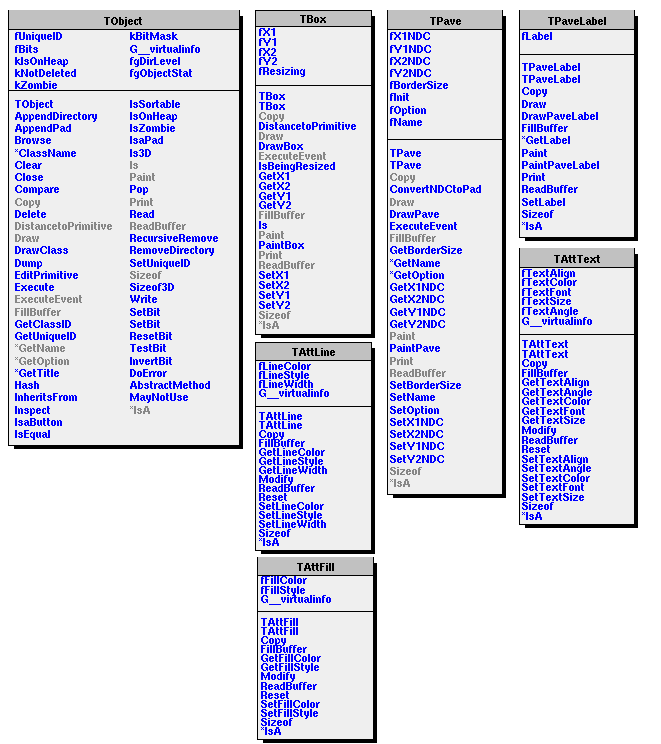
Draw class inheritance tree of the class to which this object belongs.
If a class B inherits from a class A, description of B is drawn on the right side of description of A. Member functions overridden by B are shown in class A with a blue line crossing-out the corresponding member function. The following picture is the class inheritance tree of class TPaveLabel:
Reimplemented in TGFrame, TSystemDirectory, and TSystemFile.
Definition at line 308 of file TObject.cxx.
Draw a clone of this object in the current selected pad with: gROOT->SetSelectedPad(c1).
If pad was not selected - gPad will be used.
Reimplemented in TAxis, TCanvas, TGFrame, TSystemDirectory, and TSystemFile.
Definition at line 319 of file TObject.cxx.
|
virtualinherited |
|
virtualinherited |
|
virtualinherited |
|
virtualinherited |
Dump contents of object on stdout.
Using the information in the object dictionary (class TClass) each data member is interpreted. If a data member is a pointer, the pointer value is printed
The following output is the Dump of a TArrow object:
Reimplemented in TClass, TCollection, TGFrame, TGPack, and TSystemFile.
Definition at line 367 of file TObject.cxx.
|
virtualinherited |
Issue error message.
Use "location" to specify the method where the error occurred. Accepts standard printf formatting arguments.
Reimplemented in TFitResult.
Definition at line 1098 of file TObject.cxx.
|
virtualinherited |
Execute method on this object with the given parameter string, e.g.
"3.14,1,\"text\"".
Reimplemented in ROOT::R::TRInterface, TCling, TContextMenu, TInterpreter, and TMethodCall.
Definition at line 378 of file TObject.cxx.
|
virtualinherited |
Execute method on this object with parameters stored in the TObjArray.
The TObjArray should contain an argv vector like:
Reimplemented in ROOT::R::TRInterface, TCling, TContextMenu, TInterpreter, and TMethodCall.
Definition at line 398 of file TObject.cxx.
Execute action corresponding to an event at (px,py).
This method must be overridden if an object can react to graphics events.
Reimplemented from TObject.
Reimplemented in TProfile2D, TProfile3D, and TProfile.
|
virtualinherited |
Issue fatal error message.
Use "location" to specify the method where the fatal error occurred. Accepts standard printf formatting arguments.
Definition at line 1126 of file TObject.cxx.
Reimplemented in TH2Poly.
|
virtualinherited |
Increment cell defined by namex,namey,namez by a weight w.
If the weight is not equal to 1, the storage of the sum of squares of weights is automatically triggered and the sum of the squares of weights is incremented by w^2 in the corresponding cell. The function returns the corresponding global bin number which has its content incremented by w
Reimplemented in TProfile3D.
Increment cell defined by namex,namey,z by a weight w.
If the weight is not equal to 1, the storage of the sum of squares of weights is automatically triggered and the sum of the squares of weights is incremented by w^2 in the corresponding cell. The function returns the corresponding global bin number which has its content incremented by w
Reimplemented in TProfile3D.
Increment cell defined by namex,y,namez by a weight w.
If the weight is not equal to 1, the storage of the sum of squares of weights is automatically triggered and the sum of the squares of weights is incremented by w^2 in the corresponding cell. The function returns the corresponding global bin number which has its content incremented by w
Reimplemented in TProfile3D.
Increment cell defined by namex , y ,z by a weight w.
If the weight is not equal to 1, the storage of the sum of squares of weights is automatically triggered and the sum of the squares of weights is incremented by w^2 in the corresponding cell. The function returns the corresponding global bin number which has its content incremented by w
Reimplemented in TProfile3D.
Increment cell defined by x,namey,namez by a weight w.
If the weight is not equal to 1, the storage of the sum of squares of weights is automatically triggered and the sum of the squares of weights is incremented by w^2 in the corresponding cell. The function returns the corresponding global bin number which has its content incremented by w
Reimplemented in TProfile3D.
Increment cell defined by x,namey,z by a weight w.
If the weight is not equal to 1, the storage of the sum of squares of weights is automatically triggered and the sum of the squares of weights is incremented by w^2 in the corresponding cell. The function returns the corresponding global bin number which has its content incremented by w
Reimplemented in TProfile3D.
Increment cell defined by x,y,namez by a weight w.
If the weight is not equal to 1, the storage of the sum of squares of weights is automatically triggered and the sum of the squares of weights is incremented by w^2 in the corresponding cell. The function returns the corresponding global bin number which has its content incremented by w
Reimplemented in TProfile3D.
Increment cell defined by x,y,z by 1 .
The function returns the corresponding global bin number which has its content incremented by 1
Reimplemented in TProfile3D.
Increment cell defined by x,y,z by a weight w.
If the weight is not equal to 1, the storage of the sum of squares of weights is automatically triggered and the sum of the squares of weights is incremented by w^2 in the cell corresponding to x,y,z.
The function returns the corresponding global bin number which has its content incremented by w
Reimplemented in TProfile3D.
|
virtualinherited |
Encode TNamed into output buffer.
Reimplemented in TDirectoryFile, TFile, TKey, TKeySQL, TKeyXML, TSQLFile, and TXMLFile.
Definition at line 103 of file TNamed.cxx.
|
inherited |
|
overridevirtualinherited |
Fill histogram following distribution in function fname.
| fname | : Function name used for filling the histogram |
| ntimes | : number of times the histogram is filled |
| rng | : (optional) Random number generator used to sample |
The distribution contained in the function fname (TF1) is integrated over the channel contents. It is normalized to 1. Getting one random number implies:
N.B. By dfault this methods approximates the integral of the function in each bin with the function value at the center of the bin, multiplied by the bin width
One can also call TF1::GetRandom to get a random variate from a function.
Reimplemented from TH1.
|
overridevirtualinherited |
Fill histogram following distribution in histogram h.
| h | : Histogram pointer used for sampling random number |
| ntimes | : number of times the histogram is filled |
| rng | : (optional) Random number generator used for sampling |
The distribution contained in the histogram h (TH3) is integrated over the channel contents. It is normalized to 1. Getting one random number implies:
Reimplemented from TH1.
Reimplemented in TH2Poly.
|
virtualinherited |
|
virtualinherited |
|
protectedvirtualinherited |
|
overridevirtualinherited |
Must be redefined in derived classes.
This function is typically used with TCollections, but can also be used to find an object by name inside this object.
Reimplemented from TObject.
Must be redefined in derived classes.
This function is typically used with TCollections, but can also be used to find an object inside this object.
Reimplemented from TObject.
|
virtualinherited |
|
virtualinherited |
|
virtualinherited |
|
virtualinherited |
Project slices along Z in case of a 3-D histogram, then fit each slice with function f1 and make a 2-d histogram for each fit parameter Only cells in the bin range [binminx,binmaxx] and [binminy,binmaxy] are considered.
if f1=0, a gaussian is assumed Before invoking this function, one can set a subrange to be fitted along Z via f1->SetRange(zmin,zmax) The argument option (default="QNR") can be used to change the fit options. "Q" means Quiet mode "N" means do not show the result of the fit "R" means fit the function in the specified function range
Note that the generated histograms are added to the list of objects in the current directory. It is the user's responsibility to delete these histograms.
Example: Assume a 3-d histogram h3 Root > h3->FitSlicesZ(); produces 4 TH2D histograms with h3_0 containing parameter 0(Constant) for a Gaus fit of each cell in X,Y projected along Z with h3_1 containing parameter 1(Mean) for a gaus fit with h3_2 containing parameter 2(StdDev) for a gaus fit with h3_chi2 containing the chisquare/number of degrees of freedom for a gaus fit
Root > h3->Fit(0,15,22,0,0,10); same as above, but only for bins 15 to 22 along X and only for cells in X,Y for which the corresponding projection along Z has more than cut bins filled.
NOTE: To access the generated histograms in the current directory, do eg: TH2D h3_1 = (TH2D)gDirectory->Get("h3_1");
|
protectedinherited |
|
inlinevirtualinherited |
|
inlinevirtualinherited |
|
virtualinherited |
Reimplemented from TH1.
Reimplemented in TProfile3D.
|
inlinevirtualinherited |
Reimplemented in TH2Poly, TProfile2D, TProfile2Poly, TProfile3D, and TProfile.
Reimplemented in TH2Poly, TProfile2D, TProfile2Poly, TProfile3D, and TProfile.
|
inlinevirtualinherited |
Reimplemented in TH2Poly, TProfile2D, TProfile2Poly, TProfile3D, and TProfile.
|
virtualinherited |
Reimplemented from TH1.
|
inlinevirtualinherited |
Reimplemented in TProfile2D, TProfile3D, and TProfile.
|
virtualinherited |
Reimplemented from TH1.
|
virtualinherited |
|
virtualinherited |
Compute first cell (binx,biny,binz) in the range [firstx,lastx](firsty,lasty][firstz,lastz] for which diff = abs(cell_content-c) <= maxdiff In case several cells in the specified range with diff=0 are found the first cell found is returned in binx,biny,binz.
In case several cells in the specified range satisfy diff <=maxdiff the cell with the smallest difference is returned in binx,biny,binz. In all cases the function returns the smallest difference.
NOTE1: if firstx <= 0, firstx is set to bin 1 if (lastx < firstx then firstx is set to the number of bins in X ie if firstx=0 and lastx=0 (default) the search is on all bins in X. if firsty <= 0, firsty is set to bin 1 if (lasty < firsty then firsty is set to the number of bins in Y ie if firsty=0 and lasty=0 (default) the search is on all bins in Y. if firstz <= 0, firstz is set to bin 1 if (lastz < firstz then firstz is set to the number of bins in Z ie if firstz=0 and lastz=0 (default) the search is on all bins in Z. NOTE2: if maxdiff=0 (default), the first cell with content=c is returned.
|
virtualinherited |
|
virtualinherited |
|
inherited |
|
staticinherited |
|
staticinherited |
|
inlinevirtualinherited |
|
inlineinherited |
|
virtualinherited |
Get option used by the graphics system to draw this object.
Note that before calling object.GetDrawOption(), you must have called object.Draw(..) before in the current pad.
Reimplemented in TBrowser, TFitEditor, TGedFrame, TGFileBrowser, TRootBrowser, and TRootBrowserLite.
Definition at line 445 of file TObject.cxx.
|
staticinherited |
Return destructor only flag.
Definition at line 1196 of file TObject.cxx.
|
virtualinherited |
|
virtualinherited |
|
inlinevirtualinherited |
Return the fill area color.
Reimplemented in TGraphMultiErrors, TGWin32, TGWin32VirtualXProxy, and TGX11.
Definition at line 32 of file TAttFill.h.
|
inlinevirtualinherited |
Return the fill area style.
Reimplemented in TGraphMultiErrors, TGWin32, TGWin32VirtualXProxy, and TGX11.
Definition at line 33 of file TAttFill.h.
|
virtualinherited |
|
virtualinherited |
Returns mime type name of object.
Used by the TBrowser (via TGMimeTypes class). Override for class of which you would like to have different icons for objects of the same class.
Reimplemented in ROOT::Experimental::XRooFit::xRooNode, TASImage, TBranch, TBranchElement, TGeoVolume, TGMainFrame, TKey, TMethodBrowsable, TSystemFile, and TVirtualBranchBrowsable.
Definition at line 472 of file TObject.cxx.
|
virtualinherited |
|
inlinevirtualinherited |
Return the line color.
Reimplemented in TGraphMultiErrors, and TGWin32VirtualXProxy.
Definition at line 36 of file TAttLine.h.
|
inlinevirtualinherited |
Return the line style.
Reimplemented in TGraphMultiErrors, TGWin32, TGWin32VirtualXProxy, and TGX11.
Definition at line 37 of file TAttLine.h.
|
inlinevirtualinherited |
Return the line width.
Reimplemented in TGraphMultiErrors, TGWin32, TGWin32VirtualXProxy, and TGX11.
Definition at line 38 of file TAttLine.h.
|
virtualinherited |
|
inlinevirtualinherited |
Return the marker color.
Reimplemented in TGWin32VirtualXProxy.
Definition at line 33 of file TAttMarker.h.
|
inlinevirtualinherited |
Return the marker size.
Reimplemented in TGWin32VirtualXProxy.
Definition at line 35 of file TAttMarker.h.
|
inlinevirtualinherited |
Return the marker style.
Reimplemented in TGWin32VirtualXProxy.
Definition at line 34 of file TAttMarker.h.
Reimplemented in TH2Poly.
|
virtualinherited |
|
virtualinherited |
|
inlinevirtualinherited |
Reimplemented in TH2Poly.
|
virtualinherited |
|
virtualinherited |
|
inlinevirtualinherited |
|
inlineoverridevirtualinherited |
|
inlinevirtualinherited |
Returns string containing info about the object at position (px,py).
This method is typically overridden by classes of which the objects can report peculiarities for different positions. Returned string will be re-used (lock in MT environment).
Reimplemented from TObject.
|
staticinherited |
Get status of object stat flag.
Definition at line 1181 of file TObject.cxx.
|
inlineoverridevirtualinherited |
|
inherited |
|
virtualinherited |
|
virtualinherited |
|
virtualinherited |
Return 3 random numbers along axis x, y and z distributed according to the cell-contents of this 3-dim histogram.
| [out] | x | reference to random generated x value |
| [out] | y | reference to random generated y value |
| [out] | z | reference to random generated z value |
| [in] | rng | (optional) Random number generator pointer used (default is gRandom) |
| [in] | option | (optional) Set it to "width" if your non-uniform bin contents represent a density rather than counts |
This function returns the Standard Deviation (Sigma) of the distribution not the Root Mean Square (RMS).
The name "RMS" is been often used as a synonym for the Standard Deviation and it was introduced many years ago (Hbook/PAW times). We keep the name GetRMS for continuity as an alias to GetStdDev. GetStdDev() should be used instead.
|
inlineinherited |
|
inlineprotectedinherited |
|
overridevirtualinherited |
Fill the array stats from the contents of this histogram The array stats must be correctly dimensioned in the calling program.
stats[0] = sumw stats[1] = sumw2 stats[2] = sumwx stats[3] = sumwx2 stats[4] = sumwy stats[5] = sumwy2 stats[6] = sumwxy stats[7] = sumwz stats[8] = sumwz2 stats[9] = sumwxz stats[10]= sumwyz
Reimplemented from TH1.
Reimplemented in TProfile3D.
|
inherited |
|
inlinevirtualinherited |
|
inlinevirtualinherited |
|
inlineoverridevirtualinherited |
|
virtualinherited |
Return the unique object id.
Definition at line 480 of file TObject.cxx.
Execute action in response of a timer timing out.
This method must be overridden if an object has to react to timers.
Reimplemented in TGCommandPlugin, TGDNDManager, TGFileContainer, TGHtml, TGLEventHandler, TGPopupMenu, TGraphTime, TGScrollBar, TGShutter, TGTextEdit, TGTextEditor, TGTextEntry, TGTextView, TGToolTip, TGuiBldDragManager, TGWindow, and TTreeViewer.
Definition at line 516 of file TObject.cxx.
|
inlineoverridevirtualinherited |
Return hash value for this object.
Note: If this routine is overloaded in a derived class, this derived class should also add
Otherwise, when RecursiveRemove is called (by ~TObject or example) for this type of object, the transversal of THashList and THashTable containers will will have to be done without call Hash (and hence be linear rather than logarithmic complexity). You will also see warnings like
Reimplemented from TObject.
|
inlineinherited |
Return true is the type of this object is known to have an inconsistent setup for Hash and RecursiveRemove (i.e.
missing call to RecursiveRemove in destructor).
Note: Since the consistency is only tested for during inserts, this routine will return true for object that have never been inserted whether or not they have a consistent setup. This has no negative side-effect as searching for the object with the right or wrong Hash will always yield a not-found answer (Since anyway no hash can be guaranteed unique, there is always a check)
|
virtualinherited |
Issue info message.
Use "location" to specify the method where the warning occurred. Accepts standard printf formatting arguments.
Definition at line 1072 of file TObject.cxx.
|
virtualinherited |
Returns kTRUE if object inherits from class "classname".
Reimplemented in TClass.
Definition at line 549 of file TObject.cxx.
Returns kTRUE if object inherits from TClass cl.
Reimplemented in TClass.
Definition at line 557 of file TObject.cxx.
|
virtualinherited |
Dump contents of this object in a graphics canvas.
Same action as Dump but in a graphical form. In addition pointers to other objects can be followed.
The following picture is the Inspect of a histogram object:
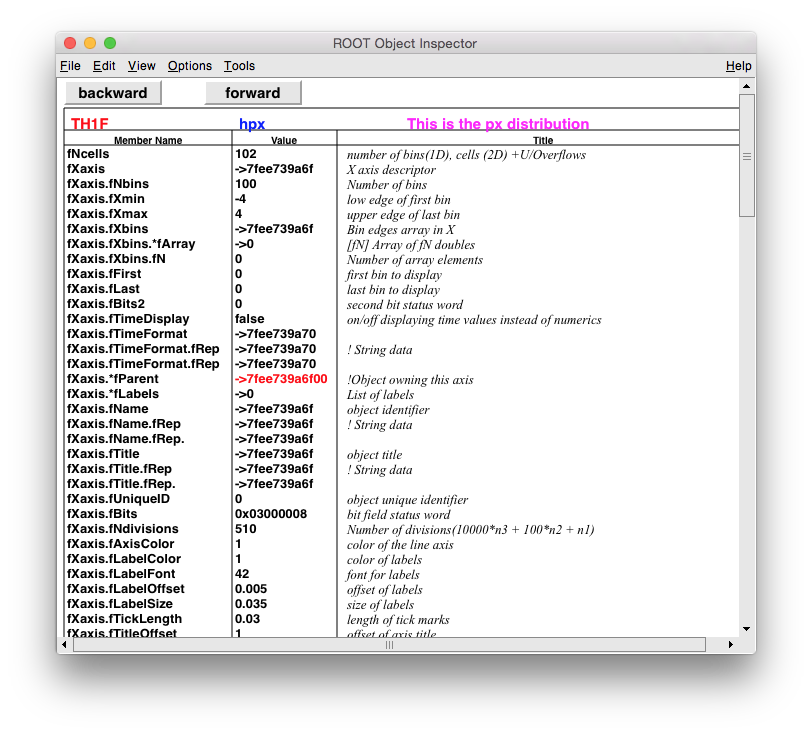
Reimplemented in ROOT::Experimental::XRooFit::xRooNode, TGFrame, TInspectorObject, and TSystemFile.
Definition at line 570 of file TObject.cxx.
|
virtualinherited |
Return integral of bin contents in range [binx1,binx2],[biny1,biny2],[binz1,binz2] for a 3-D histogram By default the integral is computed as the sum of bin contents in the range.
if option "width" is specified, the integral is the sum of the bin contents multiplied by the bin width in x, y and in z.
|
privatevirtualinherited |
Reimplemented from TH1.
Return integral of bin contents.
Only bins in the bins range are considered. By default the integral is computed as the sum of bin contents in the range. if option "width" is specified, the integral is the sum of the bin contents multiplied by the bin width in x, y and in z.
Reimplemented from TH1.
|
privatevirtualinherited |
Reimplemented from TH1.
|
virtualinherited |
Return integral of bin contents in range [binx1,binx2],[biny1,biny2],[binz1,binz2] for a 3-D histogram.
Calculates also the integral error using error propagation from the bin errors assuming that all the bins are uncorrelated. By default the integral is computed as the sum of bin contents in the range. if option "width" is specified, the integral is the sum of the bin contents multiplied by the bin width in x, y and in z.
Given a point P(x,y,z), Interpolate approximates the value via trilinear interpolation based on the 8 nearest bin center points (corner of the cube surrounding the points).
The Algorithm is described in http://en.wikipedia.org/wiki/Trilinear_interpolation.
The coordinate (x,y,z) must be in the histogram range. If a coordinate falls into the first or last bin of an axis, the histogram is assumed to be constant at the edges. The interpolation proceeds as if the bin "left of" the first bin in x had the same bin content as the first bin x, and similar for the other axes.
Reimplemented from TH1.
|
inlineoverridevirtual |
|
inlineinherited |
IsDestructed.
|
protectedinherited |
Default equal comparison (objects are equal if they have the same address in memory).
More complicated classes might want to override this function.
Reimplemented in TGObject, TObjString, TPair, and TQCommand.
Definition at line 589 of file TObject.cxx.
|
virtualinherited |
Returns kTRUE in case object contains browsable objects (like containers or lists of other objects).
Reimplemented in ROOT::Experimental::XRooFit::xRooNode, ROOT::Internal::THnBaseBrowsable, TApplicationRemote, TAxis3D, TBaseClass, TBranch, TBranchClones, TBranchElement, TBranchObject, TBranchSTL, TBrowserObject, TCanvas, TClass, TCollection, TDatabasePDG, TDirectory, TFolder, TGeoManager, TGeometry, TGeoNode, TGeoNodeMatrix, TGeoOverlap, TGeoTrack, TGeoVolume, THbookFile, THbookKey, THnBase, TKey, TMapFile, TMultiDimFit, TNode, TPad, TPair, TParticleClassPDG, TPrincipal, TRemoteObject, TROOT, TRootIconList, TSPlot, TSystemDirectory, TTask, TTree, and TVirtualBranchBrowsable.
Definition at line 579 of file TObject.cxx.
|
inlinevirtualinherited |
|
inlineoverridevirtualinherited |
Reimplemented from TObject.
Reimplemented in TStructNodeProperty.
|
inlinevirtualinherited |
Reimplemented in TGWin32VirtualXProxy.
Definition at line 49 of file TAttFill.h.
|
overridevirtualinherited |
Statistical test of compatibility in shape between THIS histogram and h2, using Kolmogorov test.
Default: Ignore under- and overflow bins in comparison
option is a character string to specify options "U" include Underflows in test "O" include Overflows "N" include comparison of normalizations "D" Put out a line of "Debug" printout "M" Return the Maximum Kolmogorov distance instead of prob
The returned function value is the probability of test (much less than one means NOT compatible)
The KS test uses the distance between the pseudo-CDF's obtained from the histogram. Since in more than 1D the order for generating the pseudo-CDF is arbitrary, we use the pseudo-CDF's obtained from all the possible 6 combinations of the 3 axis. The average of all the maximum distances obtained is used in the tests.
Reimplemented from TH1.
|
virtualinherited |
Reimplemented in TProfile2D, TProfile3D, and TProfile.
|
virtualinherited |
Reimplemented in TProfile2D, TProfile3D, and TProfile.
Reimplemented in TProfile2D, TProfile3D, and TProfile.
|
overridevirtualinherited |
List TNamed name and title.
Reimplemented from TObject.
Reimplemented in ROOT::Experimental::XRooFit::xRooBrowser, TNode, TROOT, TStreamerBase, TStreamerElement, TStreamerInfo, TStreamerSTL, TTask, TText, and TVirtualStreamerInfo.
Definition at line 112 of file TNamed.cxx.
|
inherited |
Use this method to signal that a method (defined in a base class) may not be called in a derived class (in principle against good design since a child class should not provide less functionality than its parent, however, sometimes it is necessary).
Definition at line 1160 of file TObject.cxx.
|
inlinevirtualinherited |
Reimplemented in TH2Poly, TProfile2D, TProfile2Poly, TProfile3D, and TProfile.
|
inherited |
|
virtualinherited |
|
virtualinherited |
|
virtualinherited |
|
virtualinherited |
|
virtualinherited |
|
virtualinherited |
Reimplemented in TProfile2D, TProfile3D, and TProfile.
|
virtualinherited |
Reimplemented in TProfile2D, TProfile3D, and TProfile.
Reimplemented in TH2Poly, TProfile2D, TProfile3D, and TProfile.
|
virtualinherited |
|
virtualinherited |
This method must be overridden to handle object notification (the base implementation is no-op).
Different objects in ROOT use the Notify method for different purposes, in coordination with other objects that call this method at the appropriate time.
For example, TLeaf uses it to load class information; TBranchRef to load contents of referenced branches TBranchRef; most notably, based on Notify, TChain implements a callback mechanism to inform interested parties when it switches to a new sub-tree.
Reimplemented in h1analysis, h1analysisTreeReader, TARInterruptHandler, TASInputHandler, TASInterruptHandler, TASLogHandler, TASSigPipeHandler, TBlinkTimer, TBranchElement, TBranchRef, TBreakLineCom, TBrowserTimer, TCollection, TDelCharCom, TDelTextCom, TFileHandler, TGContainerKeyboardTimer, TGContainerScrollTimer, TGInputHandler, TGLRedrawTimer, TGTextEditHist, TGuiBldDragManagerRepeatTimer, TIdleTimer, TInsCharCom, TInsTextCom, TInterruptHandler, TLeafObject, TMessageHandler, TNotifyLink< Type >, TNotifyLink< RNoCleanupNotifierHelper >, TNotifyLink< ROOT::Detail::TBranchProxy >, TNotifyLink< TTreeReader >, TPopupDelayTimer, TProcessEventTimer, TRefTable, TRepeatTimer, TSBRepeatTimer, TSelector, TSelectorDraw, TSelectorEntries, TSignalHandler, TSingleShotCleaner, TSocketHandler, TStdExceptionHandler, TSysEvtHandler, TTermInputHandler, TThreadTimer, TTimeOutTimer, TTimer, TTipDelayTimer, TTree, TTreeFormula, TTreeFormulaManager, TTreeReader, TViewTimer, and TViewUpdateTimer.
Definition at line 618 of file TObject.cxx.
|
inherited |
Use this method to declare a method obsolete.
Specify as of which version the method is obsolete and as from which version it will be removed.
Definition at line 1169 of file TObject.cxx.
|
inherited |
Operator delete for sized deallocation.
Definition at line 1234 of file TObject.cxx.
|
inherited |
Operator delete.
Definition at line 1212 of file TObject.cxx.
|
inherited |
Only called by placement new when throwing an exception.
Definition at line 1266 of file TObject.cxx.
|
inherited |
Operator delete [] for sized deallocation.
Definition at line 1245 of file TObject.cxx.
|
inherited |
Operator delete [].
Definition at line 1223 of file TObject.cxx.
|
inherited |
Only called by placement new[] when throwing an exception.
Definition at line 1274 of file TObject.cxx.
|
inlineinherited |
|
inlineinherited |
|
inlineinherited |
Generate an out-of-bounds error. Always returns false.
Definition at line 29 of file TArray.cxx.
|
overridevirtualinherited |
This method must be overridden if a class wants to paint itself.
The difference between Paint() and Draw() is that when a object draws itself it is added to the display list of the pad in which it is drawn (and automatically redrawn whenever the pad is redrawn). While paint just draws the object without adding it to the pad display list.
Reimplemented from TObject.
|
virtualinherited |
Pop on object drawn in a pad to the top of the display list.
I.e. it will be drawn last and on top of all other primitives.
Reimplemented in TFrame, TPad, and TVirtualPad.
Definition at line 640 of file TObject.cxx.
|
overridevirtualinherited |
This method must be overridden when a class wants to print itself.
Reimplemented from TObject.
Project a 3-d histogram into 1 or 2-d histograms depending on the option parameter, which may contain a combination of the characters x,y,z,e.
NB: the notation "a vs b" means "a" vertical and "b" horizontal
option = "o" original axis range of the target axes will be kept, but only bins inside the selected range will be filled.
If option contains the string "e", errors are computed
If option "width" is specified, each bin content is multiplied by its width (area) along the integrated dimension(s)
The projection is made for the selected bins only. To select a bin range along an axis, use TAxis::SetRange, eg h3.GetYaxis()->SetRange(23,56);
NOTE 1: The generated histogram is named th3name + option eg if the TH3* h histogram is named "myhist", then h->Project3D("xy"); produces a TH2D histogram named "myhist_xy" if a histogram of the same type already exists, it is overwritten. The following sequence h->Project3D("xy"); h->Project3D("xy2"); will generate two TH2D histograms named "myhist_xy" and "myhist_xy2" A different name can be generated by attaching a string to the option For example h->Project3D("name_xy") will generate an histogram with the name: h3dname_name_xy.
NOTE 2: If an histogram of the same type and with the same name already exists in current Directory, the histogram is reset and filled again with the projected contents of the TH3.
NOTE 3: The number of entries in the projected histogram is estimated from the number of effective entries for all the cells included in the projection.
NOTE 4: underflow/overflow are included by default in the projection To exclude underflow and/or overflow (for both axis in case of a projection to a 1D histogram) use option "NUF" and/or "NOF" With SetRange() you can have all bins except underflow/overflow only if you set the axis bit range as following after having called SetRange: axis->SetRange(1, axis->GetNbins());
NOTE 5: If TH1::AddDirectory is set to false, a new histogram is always created and the ownership of the returned pointer is delegated to the user. Be sure in this case to call delete on it after it's no longer needed, to avoid memory leaks.
|
virtualinherited |
Project a 3-d histogram into a 2-d profile histograms depending on the option parameter option may contain a combination of the characters x,y,z option = "xy" return the x versus y projection into a TProfile2D histogram option = "yx" return the y versus x projection into a TProfile2D histogram option = "xz" return the x versus z projection into a TProfile2D histogram option = "zx" return the z versus x projection into a TProfile2D histogram option = "yz" return the y versus z projection into a TProfile2D histogram option = "zy" return the z versus y projection into a TProfile2D histogram NB: the notation "a vs b" means "a" vertical and "b" horizontal.
option = "o" original axis range of the target axes will be kept, but only bins inside the selected range will be filled.
if option "width" is specified, each bin content is multiplied by its bin-width across integrated dimension during projection
The projection is made for the selected bins only. To select a bin range along an axis, use TAxis::SetRange, eg h3.GetYaxis()->SetRange(23,56);
NOTE 1: The generated histogram is named th3name + "_p" + option eg if the TH3* h histogram is named "myhist", then h->Project3D("xy"); produces a TProfile2D histogram named "myhist_pxy". The following sequence h->Project3DProfile("xy"); h->Project3DProfile("xy2"); will generate two TProfile2D histograms named "myhist_pxy" and "myhist_pxy2" So, passing additional characters in the option string one can customize the name.
NOTE 2: If a profile of the same type already exists with compatible axes, the profile is reset and filled again with the projected contents of the TH3. In the case of axes incompatibility, an error is reported and a NULL pointer is returned.
NOTE 3: The number of entries in the projected profile is estimated from the number of effective entries for all the cells included in the projection.
NOTE 4: underflow/overflow are by default excluded from the projection (Note that this is a different default behavior compared to the projection to an histogram) To include the underflow and/or overflow use option "UF" and/or "OF"
Reimplemented in TProfile3D.
|
virtualinherited |
Project a 3-D histogram into a 1-D histogram along X (integration along Y and Z).
The projection is always of the type TH1D. The projection is made from summing the cells along the Y and Z axes ranging from iymin to iymax and izmin to izmax included. By default, underflow and overflows are included in both the Y and Z axis. By Setting iymin=1 and iymax=NbinsY the underflow and/or overflow in Y will be excluded By setting izmin=1 and izmax=NbinsZ the underflow and/or overflow in Z will be excluded
if option "e" is specified, the errors are computed. if option "d" is specified, the projection is drawn in the current pad. if option "o" original axis range of the target axes will be kept, but only bins inside the selected range will be filled.
if option "width" is specified, each bin content is multiplied by its YZ bin-area during projection
NOTE that if a TH1D named "name" exists in the current directory or pad the histogram is reset and filled again with the projected contents of the TH3.
implemented using Project3D
|
virtualinherited |
Project a 3-D histogram into a 1-D histogram along Y (integration along X and Z).
The projection is always of the type TH1D. The projection is made from summing the cells along the X and Z axes ranging from ixmin to ixmax and izmin to izmax included. By default, underflow and overflow are included in both the X and Z axis. By setting ixmin=1 and ixmax=NbinsX the underflow and/or overflow in X will be excluded By setting izmin=1 and izmax=NbinsZ the underflow and/or overflow in Z will be excluded
if option "e" is specified, the errors are computed. if option "d" is specified, the projection is drawn in the current pad. if option "o" original axis range of the target axes will be kept, but only bins inside the selected range will be filled.
if option "width" is specified, each bin content is multiplied by its XZ bin-area during projection
NOTE that if a TH1D named "name" exists in the current directory or pad, the histogram is reset and filled again with the projected contents of the TH3.
implemented using Project3D
|
virtualinherited |
Project a 3-D histogram into a 1-D histogram along Z (integration along X and Y).
The projection is always of the type TH1D. The projection is made from summing the cells along the X and Y axis ranging from ixmin to ixmax and iymin to iymax included. By default, bins 1 to nx and 1 to ny are included By default, underflow and overflow are included in both the X and Y axis. By Setting ixmin=1 and ixmax=NbinsX the underflow and/or overflow in X will be excluded By setting iymin=1 and/or iymax=NbinsY the underflow and/or overflow in Y will be excluded
if option "e" is specified, the errors are computed. if option "d" is specified, the projection is drawn in the current pad. if option "o" original axis range of the target axes will be kept, but only bins inside the selected range will be filled.
if option "width" is specified, each bin content is multiplied by its XY bin-area during projection
NOTE that if a TH1D named "name" exists in the current directory or pad, the histogram is reset and filled again with the projected contents of the TH3.
implemented using Project3D
|
overridevirtualinherited |
Replace current statistics with the values in array stats.
Reimplemented from TH1.
Reimplemented in TProfile3D.
|
virtualinherited |
Read contents of object with specified name from the current directory.
First the key with the given name is searched in the current directory, next the key buffer is deserialized into the object. The object must have been created before via the default constructor. See TObject::Write().
Reimplemented in TBuffer, TKey, TKeySQL, and TKeyXML.
Definition at line 673 of file TObject.cxx.
Read TArray object from buffer.
Simplified version of TBuffer::ReadObject (does not keep track of multiple references to same array).
Definition at line 40 of file TArray.cxx.
|
virtualinherited |
Rebin this histogram grouping nxgroup/nygroup/nzgroup bins along the xaxis/yaxis/zaxis together.
if newname is not blank a new temporary histogram hnew is created. else the current histogram is modified (default) The parameter nxgroup/nygroup indicate how many bins along the xaxis/yaxis of this have to me merged into one bin of hnew If the original histogram has errors stored (via Sumw2), the resulting histograms has new errors correctly calculated.
examples: if hpxpy is an existing TH3 histogram with 40 x 40 x 40 bins hpxpypz->Rebin3D(); // merges two bins along the xaxis and yaxis in one in hpxpypz // Carefull: previous contents of hpxpy are lost hpxpypz->RebinX(5); //merges five bins along the xaxis in one in hpxpypz TH3 *hnew = hpxpypz->RebinY(5,"hnew"); // creates a new histogram hnew // merging 5 bins of h1 along the yaxis in one bin
NOTE : If nxgroup/nygroup is not an exact divider of the number of bins, along the xaxis/yaxis the top limit(s) of the rebinned histogram is changed to the upper edge of the xbin=newxbins*nxgroup resp. ybin=newybins*nygroup and the corresponding bins are added to the overflow bin. Statistics will be recomputed from the new bin contents.
|
virtualinherited |
|
overridevirtualinherited |
Recursively remove this object from a list.
Typically implemented by classes that can contain multiple references to a same object.
Reimplemented from TObject.
|
overridevirtual |
|
virtualinherited |
Reimplemented in TGWin32VirtualXProxy.
|
virtualinherited |
Reimplemented in TGWin32VirtualXProxy.
|
virtualinherited |
Reimplemented in TGWin32VirtualXProxy.
|
virtualinherited |
|
staticprotectedinherited |
|
overridevirtualinherited |
Save this object in the file specified by filename.
otherwise the object is written to filename as a CINT/C++ script. The C++ code to rebuild this object is generated via SavePrimitive(). The "option" parameter is passed to SavePrimitive. By default it is an empty string. It can be used to specify the Draw option in the code generated by SavePrimitive.
The function is available via the object context menu.
Reimplemented from TObject.
|
virtualinherited |
|
virtualinherited |
|
virtualinherited |
|
overridevirtualinherited |
Save a primitive as a C++ statement(s) on output stream "out".
Reimplemented from TObject.
Reimplemented in TH2Poly, TProfile2D, TProfile3D, and TProfile.
|
staticprotectedinherited |
Save object constructor in the output stream "out".
Can be used as first statement when implementing SavePrimitive() method for the object
Definition at line 777 of file TObject.cxx.
|
staticprotectedinherited |
Save invocation of primitive Draw() method Skipped if option contains "nodraw" string.
Definition at line 845 of file TObject.cxx.
|
staticinherited |
|
protectedvirtualinherited |
|
protectedinherited |
Save object name and title into the output stream "out".
Definition at line 135 of file TNamed.cxx.
|
staticprotectedinherited |
Save array in the output stream "out" as vector.
Create unique variable name based on prefix value Returns name of vector which can be used in constructor or in other places of C++ code If flag === kTRUE, just add empty line If flag === 111, check if array is empty and return nullptr or <vectorname>.data()
Definition at line 796 of file TObject.cxx.
Reimplemented in TH2Poly, TProfile2D, TProfile3D, and TProfile.
|
overridevirtualinherited |
Set size of this array to n ints.
A new array is created, the old contents copied to the new array, then the old array is deleted. This function should not be called if the array was declared via Adopt.
Implements TArray.
Definition at line 104 of file TArrayI.cxx.
Set size of this array to n ints and set the contents.
This function should not be called if the array was declared via Adopt.
Definition at line 131 of file TArrayI.cxx.
|
inlinevirtualinherited |
|
inlinevirtualinherited |
Reimplemented in TH2Poly.
Reimplemented in TH2Poly.
|
virtualinherited |
Reimplemented in TH2Poly.
|
inlinevirtualinherited |
Reimplemented in TProfile2D, TProfile3D, and TProfile.
|
virtualinherited |
Reimplemented in TProfile2D, TProfile3D, and TProfile.
|
virtualinherited |
Reimplemented in TProfile2D, TProfile3D, and TProfile.
Reimplemented in TProfile2D, TProfile3D, and TProfile.
|
virtualinherited |
Reimplemented in TProfile2D, TProfile3D, and TProfile.
|
virtualinherited |
Reimplemented in TProfile2D, TProfile3D, and TProfile.
|
overridevirtual |
Set or unset the user status bits as specified in f.
Definition at line 888 of file TObject.cxx.
Reimplemented in TProfile2D, TProfile3D, and TProfile.
|
virtualinherited |
|
virtualinherited |
|
staticinherited |
|
virtualinherited |
|
virtualinherited |
Set drawing option for object.
This option only affects the drawing style and is stored in the option field of the TObjOptLink supporting a TPad's primitive list (TList). Note that it does not make sense to call object.SetDrawOption(option) before having called object.Draw().
Reimplemented in RooPlot, TAxis, TBrowser, TGedFrame, TGFrame, TPad, TPaveStats, TRootBrowserLite, TSystemDirectory, and TSystemFile.
Definition at line 871 of file TObject.cxx.
|
staticinherited |
Set destructor only flag.
Definition at line 1204 of file TObject.cxx.
|
inlinevirtualinherited |
|
virtualinherited |
|
virtualinherited |
Reimplemented in TGWin32VirtualXProxy.
|
inlinevirtualinherited |
Set the fill area color.
Reimplemented in TGQuartz, TGraphMultiErrors, TGWin32, TGWin32VirtualXProxy, TGX11, TPDF, TPostScript, TSpider, TSVG, TTeXDump, and TVirtualX.
Definition at line 40 of file TAttFill.h.
|
inherited |
Reimplemented in TGraphMultiErrors.
|
inlinevirtualinherited |
Set the fill area style.
Reimplemented in TGQuartz, TGraphMultiErrors, TGWin32, TGWin32VirtualXProxy, TGX11, TPad, TSpider, and TVirtualX.
Definition at line 42 of file TAttFill.h.
Set font number used to draw axis labels.
font : Text font code = 10*fontnumber + precision Font numbers must be between 1 and 14 precision = 1 fast hardware fonts (steps in the size) precision = 2 scalable and rotatable hardware fonts
The default font number is 62. axis specifies which axis ("x","y","z"), default = "x" if axis="xyz" set all 3 axes
|
virtualinherited |
Reimplemented in TGWin32VirtualXProxy.
|
inlinevirtualinherited |
Set the line color.
Reimplemented in ROOT::Experimental::REveLine, ROOT::Experimental::REveStraightLineSet, ROOT::Experimental::REveTrackList, TEveLine, TEveStraightLineSet, TEveTrackList, TGeoVolume, TGeoVolumeMulti, TGQuartz, TGraphMultiErrors, TGWin32, TGWin32VirtualXProxy, TGX11, TParallelCoordRange, TPDF, TPostScript, TSpider, TSVG, TTeXDump, and TVirtualX.
Definition at line 44 of file TAttLine.h.
|
inherited |
Reimplemented in TGraphMultiErrors.
|
inlinevirtualinherited |
Set the line style.
Reimplemented in ROOT::Experimental::REveLine, ROOT::Experimental::REveTrackList, TEveLine, TEveTrackList, TGeoVolume, TGeoVolumeMulti, TGQuartz, TGraphMultiErrors, TGWin32, TGWin32VirtualXProxy, TGX11, TPDF, TPostScript, TSpider, TSVG, TTeXDump, and TVirtualX.
Definition at line 46 of file TAttLine.h.
|
inlinevirtualinherited |
Set the line width.
Reimplemented in ROOT::Experimental::REveLine, ROOT::Experimental::REveTrackList, TEveLine, TEveTrackList, TGeoVolume, TGeoVolumeMulti, TGQuartz, TGraphMultiErrors, TGWin32, TGWin32VirtualXProxy, TGX11, TPaletteAxis, TParallelCoordRange, TPDF, TPostScript, TSpider, TSVG, TTeXDump, and TVirtualX.
Definition at line 47 of file TAttLine.h.
|
virtualinherited |
Reimplemented in TGWin32VirtualXProxy.
|
inlinevirtualinherited |
Set the marker color.
Reimplemented in ROOT::Experimental::REveLine, ROOT::Experimental::REvePointSet, ROOT::Experimental::REvePointSetArray, ROOT::Experimental::REveTrackList, TEveLine, TEvePointSet, TEvePointSetArray, TEveTrackList, TGQuartz, TGWin32, TGWin32VirtualXProxy, TGX11, TPDF, TPostScript, TSVG, TTeXDump, and TVirtualX.
Definition at line 41 of file TAttMarker.h.
|
inherited |
|
inlinevirtualinherited |
Set the marker size.
Note that the marker styles number 1 6 and 7 (the dots), cannot be scaled. They are meant to be very fast to draw and are always drawn with the same number of pixels; therefore this method does not apply on them.
Reimplemented in ROOT::Experimental::REvePointSet, ROOT::Experimental::REvePointSetArray, ROOT::Experimental::REveTrackList, TEvePointSet, TEvePointSetArray, TEveTrackList, TGQuartz, TGWin32, TGWin32VirtualXProxy, TGX11, TTeXDump, and TVirtualX.
Definition at line 48 of file TAttMarker.h.
|
inlinevirtualinherited |
Set the marker style.
Reimplemented in ROOT::Experimental::REvePointSet, ROOT::Experimental::REvePointSetArray, ROOT::Experimental::REveTrackList, TEvePointSet, TEvePointSetArray, TEveTrackList, TGQuartz, TGWin32, TGWin32VirtualXProxy, TGX11, and TVirtualX.
Definition at line 43 of file TAttMarker.h.
|
inlinevirtualinherited |
|
inlinevirtualinherited |
|
overridevirtualinherited |
Set the name of the TNamed.
WARNING: if the object is a member of a THashTable or THashList container the container must be Rehash()'ed after SetName(). For example the list of objects in the current directory is a THashList.
Reimplemented from TNamed.
|
overridevirtualinherited |
Set all the TNamed parameters (name and title).
WARNING: if the name is changed and the object is a member of a THashTable or THashList container the container must be Rehash()'ed after SetName(). For example the list of objects in the current directory is a THashList.
Reimplemented from TNamed.
Set the number of divisions to draw an axis.
ndiv : Number of divisions.
 n = N1 + 100*N2 + 10000*N3
 N1=number of primary divisions.
 N2=number of secondary divisions.
 N3=number of 3rd divisions.
     e.g.:
     nndi=0 --> no tick marks.
     nndi=2 --> 2 divisions, one tick mark in the middle
                of the axis.
axis specifies which axis ("x","y","z"), default = "x" if axis="xyz" set all 3 axes
|
inlinevirtualinherited |
|
staticinherited |
Turn on/off tracking of objects in the TObjectTable.
Definition at line 1188 of file TObject.cxx.
|
inlinevirtualinherited |
|
virtualinherited |
When the mouse is moved in a pad containing a 3-d view of this histogram a second canvas shows a projection type given as option.
To stop the generation of the projections, delete the canvas containing the projection. option may contain a combination of the characters x,y,z,e option = "x" return the x projection into a TH1D histogram option = "y" return the y projection into a TH1D histogram option = "z" return the z projection into a TH1D histogram option = "xy" return the x versus y projection into a TH2D histogram option = "yx" return the y versus x projection into a TH2D histogram option = "xz" return the x versus z projection into a TH2D histogram option = "zx" return the z versus x projection into a TH2D histogram option = "yz" return the y versus z projection into a TH2D histogram option = "zy" return the z versus y projection into a TH2D histogram option can also include the drawing option for the projection, eg to draw the xy projection using the draw option "box" do myhist.SetShowProjection("xy box"); This function is typically called from the context menu. NB: the notation "a vs b" means "a" vertical and "b" horizontal
|
inlineprivateinherited |
Sets the content of a slice of bins in a histogram.
This function allows setting the content of a slice of bins in a histogram by specifying the edges of the slice and the corresponding values to assign.
| ValueType | The type of the histogram's data. |
| values | A vector of values to assign to the bins in the specified slice. |
| sliceEdges | A vector of pairs specifying the low and upper edges of the slice for each dimension. |
| dataArray | A pointer to the histogram's data array. |
|
inlineinherited |
|
overridevirtualinherited |
Set the title of the TNamed.
Reimplemented from TNamed.
Specify a parameter offset to control the distance between the axis and the axis' title.
axis specifies which axis ("x","y","z"), default = "x" if axis="xyz" set all 3 axes
|
virtualinherited |
Set the unique object id.
Definition at line 899 of file TObject.cxx.
|
inlinevirtualinherited |
|
inlinevirtualinherited |
|
inlinevirtualinherited |
|
virtualinherited |
Reimplemented in TH2.
|
virtualinherited |
Return size of the TNamed part of the TObject.
Reimplemented in TDirectory, TDirectoryFile, TFile, TKey, TSQLFile, and TXMLFile.
Definition at line 182 of file TNamed.cxx.
|
virtualinherited |
|
inlineprivateinherited |
Slices a histogram in place based on the specified bin ranges for each dimension.
This function modifies the histogram by extracting a sub-region defined by the provided bin ranges for each dimension. The resulting histogram will have updated bin counts, edges, and contents. Bin contents outside the range fall into the flow bins. The histogram's internal data array is freed and reallocated by this function. This function is used by the python implementation of the Unified Histogram Interface (UHI) for slicing.
| ValueType | The type of the histogram's data. |
| args | A vector of integers specifying the low and upper edges of the slice for each dimension. |
| dataArray | A pointer to the histogram's data array. |
| fN | The size of dataArray. |
Reimplemented in TH2.
|
overridevirtual |
Stream an object of class TH3.
Reimplemented from TH3.
|
inline |
Reimplemented in TProfile2D, TProfile3D, and TProfile.
|
virtualinherited |
Issue system error message.
Use "location" to specify the method where the system error occurred. Accepts standard printf formatting arguments.
Definition at line 1112 of file TObject.cxx.
|
staticinherited |
|
overridevirtualinherited |
Set current style settings in this object This function is called when either TCanvas::UseCurrentStyle or TROOT::ForceStyle have been invoked.
Reimplemented from TObject.
|
virtualinherited |
Issue warning message.
Use "location" to specify the method where the warning occurred. Accepts standard printf formatting arguments.
Definition at line 1084 of file TObject.cxx.
|
virtualinherited |
Write this object to the current directory.
For more see the const version of this method.
Reimplemented in ROOT::TBufferMergerFile, TBuffer, TCollection, TDirectory, TDirectoryFile, TFile, TMap, TParallelMergingFile, TSQLFile, TTree, and TXMLFile.
Definition at line 989 of file TObject.cxx.
|
virtualinherited |
Write this object to the current directory.
The data structure corresponding to this object is serialized. The corresponding buffer is written to the current directory with an associated key with name "name".
Writing an object to a file involves the following steps:
Bufsize can be given to force a given buffer size to write this object. By default, the buffersize will be taken from the average buffer size of all objects written to the current file so far.
If a name is specified, it will be the name of the key. If name is not given, the name of the key will be the name as returned by GetName().
The option can be a combination of: kSingleKey, kOverwrite or kWriteDelete Using the kOverwrite option a previous key with the same name is overwritten. The previous key is deleted before writing the new object. Using the kWriteDelete option a previous key with the same name is deleted only after the new object has been written. This option is safer than kOverwrite but it is slower. NOTE: Neither kOverwrite nor kWriteDelete reduces the size of a TFile– the space is simply freed up to be overwritten; in the case of a TTree, it is more complicated. If one opens a TTree, appends some entries, then writes it out, the behaviour is effectively the same. If, however, one creates a new TTree and writes it out in this way, only the metadata is replaced, effectively making the old data invisible without deleting it. TTree::Delete() can be used to mark all disk space occupied by a TTree as free before overwriting its metadata this way. The kSingleKey option is only used by TCollection::Write() to write a container with a single key instead of each object in the container with its own key.
An object is read from the file into memory via TKey::Read() or via TObject::Read().
The function returns the total number of bytes written to the file. It returns 0 if the object cannot be written.
Reimplemented in TBuffer, TCollection, TDirectory, TDirectoryFile, TFile, TMap, TParallelMergingFile, TSQLFile, TTree, and TXMLFile.
Definition at line 964 of file TObject.cxx.
Write TArray object to buffer.
Simplified version of TBuffer::WriteObject (does not keep track of multiple references to the same array).
Definition at line 81 of file TArray.cxx.
|
protectedinherited |
|
protectedinherited |
|
protectedinherited |
|
privateinherited |
|
protectedinherited |
|
protectedinherited |
|
protectedinherited |
|
protectedinherited |
|
protectedinherited |
Fill area color.
Definition at line 24 of file TAttFill.h.
|
protectedinherited |
Fill area style.
Definition at line 25 of file TAttFill.h.
|
protectedinherited |
|
staticprotectedinherited |
|
staticprivateinherited |
|
protectedinherited |
|
protectedinherited |
Line color.
Definition at line 24 of file TAttLine.h.
|
protectedinherited |
Line style.
Definition at line 25 of file TAttLine.h.
|
protectedinherited |
Line width.
Definition at line 26 of file TAttLine.h.
|
protectedinherited |
Marker color.
Definition at line 24 of file TAttMarker.h.
|
protectedinherited |
Marker size.
Definition at line 26 of file TAttMarker.h.
|
protectedinherited |
Marker style.
Definition at line 25 of file TAttMarker.h.
|
protectedinherited |
|
protectedinherited |
|
protectedinherited |
|
protectedinherited |
|
protectedinherited |
|
protectedinherited |
|
protectedinherited |
|
protectedinherited |
|
protectedinherited |
|
protectedinherited |
|
protectedinherited |
|
protectedinherited |
|
protectedinherited |
|
protectedinherited |
|
protectedinherited |
|
protectedinherited |
|
protectedinherited |
|
privateinherited |