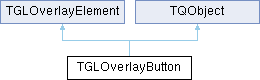
GL-overlay button.
Definition at line 22 of file TGLOverlayButton.h.
|
| | TGLOverlayButton (TGLViewerBase *parent, const char *text, Float_t posx, Float_t posy, Float_t width, Float_t height) |
| | Constructor.
|
| | ~TGLOverlayButton () override |
| Bool_t | AreSignalsBlocked () const |
| Bool_t | BlockSignals (Bool_t b) |
| virtual void | ChangedBy (const char *method) |
| virtual void | Clicked (TGLViewerBase *viewer) |
| | Emits "Clicked(TGLViewerBase*)" signal.
|
| void | CollectClassSignalLists (TList &list, TClass *cls) |
| | Collect class signal lists from class cls and all its base-classes.
|
| Bool_t | Connect (const char *signal, const char *receiver_class, void *receiver, const char *slot) |
| | Non-static method is used to connect from the signal of this object to the receiver slot.
|
| virtual void | Connected (const char *) |
| virtual void | Destroyed () |
| Bool_t | Disconnect (const char *signal=nullptr, void *receiver=nullptr, const char *slot=nullptr) |
| | Disconnects signal of this object from slot of receiver.
|
| virtual void | Disconnected (const char *) |
| void | Emit (const char *signal) |
| | Activate signal without args.
|
| template<typename T> |
| void | Emit (const char *signal, const T &arg) |
| | Activate signal with single parameter.
|
| template<typename... T> |
| void | EmitVA (const char *signal_name, Int_t, const T &... params) |
| | Emit a signal with a varying number of arguments.
|
| virtual Pixel_t | GetBackColor () const |
| TList * | GetListOfClassSignals () const |
| | Returns pointer to list of signals of this class.
|
| TList * | GetListOfConnections () const |
| TList * | GetListOfSignals () const |
| ERole | GetRole () const |
| EState | GetState () const |
| virtual const char * | GetText () const |
| virtual Pixel_t | GetTextColor () const |
| Bool_t | Handle (TGLRnrCtx &rnrCtx, TGLOvlSelectRecord &selRec, Event_t *event) override |
| | Handle overlay event.
|
| virtual Bool_t | HasConnection (const char *signal_name) const |
| | Return true if there is any object connected to this signal.
|
| virtual void | HighPriority (const char *signal_name, const char *slot_name=nullptr) |
| TClass * | IsA () const override |
| virtual void | LowPriority (const char *signal_name, const char *slot_name=nullptr) |
| virtual void | Message (const char *msg) |
| Bool_t | MouseEnter (TGLOvlSelectRecord &selRec) override |
| | Mouse has entered overlay area.
|
| void | MouseLeave () override |
| | Mouse has left overlay area.
|
| virtual Bool_t | MouseStillInside (TGLOvlSelectRecord &selRec) |
| virtual Int_t | NumberOfConnections () const |
| | Return number of connections for this object.
|
| virtual Int_t | NumberOfSignals () const |
| | Return number of signals for this object.
|
| void | Render (TGLRnrCtx &rnrCtx) override |
| | Render the overlay elements.
|
| virtual void | ResetState () |
| virtual void | SetAlphaValues (Float_t norm, Float_t high) |
| virtual void | SetBackColor (Pixel_t col) |
| void | SetBinaryState (Bool_t s) |
| virtual void | SetPosition (Float_t x, Float_t y) |
| void | SetRole (ERole r) |
| virtual void | SetSize (Float_t w, Float_t h) |
| void | SetState (EState s) |
| virtual void | SetText (const char *text) |
| virtual void | SetTextColor (Pixel_t col) |
| void | Streamer (TBuffer &) override |
| | Stream an object of class TQObject.
|
| void | StreamerNVirtual (TBuffer &ClassDef_StreamerNVirtual_b) |
|
| static Bool_t | AreAllSignalsBlocked () |
| | Returns true if all signals are blocked.
|
| static Bool_t | BlockAllSignals (Bool_t b) |
| | Block or unblock all signals. Returns the previous block status.
|
| static TClass * | Class () |
| static const char * | Class_Name () |
| static constexpr Version_t | Class_Version () |
| static Bool_t | Connect (const char *sender_class, const char *signal, const char *receiver_class, void *receiver, const char *slot) |
| | This method allows to make a connection from any object of the same class to a single slot.
|
| static Bool_t | Connect (TQObject *sender, const char *signal, const char *receiver_class, void *receiver, const char *slot) |
| | Create connection between sender and receiver.
|
| static const char * | DeclFileName () |
| static Bool_t | Disconnect (const char *class_name, const char *signal, void *receiver=nullptr, const char *slot=nullptr) |
| | Disconnects "class signal".
|
| static Bool_t | Disconnect (TQObject *sender, const char *signal=nullptr, void *receiver=nullptr, const char *slot=nullptr) |
| | Disconnects signal in object sender from slot_method in object receiver.
|
|
| static Int_t | CheckConnectArgs (TQObject *sender, TClass *sender_class, const char *signal, TClass *receiver_class, const char *slot) |
| | Checking of consistency of sender/receiver methods/arguments.
|
| static TString | CompressName (const char *method_name) |
| | Removes "const" words and blanks from full (with prototype) method name and resolve any typedefs in the method signature.
|
| static Bool_t | ConnectToClass (const char *sender_class, const char *signal, TClass *receiver_class, void *receiver, const char *slot) |
| | This method allows to make connection from any object of the same class to the receiver object.
|
| static Bool_t | ConnectToClass (TQObject *sender, const char *signal, TClass *receiver_class, void *receiver, const char *slot) |
| | Create connection between sender and receiver.
|
| TString TQObject::CompressName |
( |
const char * | method_name | ) |
|
|
staticprotectedinherited |
Removes "const" words and blanks from full (with prototype) method name and resolve any typedefs in the method signature.
If a null or empty string is passed in, an empty string is returned.
Example:
Option_t * , Int_t , Int_t)");
static TString CompressName(const char *method_name)
Removes "const" words and blanks from full (with prototype) method name and resolve any typedefs in t...
returns the string "Draw(char*,char*,char*,int,int)".
Definition at line 94 of file TQObject.cxx.
| Bool_t TQObject::Connect |
( |
const char * | class_name, |
|
|
const char * | signal, |
|
|
const char * | cl, |
|
|
void * | receiver, |
|
|
const char * | slot ) |
|
staticinherited |
This method allows to make a connection from any object of the same class to a single slot.
Signal and slot string must have a form: "Draw(char*, Option_t* ,Int_t)" All blanks and "const" words will be removed,
cl != 0 - class name, it can be class with or without dictionary, e.g interpreted class. Example:
"TH2F", myHist, "Draw(Option_t*)");
2-D histogram with a float per channel (see TH1 documentation)
Bool_t Connect(const char *signal, const char *receiver_class, void *receiver, const char *slot)
Non-static method is used to connect from the signal of this object to the receiver slot.
cl == 0 - corresponds to function (interpereted or global) the name of the function is defined by the slot string, parameter receiver should be 0. Example:
Warning:
If receiver class not derived from TQObject and going to be deleted, disconnect all connections to this receiver. In case of class derived from TQObject it is done automatically.
Definition at line 791 of file TQObject.cxx.
| Bool_t TQObject::Connect |
( |
TQObject * | sender, |
|
|
const char * | signal, |
|
|
const char * | cl, |
|
|
void * | receiver, |
|
|
const char * | slot ) |
|
staticinherited |
Create connection between sender and receiver.
Signal and slot string must have a form: "Draw(char*, Option_t* ,Int_t)" All blanks and "const" words will be removed,
cl != 0 - class name, it can be class with or without dictionary, e.g interpreted class. Example:
"TH2F", myHist,"Draw(Option_t*)");
cl == 0 - corresponds to function (interpereted or global) the name of the function is defined by the slot string, parameter receiver should be 0. Example:
Warning: If receiver is class not derived from TQObject and going to be deleted, disconnect all connections to this receiver. In case of class derived from TQObject it is done automatically.
Definition at line 699 of file TQObject.cxx.
| Bool_t TQObject::Disconnect |
( |
TQObject * | sender, |
|
|
const char * | signal = nullptr, |
|
|
void * | receiver = nullptr, |
|
|
const char * | slot = nullptr ) |
|
staticinherited |
Disconnects signal in object sender from slot_method in object receiver.
For objects derived from TQObject signal-slot connection is removed when either of the objects involved are destroyed.
Disconnect() is typically used in three ways, as the following examples shows:
- Disconnect everything connected to an object's signals:
Bool_t Disconnect(const char *signal=nullptr, void *receiver=nullptr, const char *slot=nullptr)
Disconnects signal of this object from slot of receiver.
- Disconnect everything connected to a signal:
- Disconnect a specific receiver:
0 may be used as a wildcard in three of the four arguments, meaning "any signal", "any receiving object" or "any slot in the receiving object", respectively.
The sender has no default and may never be 0 (you cannot disconnect signals from more than one object).
If signal is 0, it disconnects receiver and slot_method from any signal. If not, only the specified signal is disconnected.
If receiver is 0, it disconnects anything connected to signal. If not, slots in objects other than receiver are not disconnected
If slot_method is 0, it disconnects anything that is connected to receiver. If not, only slots named slot_method will be disconnected, and all other slots are left alone. The slot_method must be 0 if receiver is left out, so you cannot disconnect a specifically-named slot on all objects.
Definition at line 956 of file TQObject.cxx.